dailynewsnblog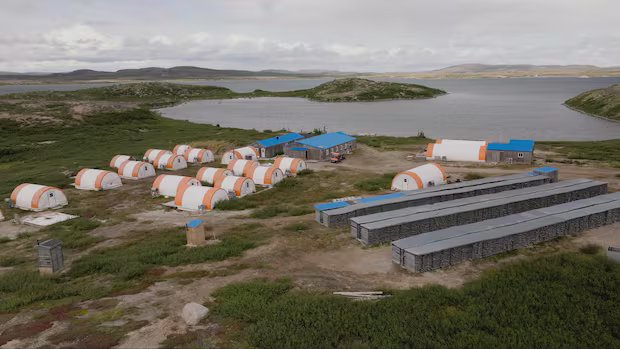
Amid Prime Minister Mark Carney’s calls that the Canada-U.S. relationship is ruptured, Ottawa has committed $175 million to a mining project in northern Quebec whose major U.S. investor is closely linked to the Trump administration.
Energy and Natural Resources Minister Tim Hodgson says the Carney government’s support for the rare earth mine is necessary to protect Canadian jobs and the economy.
“We’re doing things that are exceptional because we are in exceptional times,” Hodgson told the fifth estate in an interview.
“I’ll go back to what the prime minister said: We are in a hinge moment. We are in a rupture. We need to respond to that.”
The proposed mine is near Lac Brisson in Nunavik, approximately 235 kilometres northeast of Schefferville, Que., on the Labrador border.
- Watch the full documentary, “Critical Threat,” from the fifth estate on YouTube or CBC-TV on Friday at 9 p.m.
Montreal’s Torngat Metals says its mine, called Strange Lake, will extract up to 13 million metric tonnes of material a year for 30 years. The company wants to cut a 170-kilometre road to the Labrador coast and ship the elements about 1,700 kilometres to a proposed French-owned processing plant in Sept-Îles, Que.
“The vision with Strange Lake is to build in Canada, in Quebec in particular, an extraction-to-refined-value chain that would make Canada and Quebec unique as the main alternate source to the Chinese monopoly, something the Western world is eagerly awaiting,” Torngat’s CEO at the time, Yves Leduc, told the fifth estate in late February.
On March 17, Torngat announced that Leduc, who was hired as CEO last year, had “decided to step down.”
1st of its kind
What makes the Strange Lake deposit so enticing to governments and private investors is the presence of heavy rare earth elements, most notably dysprosium and terbium, which are key to the magnets used in everything from electric vehicles to fighter jets and missiles.
One of the federal government’s lending arms — Export Development Canada (EDC) — has highlighted the fact that Ottawa has never before committed to financing a mine at such an early stage.
In a media release last June, EDC president and CEO Alison Nankivell called their $110-million Torngat loan “unprecedented.”
“This is a first-of-its-kind transaction for EDC, reflecting our commitment to taking strategic risk for sectors of strategic interest,” Nankivell said.
At the same time, the federal government’s Canada Infrastructure Bank provided an additional $55 million to “to further advance the next stage of the project.”
The federal government’s Critical Minerals Infrastructure Fund had already committed $10 million to the project in December 2024.

Pentagon investments in Canada’s critical minerals are a good thing, says Canada’s minister of energy and natural resources.
Leduc said the federal funding commitment coming years ahead of hundreds of required permits is a recognition of the importance of the project.
“There are many permits. They relate to environmental approvals, both from the federal and Quebec environmental ministries. Obviously the mining permit and all related permits that come with it, that’s provincial jurisdiction. We’re literally talking of hundreds and hundreds of permits and that’s what’s required here to operate a mine.”
The EDC’s Nankivell said in the June statement that the federal government was able to take a financial risk on the mine because of “the well-capitalized nature of the Strange Lake project.”
Discovered in the early 1980s, the deposit has never progressed beyond the exploratory stage.
Strange Lake would remain a rare earth deposit with potential but no source of major capital until 2022, when the large U.S. private equity firm Cerberus Capital Management invested $50 million US.
Trump’s choice
“This is a Canadian asset, developed on Canadian soil, backed by strategic Canadian and allied country capital, for the benefit of Canada, all of North America and our global allies,” Cerberus said in a statement to the fifth estate. “We are honoured to be part of it.”
Cerberus was co-founded in 1992 by Stephen Feinberg, who would be the firm’s CEO for nearly three decades until he was tapped by U.S. President Donald Trump in 2018 to chair his Intelligence Advisory Board.
According to U.S. Federal Election Commission filings, Feinberg donated $1.8 million US to pro-Trump political action committees in the 2016 election and more than $1.3 million in the 2020 election.
Feinberg continued to lead Cerberus after the president lost the 2020 election.
Cerberus says it has $65 billion US in assets under management. With investments in the U.S. and around the world, a number of companies Cerberus has controlled have been controversial:
- After public protests, Cerberus sold the gun company that made the assault rifle used to kill 20 children and six adults at the Sandy Hook Elementary School in Newtown, Conn., in 2012.
- The New York Times revealed that a Cerberus-owned security company had trained four Saudis who later participated in the 2018 killing of Washington Post journalist Jamal Khashoggi.
- In 2020, the U.S. Department of Justice fined a private paramilitary company $1.5 million US for a kick-back scheme related to an Iraqi security contract. The company was owned by Cerberus when the fraud was committed.

Washington, D.C., consultant Drew Horn worked with Feinberg in the first Trump White House. He told the fifth estate he later worked with Cerberus on the Torngat Metals investment, calling it a “blueprint to double down on with other projects.”
A former U.S. army commando, Horn is now CEO of Greenmet, a Trump-connected consulting firm that helps arrange funding for rare earth projects, often involving the U.S. government. Horn has also spent a lot of time in Greenland promoting critical mineral and artificial intelligence data centre deals involving U.S. business interests.
Greenmet’s founding and current shareholders include former Trump Organization lawyer George Sorial and Trump’s longtime bodyguard, former New York police officer Keith Schiller.

Last year, Trump nominated Cerberus’s Feinberg to be deputy defence secretary — the White House’s No. 2 position at the Pentagon.
In his filings to the U.S. Office of Government Ethics, Feinberg reported shares in Torngat Metals valued at between $5 million US and $25 million US.
Cerberus told the fifth estate that “Mr. Feinberg divested his stake in Cerberus and any funds that it manages to a qualified blind trust.”

In documents filed with the Pentagon in January, Feinberg reported that he was unable to find another company that could provide administrative services to manage his private finances.
“I will extend this contract so that Cerberus will continue to provide these services to me, for which I will pay customary and reasonable fees,” Feinberg wrote to a Pentagon ethics official.
In a statement, chief Pentagon spokesman Sean Parnell told the fifth estate “Deputy Secretary Feinberg, as with every DOW official, is in full compliance with all ethics law and regulations.”
Parnell also said Feinberg’s “generational impact on the Department of War” over the last year included the fact that he “spearheaded the department’s work on critical minerals.”
Former Torngat CEO Leduc told the fifth estate he was hired by Cerberus and reported to them.
“They have majority seats at the board. So I deal with the board, obviously, and when it comes to capital raise and strategic questions, I deal mostly with Cerberus, which is absolutely normal.”
While Torngat’s website calls Cerberus a “cornerstone investor and strategic partner” and two of the five Torngat board directors are Cerberus executives, the U.S. firm told the fifth estate its “current equity stake is less than 50 per cent.”
Project 2025
In October, Radio-Canada reported that another Trump ally, Thomas Gilman, who helped bring the Cerberus investment to Torngat, was chairing the board of the Quebec company.
Gilman was an official in the U.S. Department of Commerce in Trump’s first term and later one of the authors of Project 2025 — the right-wing Heritage Foundation’s blueprint for Trump’s second term. Gilman wrote controversial sections calling for major cuts to climate change research.
Days after that Radio-Canada story appeared, Gilman stepped down as chair of Torngat and was replaced by longtime Quebec mining executive Maryse Bélanger.
Gilman’s involvement and the company’s Trump administration connections had local residents in Sept-Iles concerned. Local industries like lumber and aluminum already had to deal with rising tariffs from the U.S. president, leaving many wary about his next move.

Hodgson said despite the Trump-connected investors, Ottawa will make sure the mine is beneficial to Canada
“We welcome foreign investment from responsible parties,” Hodgson said. “We will make sure that foreign investment is for a net benefit of Canada. That’s why we have the Investment Canada Act.”
Canada’s Ministry of Innovation, Science and Economic Development would not disclose whether the federal government had conducted a national security review of the Torngat project, which would have been triggered under the Investment Canada Act when Cerberus invested in the Quebec company.
“The Investment Canada Act includes confidentiality provisions prohibiting the government to disclose whether a specific investment may or may not be reviewed for national security concerns,” the ministry said in a statement to the fifth estate.
Assessing the threat
In a recent report submitted to the House of Commons standing committee on national defence, the environmental and human rights group Mining Watch Canada recommended that the federal government publicly clarify whether they intend to “tolerate, accept or refuse foreign state access” to Canada’s critical minerals.
“There are many things that they can do, you know. It could be from taking over the projects, like they did with some Chinese projects, if they assess that it’s the same level of threats,” said Rodrigue Turgeon, the national co-lead at MiningWatch.
Despite Canada’s fractured relationship with the U.S., Leduc said American capital is a good thing and that, in the parlance of Trump, Canada holds all the cards.
“The more interest the U.S. administration shows in Torngat, the greater the leverage for Canada, and that’s actually a good thing. And that’s how I present it to stakeholders. It’s good that we have American capital.”
Ahead of any completed environmental assessments, Torngat had been meeting with neighbouring communities in northern Quebec to hear their concerns. Leduc said the company plans to implement the highest environmental protection standards.
“Minimizing the impact of mining operations on the environment, including caribou herds and biodiversity, is part of our strategy.”
How to contain radioactive waste produced when mining for rare earths is a major concern for local communities down river of the mine and in Sept-Iles, where uranium will be removed from the rare earth elements and stored.
Large amounts of uranium are often found in rare earth deposits.
“We anticipate that the [radioactivity] levels will be significantly below the health norms and thresholds set by Health Canada,” Leduc said, adding “that is something that we’re seriously focusing on and as we collect the data we’ll have the science-backed information to reassure the communities and the government obviously that we’re not talking about radioactivity levels that are problematic.”

Former CEO Yves Leduc credits the U.S private equity firm’s key role in developing the rare earth project.
Quebec put a moratorium on uranium mining in 2013 after opposition from Indigenous communities.
The communities around the proposed Torngat mine worry that the operation will disrupt the caribou herds they rely on for food and that the tonnes of radioactive waste produced by rare earth mining could contaminate their land and waterways.
“We don’t want to be forgotten and I just hope that our provincial and federal leaders will support our worries, you know, our concerns,” said Maggie Emudluk, chair of the Kativik Regional Government council in northern Quebec.
“I’m almost scared that in the near future things will have to be developed and that’s why I’m saying we’re really closely monitoring all of this as it’s developing.”
China’s control
Calling it a “key milestone,” Torngat Metals said the company recently completed a feasibility study confirming the “technical feasibility and economic viability” of their mining project.
Asked how the Canadian government could make a large financial commitment before any environmental assessment had been completed, Hodgson told the fifth estate Canada had to act to address China’s control of most of the world’s critical minerals, which are used in every part of Canada’s manufacturing sector.
“So, what it says is we are focused to make sure Canadian manufacturers don’t shut down. We’re focused on making sure Canadians don’t lose their jobs because they can’t produce the aircraft or the cars or the semiconductors that they are producing today because they lose access to critical minerals.”
But it’s unclear how much of the rare earths from the Torngat mine would benefit Canada.
Torngat says it is already in discussions with several countries about purchasing the rare earths from their mine.

Last year, Torngat signed a memorandum of understanding with the German processing company Vacuumschmelze, an agreement highlighted by Carney during his visit to Germany in August.
With millions of dollars from the U.S. Department of War, Vacuumschmelze built a new processing facility in Sumter, S.C., where rare earth elements are used to make magnets for F-35 fighters, drones and other weapons for the U.S. arsenal.
While rare earths from the Torngat mine will likely be shipped to the U.S., Hodgson argued they will benefit Canada’s defence supply chain.
“We’re in a more dangerous world,” he said. “And Canada is making a generational commitment to our defence. We are significantly beefing up our defence. We are significantly growing our defence capabilities in this country. Controlling our critical minerals so we can do that is in Canada’s interest.”