dailynewsnblog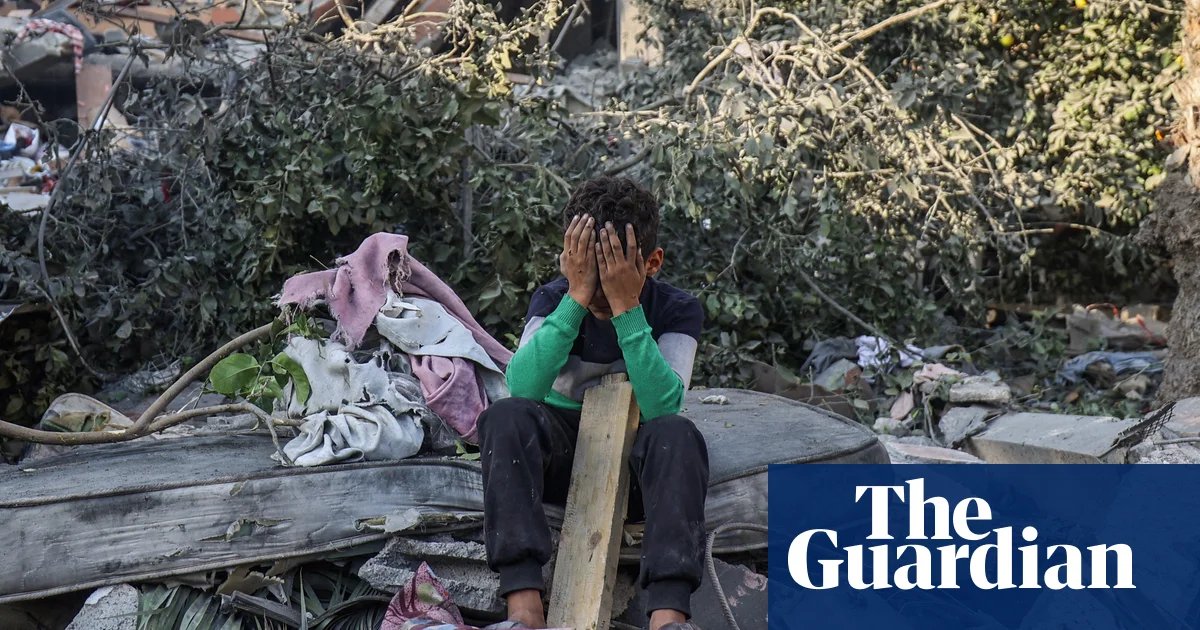
When Jumaa and Fadi Abu Assi went to look for firewood their parents thought they would be safe. They were just young boys, aged nine and 10 and, after all, a ceasefire had been declared in Gaza.
Their mother, Hala Abu Assi, was making tea in the family’s tent in Khan Younis when she heard an explosion, a missile fired by an Israeli drone. She ran to the scene – but it was too late.
Since the US-brokered ceasefire was announced on 10 October, Israeli forces have killed more than 360 Palestinians in Gaza; according to a UN official, at least 70 are children – like Jumaa and Fadi.
They were killed, their mother said, at “a time when bloodshed was supposed to stop”.
“After the ceasefire was announced, I felt a bit of safety and believed that nothing would harm my children any more,” Abu Assi said. “But fate had another plan.”
She is focused now on keeping her two surviving daughters alive. “I still hear explosions and gunfire,” she said. “I do not feel that the war has ended.”
The toll from Israeli attacks in Gaza has fallen significantly compared with the preceding two years of war, when on average 90 Palestinians were killed each day, but significant numbers of civilians are still losing their lives.
On average, Israeli weapons now kill seven people a day. That rate of violent death would be considered an active conflict in many other contexts, raising questions about how accurately “ceasefire” describes the new status quo.
“It’s something that if you want to you can call a ceasefire, which is very convenient for the Americans and for everyone who wants this off their television screens and off their streets and off their annoying parliamentary and political schedules,” said Daniel Levy, a former Israeli negotiator and the president of the US/Middle East Project.
“It is very convenient for Israel. The pressure is off and they have smashed the whole place up, and can still kill as they please.”
Amnesty International has alleged that Israel is still committing genocide in Gaza and that the use of the term ceasefire “risks creating a dangerous illusion that life in Gaza is returning to normal”.
The Israeli military has made clear it is still operating a shoot-to-kill policy around its positions. It acknowledged the drone strike on Jumaa and Fadi Abu Assi, describing the two young boys collecting wood to feed and warm their family as “suspects” who threatened Israeli soldiers.
‘Yellow line’ hardens
Like many of those killed under the ceasefire, the young brothers were targeted for approaching the “yellow line” to which the army has withdrawn under the truce. It now bifurcates Gaza, giving Israel the lion’s share. In the original ceasefire map Israel would continue to occupy 53% of the Gaza Strip, but the Israeli army unilaterally expanded that to 58% when it laid down markers to delineate its territory.
This division is Gaza’s new reality, with the US military preparing for an indefinite partition into what it calls a “green zone” under Israeli and international military control, where reconstruction would start, and a “red zone” to be left in ruins.
According to a geographical analysis by Forensic Architecture, the great bulk of Gaza’s fertile farmland is in Israeli hands, while the population is mostly confined to the barren coastal sand dunes, the “red zone”.
The ceasefire proposals put forward by Donald Trump, enshrined in large part in a UN security council resolution last month, imagined further steps after the first-phase hostage and prisoner exchange and the pullback to the “yellow line”.
Israeli forces are supposed to continue to withdraw, to be replaced by an international stabilisation force (ISF) overseen by a “peace board” chaired by Trump, with other world leaders of his choosing, with a technocratic Palestinian committee to conduct day-to-day governance.
However, these phases, even more difficult to agree than the initial halt to fighting, were left purposefully vague and remain just as hazy two months on.
Israel has been adamant there can be no progress from the first phase until all the bodies of hostages killed during the war are returned and Hamas is disarmed.
Hamas has found and returned all but one of the bodies and has said it is prepared to discuss handover of offensive weapons, such as rocket launchers and rockets, but not to Israel or any Israeli-backed entity.
The UN resolution in November suggested the ISF could lead the disarmament, but none of the countries supposed to be contributing troops, such as Indonesia, Azerbaijan or Pakistan, are willing to send soldiers to take weapons from Hamas against its will.
A EU-sponsored training programme for Palestinian police involving recruits from Gaza and the West Bank, which was under way in Egypt and Jordan before the ceasefire, is due to be expanded. But without a governing authority for Gaza it is uncertain who would direct such a force, and Israel has made clear it will not countenance anything with a Palestinian national character.
Against this backdrop of uncertainty and delay, there are growing signs that the “yellow line” is hardening into something more permanent, a partition of Gaza.
The army has been building concrete outposts along the “yellow line”, creating new free-fire areas around them. On the Israeli-occupied side of the line, the army has continued to flatten Palestinian neighbourhoods wrecked by the war, despite the Trump plan’s commitment to reconstruction.
What will rise in their place, if anything, is unclear. Israel has indicated it will allow construction only in the “green zone” it occupies, and plans developed by the US government and military envisage scattered fenced camps, rather than rebuilding Palestinian communities.
Referred to as “alternative safe communities” (ASCs), they would be little more than refugee camps, with Palestinians living in prefabricated units or repurposed shipping containers, with shared community toilets and showers.
Residents would be vetted to exclude any Palestinian who had been paid by Hamas even in a civilian role, or who had a relative, including cousins, aunts and uncles, who had been on any Hamas payroll.
It is not clear if those who moved to the Israeli-controlled areas would be allowed to cross back to the western zone of Gaza.
Several humanitarian organisations and European countries have refused to take part in planning for ASCs, on the grounds the project could break international law. They fear the ASCs could be used as a tool of coercive displacement, and exploit civilian needs to pursue military goals.
The US is also ignoring basic issues such as land ownership, said Amjad Iraqi, the senior analyst for Israel and Palestine at the International Crisis Group. “American officials coming in with this sort of blank slate approach, that you just can sort of reconstruct things from scratch as if nothing existed before, no houses or no communities or no land registrations in the areas. It breaks every international law in the book,” Iraqi said.
Even if the US does push ahead with a pilot ASC planned for Rafah, the project will do almost nothing to ease the current humanitarian crisis in Gaza.
Mountains of rubble dotted with unexploded bombs must be cleared before construction can start and even the most optimistic timeline allows for six months’ work before the first Palestinians move in, sources briefed on the plans said.
When completed it would house only 25,000 people, barely 1% of Gaza’s population.
Locked in dire conditions
Meanwhile, the ceasefire deal as it stands leaves Gaza’s remaining 2.2 million Palestinians hemmed into just 42% of their former territory, and locked into dire conditions.
Palestinians are by no means safe from Israeli strikes, many of which have been in “relocation areas” set aside for them, according to the Forensic Architecture analyst group.
Nine in 10 Palestinians in Gaza are without homes, which have been reduced to ruins. The latest satellite data suggests 81% of dwellings have been destroyed or severely damaged by Israeli bombardment. Most live in tents, vulnerable to the coming winter.
Two heavy downpours in November flooded Gaza’s tented camps, washing away hundreds ,if not thousands, of shelters. In the most recent deluge, on 25 November, tents in Deir al-Balah collapsed under the pressure of water pouring in from all directions. Some people tried digging channels to divert the water away, while most stayed huddled in their tents. Much of the flood water came from overflowing sewage pits nearby.
“We are very concerned about water-borne diseases given the dire hygiene situation and lack of sufficient sanitation. We are concerned that diseases like cholera could appear if the situation doesn’t improve as soon as possible,” said Jonathan Crickx, spokesperson for the UN child protection agency, Unicef, in Palestine. “There’s been a significant spike in acute watery diarrhoea over the past four weeks affecting children above five.”
Food supplies in Gaza have increased since the declaration of the ceasefire. Aid deliveries have gone up from an average of 91 trucks a day in the month before the 10 October truce, to 133 a day in the following month.
A reduction in looting also makes it easier for aid groups to reach the most vulnerable people. Before the ceasefire, most aid was stolen by gangs or desperate Palestinians before reaching its destination.
At the same time, non-UN shipments, including commercial supplies and deliveries from Arab countries, have increased at a faster rate. According to World Food Programme figures, commercial shipments have nearly quadrupled from 37 trucks a day in September to 144 trucks daily in the first week of November.
The influx of commercial goods has reduced prices in markets from the astronomical levels of the war. Flour in the Deir al-Balah market costs four shekels (93p) a kg, a kg of sugar is five shekels (£1.16), a single egg four shekels, and a chicken 35 shekels (£8.11). A tent costs between 1,000 and 2,000 shekels (£231 to £462).
But even these prices are beyond the vast majority of Palestinians, who have exhausted their savings after two years without work and now rely on aid.
However, the total inflow of goods remains below the prewar average of 600 trucks a day, while the needs of the population have increased exponentially, as the war has robbed almost all Palestinians of shelter, their livelihoods, schools and hospitals.
“We’re not seeing major increases in the scope of stuff that is coming in,” said Sam Rose, the acting director for Gaza for Unrwa, the UN relief agency serving Palestinians in the region.
Unrwa is by far the biggest aid agency in Gaza, but has been banned by Israel, which claims some of its 13,000 employees in the territory took part in the October 2023 attack on Israel that ignited the war.
World risks being complicit
European and Arab states justified their support for the Trump proposals at the UN resolution that codified them as a way to keep the US engaged in peace efforts and to give his proposed steps some form of legitimacy – and at least a nod towards some future Palestinian state.
They have rationalised their involvement in the Civil-Military Coordination Centre (CMCC) along similar lines, pointing to modest improvements in aid deliveries in the hope of containing the threat of famine.
The CMCC, established in a warehouse in Kiryat Gat, southern Israel, is staffed by the Israeli and US militaries along with liaison officers from other countries backing the ceasefire. There is no Palestinian representation.
Observers warn European and Arab states as well as aid agencies that without significant advances in the peace process, the CMCC risks being complicit with the Israeli military in a status quo that keeps Palestinians in inhuman conditions, and in schemes such as the ASC plan, in contravention of humanitarian law.
“An army that has just committed a genocide has 30, 40 other militaries now collaborating with it in its back yard,” Daniel Levy said.
Rose said: “There’s not as much international outrage and pressure directed towards Israel these days, but the fact is that people are living in miserable conditions and continue to be killed in spite of the ceasefire.
“Palestinians are being confronted with these multiple possible futures over which they have zero control. So that element of helplessness, psychological torture and cruelty they’ve endured for the past two years – that persists.”
Faiq al-Sakani has nowhere to take his family of nine other than the wrecked shell of their home in Gaza City’s Tuffah district, about 500 metres from the “yellow line”. For the 37-year-old, no day is without anxiety that his children could die.
“The situation is extremely tense. Every day, we hear the sounds of tanks moving, firing shells, and shooting in all directions,” he said on Thursday. “Just yesterday, a group of my relatives was directly targeted in the area; three of them were killed, and several others were critically injured.”
“It feels as if the war is still ongoing and there has been no ceasefire,” Sakhani added. “It is unbearable; there is no sign of normal life at all.”