dailynewsnblog
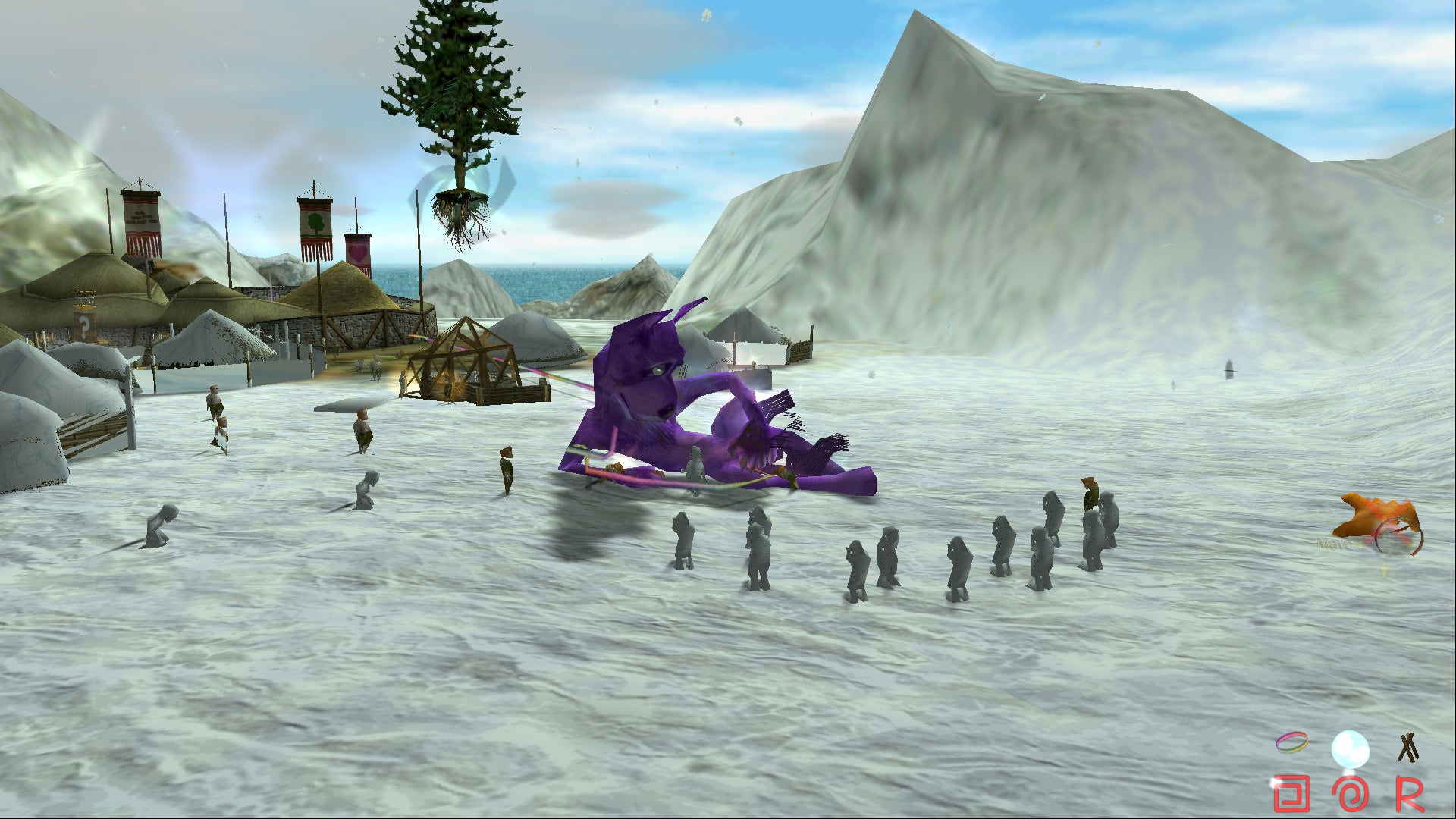
Your disembodied hand trembles with raw power. It can raze forests, summon storms, and dedicate villagers to single tasks for their entirety of their humble lives: fishing, for example, or the most profound act of all – procreation (fine, shagging). But in Black & White, which recently turned 25-years-old, your divine command of mind and matter does not extend to the capricious creature roaming the grassy land below. This pesky being may be your godly will made flesh, but they’re liable to dissent from it at the most inconvenient moments.
Not even Richard Evans, the AI programmer of Black & White, could safely predict the creature’s actions. In 2000, the mayor of Guildford was being shown around the office of Lionhead Studios, the new crown jewel of the town’s burgeoning game development scene. During one demo, the creature, an ape in this instance, had its own ideas about where the presentation would lead. “The creature did a poo, picked up his own poo, looked at it, sort of looked like he was sniffing it, and ate it,” says Evans, whose rapid-fire speech and rumpled appearance evoke celluloid’s most famous eccentric scientist, Emmett “Doc” Brown. “Then,” continues Evans, “the creature was sick all over a villager, which caused the villager to fall off a cliff.”

The scene he is describing is pure slapstick – a silly turn of events that nonetheless speaks to the mighty intellect underpinning every one of the creature’s smart or hare-brained decisions. To be fair to the beast, it could also be a great help, performing miracles to water crops, ripping up and tossing trees into a lumber yard, and even doing childcare for your village’s children. Playing as a god, you nurtured this being, sculpting their pliable personality into a warts-and-all reflection of your teachings. This all took place in a game that was (and remains) remarkable for other reasons: the minimalist UI feels strikingly, elegantly modern and the morality system is beautifully supple. But it is the creature that people remember – a wily, free-thinking companion rather than a performing monkey or docile pet.
Today, the animal – which can take many forms: bear, lion, tortoise, and more – remains one of the most ambitious applications of AI in video games ever, born, in part, from designer Peter Molyneux’s dreamy ambition and Evans’ whip-smart engineering. Black & White has also become a curious and complex footnote in the broader and rapidly evolving history of AI. Evans went on to work at Google DeepMind, the company founded in 2010 by his predecessor at Lionhead Studios, Demis Hassabis. No organisation more encapsulates the possibilities and hazards of AI: Google DeepMind has big society-bettering aspirations – for example, using the technology to answer questions of hard science, like the structure of proteins (which won Hassabis the 2024 Nobel prize in chemistry).
But it is also associated with the technology’s enshittifying and tragic implementations: the sometimes factually bogus “AI summaries” scraped from media outlets which now accompany Google search engine queries; or, more troublingly, in how the tech giant is facing a lawsuit for the alleged role its Gemini chatbot played in the death of a 36-year-old man from Florida. Between Black & White and Google DeepMind, the trajectory is clear: AI escaped containment – from the relative safety of video game worlds to the real one where the risks are existential.
The stakes may be higher, yet people interact with today’s AI in strikingly similar ways to how players did with Black & White’s creature in the early 2000s. The relationship between person and machine is exploratory and conversational. In Black & White’s case, this is because of one key design feature: the creature can learn. Most video game AI is “knowledge driven,” explains Mike Cook, an AI researcher at King’s College, London, meaning that an “AI system is given everything that it needs to reason about things.” But Black & White’s creature is “data driven” – their behaviour isn’t fixed but evolves depending on what the player does. “For lots of people, this would have been one of the first experiences of a digital thing reconfiguring itself in response to something they’d done,” he says.

The creature, which set Evans on a trajectory from the Lionhead office in Guildford to the rarefied corridors of Google DeepMind in London, began as just a few simple scribblings by Molyneux on a piece of A4 paper. “I thought, let’s do a game with an AI agent in it,” says Molyneux, toking intermittently on a vape from the office of his current studio, 22Cans. “We wanted to explore the idea of morality, and focus that morality through this entity – the creature. You could make an evil creature, a good creature, or anything in between.”
Mark Healey, an artist and animator on Black & White (who co-founded Media Molecule in 2006), puts the game’s ambitions more punkishly: “Tamagotchi on steroids,” he says over a video call, sweeping his long hair from his eyes.
Something was in the cultural waters of the mid-to-late ’90s: the Tamagotchi was released in 1996, causing tens of millions, including Molyneux, to tend to tiny 8-bit creatures. The animal-raising simulator, Creatures, arrived the same year; obscure Dreamcast virtual pet simulator Seaman followed in 1999. Each of these titles, like Black & White, saw game makers trying to wrangle the binary foundations of computer technology into lifelike, responsive forms.
The resulting virtual critters may have been crude but the emotions felt by players towards them were revelatory. Molyneux can still recall the despair he felt when his own Tamagotchi was “drowned” in a cup of coffee by Andy Robson, the head of testing at Lionhead, who had tired of hearing its electronic beeps. “The device shorted out. It was dead,” says Molyneux. “This was a plastic egg. It shouldn’t have meant anything to me, but because I had nurtured it and because it had become part of my daily ritual, I really grieved it. I remember thinking, ‘Why do I feel so upset about this? Why do I now look at Andy Robson with utter loathing?'”
Hassabis departed Lionhead in 1998 to found Elixir Studio (working on another game with cutting-edge AI, Republic: The Revolution). By pure coincidence, Evans cold-called Molyneux a few days later, having just seen a presentation for Dungeon Keeper. “I said I wanted to do AI in games, and [Peter] seemed relieved – weirdly relieved,” says Evans, who cut his teeth making highly experimental AI games in his bedroom in the early ’90s. “Of course, I didn’t know this at the time, but Peter had this huge, AI-shaped hole in the company.”

So Evans – “starstruck” the first time he walked into the Lionhead office – set about writing code to bring the creature to life. The primary challenge the programmer needed to solve is rooted in an AI field called reinforcement learning: the entity had to learn quickly from a tiny dataset. “The thing about reinforcement learning is you need thousands or millions of examples of punishments and rewards before you’ll make a significant change to a given agent’s mind,” says Evans. “But the extremely difficult constraint with Black & White we didn’t have that luxury: the creature needed to learn immediately from a single piece of player feedback.”
Today, says Evans, this challenge is called few-short learning or data-efficient learning, and it remains unsolved in the general case. But the programmer devised ways of making it work for Black & White using a PC with just a few hundred megabytes of RAM. “Instead of having an infinite number of possible desires, [the creature] had a small set of possible desires they were trying to satisfy,” he says. “Then we used simple techniques like perceptrons – basically, single-layer neural networks and decision trees to teach them what sort of things they liked and didn’t like.”
As Evans toiled on the creature’s AI in the abstract, Healey and other artists and programmers set about giving it physical personality. The creature could age, gain and lose weight, and morph features depending on the benevolence or malevolence of its personality at any one moment. Healey, who created art for the ape, describes a matrix with a number of different axes for each appearance aspect. “It’s the same basic topology on the [creature] mesh, but we’d sort of pull the points around to make a different shape and then crossfade the textures,” he says.

In the late ’90s, developers didn’t have access to third-party game engines with built-in modern conveniences (like pre-programmed physics). This meant that every element of the game – the actual world, its objects, the creature’s AI, art, and animations – were laboured on separately before being brought together. “I can distinctly remember the evening when me, Richard, Scawen Roberts, and Jean-Claude Cottier decided to get the creature into the game for the first time,” says Molyneux. “The creature woke up, and he started reaching down with his arm on his legs. We all said, ‘What the hell is it doing?'” The creature, continues Molyneux, kept swiping down at his leg, as if it had an interminable itch. That itch, the designer and his colleagues realised, was its desire to eat something. “The code said, ‘Find the most nutritious thing closest to you to eat’, and the closest thing to it was its own body.”
For Evans, the major breakthrough arrived with the leashes that the player could shackle from their floating hand to the creature. Connected in this way, the creature would watch your actions and try to copy them – a more direct way of learning which later came to be known in AI as inverse reinforcement learning. This led to a “more pleasant user experience,” says Evans, though he stresses that this aspect of the AI was deeper than mere mimicry. “[The creature],” says Evans, “was learning by trying to perceive the intention behind the user’s action, and then generalising [from it].”

In this application of theoretical AI ideas to an entertainment product, Lionhead’s work was “groundbreaking,” opines Cook, who describes Evans as one of the “smartest, most interesting” people he’s ever met.
But everyone at Lionhead was talented. Healey describes the studio as a kind of jazz ensemble where everyday development was akin to “jamming”. “We would try out different ideas, try to catch the groove,” he says. Evans introduced the idea that that your creature became traumatised if slapped too much (because you either rewarded or punished the creature to reinforce behaviours) – not just physically black and blue but loping around as if depressed. Another idea, an easter egg that is now practically impossible to find on the internet, sees the creature walk to a beach at night if there is a full moon, summoning villagers around them to dance to its milky glow.
More ideas tumbled forth, fostered, in part, by the stoner culture at Lionhead. “It would get to six o’clock, which was the official end of the day, and the ‘normal’ people with families would go home, and we’d just skin up,” says Healey. “I’d just sit down in the office smoking a big fucking reefer.” He remembers parties where there were two pots of chilli con carne: one regular pot seasoned with coriander and oregano; the other laced with marijuana. “We would just riff about the game,” enthuses Molyneux, adding, “If there’s any stimulant that aids creativity, it’s weed.”
Perhaps you can feel these zonked stoner chats in the actual game: its combination of the sublime and stupid and its starry-eyed, almost naive aspirations for the creature AI. Often, the creature appears stoned itself, wandering around the game world in a rapturous and curious daze. “We crunched for a long fucking time, for months and months and months,” says Molyneux. “But we had some fantastic times – fantastically funny, creative times.”

Compared to the turn of the millenium, the world in 2026 is darker – and it is being reshaped by AI into something even faster, stranger, and more chaotic: slopaganda has infected political discourse; misinformation thrives; AI companies gobble up global RAM supplies; jobs are being replaced; autonomous lethal weapons explode human bodies into nothing. According to Geoffrey Hinton, the computer scientist (and a socialist) who is widely hailed as the godfather of AI, the spectre of a broader risk looms on the horizon. He believes that rather than human intelligence being replicated, it has actually been surpassed: here’s the kicker, it may also be immortal. Hinton quit his job as a vice president at Google in 2023 to warn the world of his life’s work’s dangers: the evangelist of AI had turned into its prophet of doom.
Today’s AI landscape makes the video game experiments of Evans, Molyneux, and Hassabis look supremely quaint. But the throughline is clear: video games remain an “exciting test bed for trying out AI,” says Evans. That’s partly because there are almost no safety issues in a game world. Researchers can try out many different simulations in quick succession. Often, as in Black & White, the agents are embodied, which has major applications for robotic research. “There’s a hell of a lot of aspects of AI research that you can do in game-like environments,” says Evans. “That was one of the driving forces of Demis’ vision for DeepMind.”
In the years following Google DeepMind’s formation, the company developed stunning systems: AlphaGo pummeled the world champion of Go, Lee Sedol; AlphaStar became an elite Starcraft 2 player; a DeepMind agent beat human players at Quake 3. In 2026, Genie 3 made headlines for its ability to create 3D worlds, rudimentary in terms of actual interactions yet a clear expression of how AI might come to be wielded as both a world-building and world-understanding technology.
“Of course, there’s lots of implications for entertainment and generating games and videos,” Hassabis said in an interview with the US news show 60 Minutes. “But actually, the bigger goal is building a world model, a model that can understand our world… You can imagine a future version creating an almost infinite variety of different simulated environments which the AIs can learn from and interact in and then translate that to the real world.”
Hassabis’ words evoke the kind of all-seeing power we typically associate with gods. It is fitting that he and the technology he is associated with should have such close ties with the ‘god’ game genre.
His former boss Molyneux strikes a humanistic note when discussing the allure of ‘god’ games, reflecting on why he has dedicated his career to this type of game, likely ending it with one, too, in the upcoming Masters of Albion. It is not about “playing god,” says Molyneux – about exerting massive control over a tiny world and its inhabitants.
Rather, “it comes from childhood,” he says. “When I was a kid, I read this story which has kind of stayed with me for the whole of my life. It was a short story about a family who had a cage and inside this cage was a little house where tiny gnomes lived. Some kind of tragedy befell the gnomes and they changed and became aggressive towards the family. I fantasised for a long time about these little creatures, about caring for them. My games aren’t necessarily about me having power over something. It’s more about nurturing, responsibility and consequences. Those are the explorations which I find – still find – exciting.”

What is more whimsical, joyful, and satisfying than seeing your creature enact your teachings in the virtual world of its own volition? Fertilising fields; finally learning to eat sheep rather than people; break-dancing to entertain those same hard-working denizens. Here is playful AI which doesn’t promise to make efficiency gains in the workplace or generate eye-watering returns for shareholders. Unlike today’s mainstream AI applications, it is powered by a single desktop PC rather than a datacentre reliant on tens of megawatts of electricity and which requires millions of gallons of water to cool its scorching hardware.
In the way that the creature of Black & White exists only to delight and infuriate the player, it is a relic. But the knotty ideas Evans wrestled with while programming it – notably perception and consciousness – carried into the following decades, becoming the foundation of his PhD thesis which he completed while working at Google DeepMind (and then expanded into a research paper). “Part of you is always thinking about the future when working on current AIs,” says Evans. The creature, then, is a modest yet important appendage in the grand scheme of AI – a lovable half-wit, and something of a half-step, on the way to the unleashing of a ferocious new intelligence.