dailynewsnblog
If the star is sufficiently massive, this will cause the near-instantaneous onset of oxygen fusion, releasing a massive burst of energy. That energy is thought to be enough to completely destroy the star without leaving a remnant black hole behind. Alternatively, smaller bursts of oxygen fusion may blast away the star’s outer layers, leaving a much smaller star behind that will ultimately create a far less massive black hole.
While that’s pretty well established through modeling, it’s a very difficult process to confirm. There have been a number of proposed examples of potential pair-instability events, and we don’t have a clear picture of what observations would distinguish them from more run-of-the-mill stellar explosions. And while we’ve been able to estimate the mass of the black holes we’ve observed merging, that hasn’t been as helpful as we would like.
The problem is that several of the mergers we’ve seen involve black holes that seem to have merged previously. So they’re big enough to be above the cutoff where pair-instability should have blocked the formation of a black hole, but they might have gotten that hefty by swallowing another black hole.
Numbers to the rescue
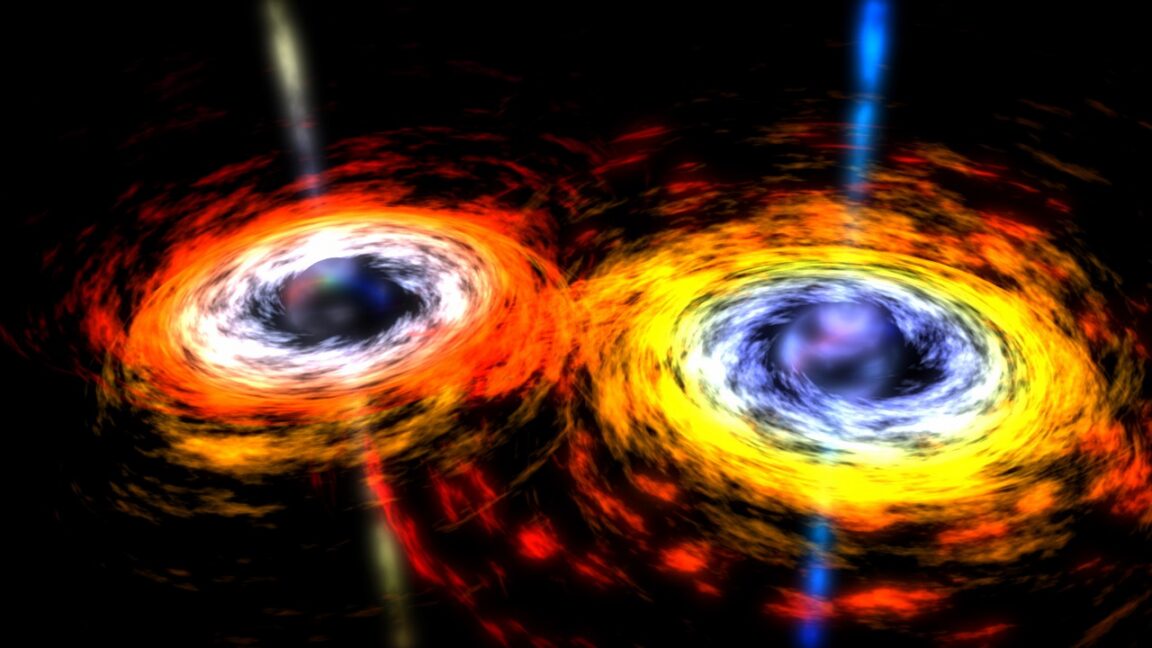
The international team behind the new work considered what kinds of collisions we might see. One is two first-generation (G1) black holes merging, in which case both should be below the mass at which pair-instability destroys everything. Then there’s a G1 colliding with a second-generation (G2) that’s the product of a previous merger, with the G2 potentially being above the mass cutoff. Finally, there’s a G2-G2 merger, where both are above the cutoff.
Any black hole mergers are likely to take place within a structure filled with lots of high-mass stars, such as a globular cluster. But the merger itself tends to impart a lot of energy to the resulting black hole, which could potentially kick it out of the cluster. As a result, G2-G2 mergers would likely be far more rare than G1-G2 mergers; the team estimates that only about 1 percent of all mergers would be G2-G2.