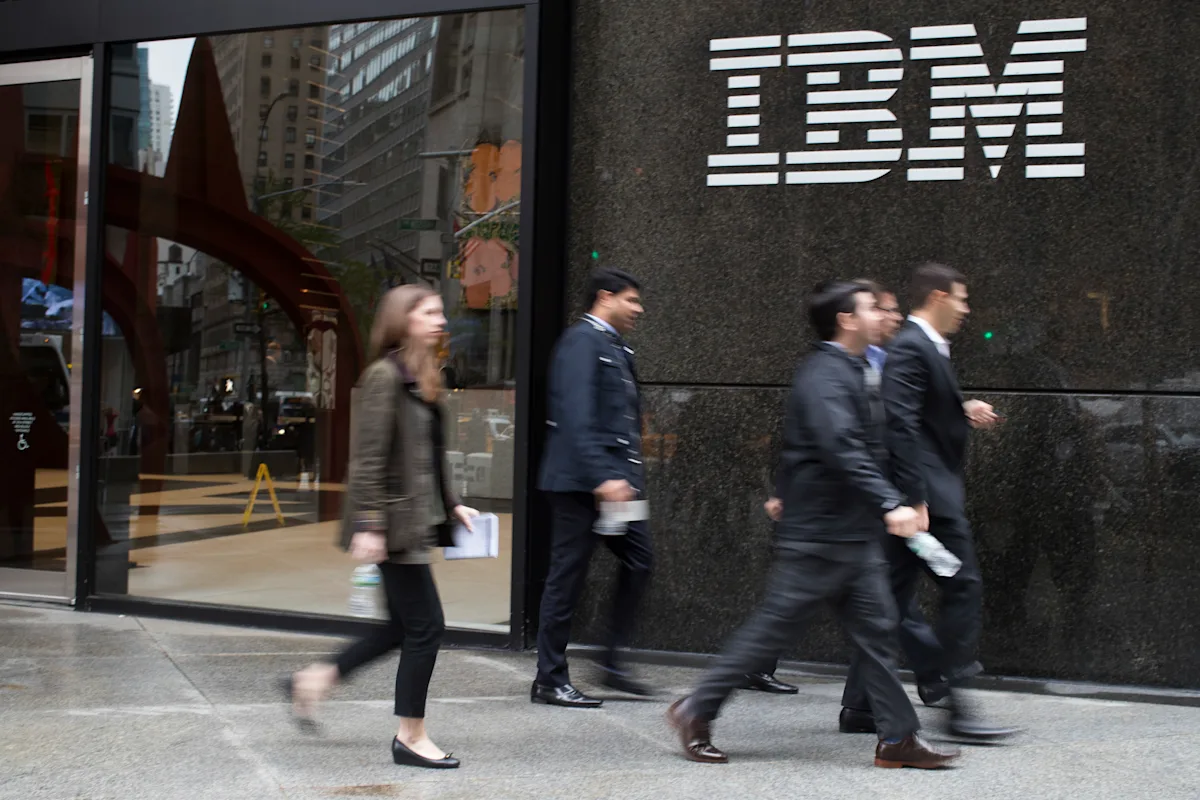
Big Tech companies are starting to look like IBM in the 1960s


The race to dominate the burgeoning AI market is pushing tech giants to adopt business models reminiscent of IBM’s (IBM) in the 1960s.

Big Tech “hyperscalers” Alphabet (GOOG, GOOGL), Meta (META), Microsoft (MSFT), and Amazon (AMZN) are all in various stages of developing their own custom AI chips to put in their data centers and power their cloud and software offerings. Alphabet, the farthest along of the four companies, is even reportedly in talks to sell its physical chips called TPUs to Meta — a move that would see it go head-to-head with leading chipmaker Nvidia (NVDA).

Those efforts have led Bloomberg Intelligence analysts to predict the custom AI chip market will grow to $122 billion by 2033.

Big Tech’s production of their own components goes beyond chips: Microsoft and Amazon are actively investing in dark fiber, or currently unused fiber-optic cables that are already underground, RBC Capital Markets analyst Jonathan Atkin said in a recent note to clients. Google and Meta also own their own cables but still buy from third parties, he wrote. Those cables are necessary to connect companies’ data centers and the enterprises that use them.

The dynamic in which cloud providers are making their own components (hardware) to run their core products (software) shows Silicon Valley swinging back toward vertical integration — an operating model pioneered by oil and steel tycoons in the late 19th century and adopted by IBM during the digital revolution.

IBM was one of the most successful vertically integrated companies in the 1960s, when it made the hardware components for its mainframes, or large computer systems. IBM’s strategy emerged from the idea that making its own specialized parts would improve its end product (mainframes) and profit margins — and amid concerns over supply shortages of parts for early computers. It worked: In 1985, the company accounted for more than half the market value of the computer industry, Carliss Y. Baldwin noted in her book “Design Rules.”

Of course, that all fell apart later. In the 1990s, the falling costs of producing semiconductors — as well as the rise of software powerhouse Microsoft and chip leader Intel — dug into IBM’s once-formidable competitive moat, and the company no longer claimed to be vertically integrated by 2000, Baldwin said.

Just as the emergence of computers pushed IBM toward vertical integration, the popularization of AI since the launch of ChatGPT in late 2022 has put today’s cloud giants on a similar trajectory. In particular, the steep costs of Nvidia’s chips and their limited availability have pushed tech giants to advance their AI chip efforts. Those custom chips are cheaper and better optimized for the companies’ software.

Nvidia founder and CEO Jensen Huang holds up a Rubin GPU and a Vera CPU as he speaks during a Nvidia news conference ahead of the CES tech show Monday, Jan. 5, 2026, in Las Vegas. (AP Photo/John Locher)
Nvidia founder and CEO Jensen Huang holds up a Rubin GPU and a Vera CPU during the CES tech show on Jan. 5, 2026, in Las Vegas. (AP Photo/John Locher) · ASSOCIATED PRESS

“The hyperscalers … recognize there’s a grave strategic danger from having a single supplier of AI compute,” Seaport analyst Jay Goldberg said. “And so they now have a very strong strategic reason to do their own silicon.”

Meta reportedly began testing an in-house AI chip for training models last year and recently acquired chip startup Rivos to accelerate its custom semiconductor efforts. Google’s TPUs have become so advanced that Anthropic (ANTH.PVT), OpenAI (OPAI.PVT), and even rival Meta have signed major cloud deals with the company to access them. And after a long delay, Microsoft unveiled its next-generation Maia 200 chip in January.

During Yahoo Finance’s recent visit to Amazon’s chip lab and nearby data center in Austin, Texas, the company showed off its latest UltraServers, a cluster of servers that include Amazon’s latest-generation in-house GPU called Trainium, its CPU Graviton, and custom networking cables and switches that connect them. Amazon still sells more AI compute in its remote data centers powered by Nvidia’s GPUs than in its custom accelerators, but the tech giant is increasingly highlighting the advantages of its in-house hardware.

Amazon Web Services director of technology Paul Roberts told Yahoo Finance that its Trainium3 chip can deliver up to a 60% price-performance benefit for its cloud customers compared to GPUs for inference workloads.

“I think what we’re seeing in the market is a lot of validation that this approach [of making custom chips] — versus having kind of generic GPUs — now you can have these specialized processors and accelerators that are achieving incredible energy efficiency savings,” he said.

Those kinds of energy savings are going to become a bigger deal as the AI data center boom starts to feel the effects of power constraints.

But Seaport’s Goldberg thinks the swing toward vertical integration is reaching its “far limit,” and not all Big Tech players will succeed.

“If you want to design a leading-edge chip, that’s a massive expense,” he said, adding that “only so many companies can afford that.”

StockStory aims to help individual investors beat the market.

Click here for the latest technology news that will impact the stock market

Read the latest financial and business news from Yahoo Finance


Source link

  • Related Posts

    Trump praises Nexstar-Tegna broadcast television deal he once opposed

    WASHINGTON (AP) — President Donald Trump on Saturday endorsed Nexstar Media Group’s $6.2 billion purchase of broadcast rival Tegna, an apparent reversal from earlier criticism of the deal. “We need…

    White House holds press briefing

    IE 11 is not supported. For an optimal experience visit our site on another browser. UP NEXT Timothy Busfield indicted on child sex abuse charges by New Mexico grand jury…

    Leave a Reply

    Your email address will not be published. Required fields are marked *

    You Missed

    Bilt 2.0 cards now live — here’s how to activate your card

    Bilt 2.0 cards now live — here’s how to activate your card

    Trump praises Nexstar-Tegna broadcast television deal he once opposed

    Trump praises Nexstar-Tegna broadcast television deal he once opposed

    P.E.I.'s Progressive Conservative Party to choose next leader, premier

    P.E.I.'s Progressive Conservative Party to choose next leader, premier

    5 French-Girl Spring 2026 Microtrends to Note, According to a Fashion Editor Living in Paris

    5 French-Girl Spring 2026 Microtrends to Note, According to a Fashion Editor Living in Paris

    Nithya Raman Announces She Will Run for Los Angeles Mayor

    Scientists find a missing link between Epstein-Barr virus and multiple sclerosis

    Scientists find a missing link between Epstein-Barr virus and multiple sclerosis