dailynewsnblog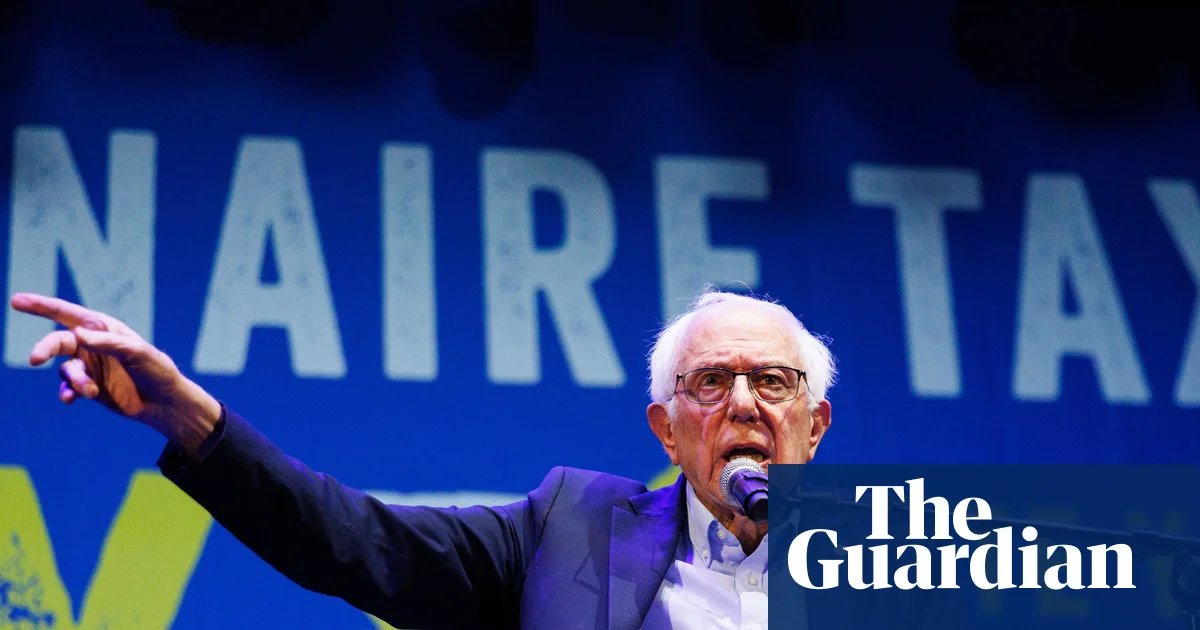
Billionaires are “treading on very, very thin ice,” Bernie Sanders warned on Wednesday during a fiery speech in Los Angeles, imploring California voters to fight “grotesque” levels of economic inequality by approving a proposed tax on the state’s richest residents.
The Vermont senator railed against the “greed”, “arrogance” and “moral turpitude” of the nation’s “ruling class”, calling it “fairly disgusting” that some ultra-wealthy tech leaders have fled California – or are threatening to do so, if the proposed wealth tax becomes law.
“Never before have so few people had so much wealth and so much power,” Sanders thundered on stage at the Wiltern theater, where a raucous crowd of longtime supporters shouted “shame”.
Though the 84-year-old two-time presidential candidate has railed against the billionaire class for decades, his remarks on Wednesday were an exceptionally scathing – and at times personal – indictment of the top 1%. Comparing America’s highest earners to the oligarchs and monarchs of past centuries, he said the US billionaire elite “no longer sees itself as a part of American society”.
“These guys literally believe that they have the divine right to rule and are no longer subject to democratic governance,” Sanders told a rapt audience.
Sanders framed the wealth tax on billionaires in California, led by the Service Employees International Union-United Healthcare Workers West (SEIU-UHW), as a referendum on American “oligarchy” itself.
“These billionaires are going to learn that we are still living in a democratic society where the people have some power,” Sanders said.
Under the proposal, which has rattled wealthy Californians and split Democrats, residents worth more than $1bn would have to pay a one-time 5% tax on their assets to offset looming federal cuts to health care and support public education and state food assistance programs. California is home to more billionaires than any other state, and analysts say the tax would apply to about 200 residents.
Taking the stage before Sanders, Suzanne Jimenez, chief of staff at SEIU-UHW, said the proposal would ensure billionaires “pay their fair share”.
“If we don’t act, our friends and our family will have to drive twice as far – will have to wait twice as long – for the life-saving care that they’re going to need,” she said. “And for what? So that billionaires can own another yacht?”
Outside the event, organizers collected signatures to put the California Billionaire Tax Act on the ballot in November. The union must gather nearly 875,000 valid signatures to qualify. If they are successful, it would still need to win approval from a majority of California voters.
Even in deep-blue California, the politics are complicated. Opponents, including the state’s Democratic governor, Gavin Newsom, argue the tax would erode the state’s long-term tax base and put California – which boasts the world’s fourth largest economy – at a competitive disadvantage against other US states.
The tax proposal is already facing deep-pocketed opposition from business leaders and tech titans. Google co-founder Sergey Brin and other billionaires are bankrolling a new political group that is backing a series of competing ballot initiatives that would nullify the union-backed proposal. Brin, one of the world’s wealthiest people, is among the recent Silicon Valley magnates to cut ties with the state where he made his fortune.
The proposal’s retroactive structure – taxing wealth accumulated in 2025 – is designed to deter billionaires from fleeing the state before it takes effect, its authors have said, while proponents and critics alike anticipate legal challenges if the tax is adopted.
A nonpartisan analysis from the California Legislative Analyst’s Office estimates that the one-time billionaire tax would “probably” generate tens of billions of dollars for the state. But it cautioned that there was a significant degree of uncertainty if, for example, wealthy Californians departed the state, resulting in hundreds of millions of dollars of losses in state income tax revenues annually. It also notes the complexity and cost of implementation, as valuing complex, non-cash assets such as art, private business, and intellectual property is tricky and time-consuming.
A January poll found that 48% of likely voters support the initiative, while 38% are opposed and 14% remain undecided, underscoring both its appeal and its political risk.
At the Wiltern on Wednesday evening, attendees posed in front of signs that read “Billionaire Tax Now” while the crowd chanted “Tax the billionaires”.
Among the crowd was Morgan, a 29-year-old progressive and longtime supporter of Sanders who declined to give her last name. She hopes his influence can counter the well-financed opposition to the wealth tax. “Their money can do a lot more and go a lot further than ours,” she said of the state’s richest residents.
Chelsea Gods, a content creator and political activist, drove two-and-a-half hours from San Diego to attend the event. “Americans are poor. We are strapped for cash. We are struggling and we are tired,” she said. “People First-policies are the only way to win a political future for people on the left.”
California is familiar terrain for Sanders, who won the state on Super Tuesday during the 2020 Democratic presidential primary.
In his remarks, the populist senator said he didn’t know whether the uber-rich would follow through on their threats to leave California, noting that wealthy New Yorkers had also warned they would flee if democratic socialist, Zohran Mamdani, was elected mayor of the city. They do not appear to have done so.
Sanders also named names and listed assets, drawing boos and jeers as he listed Larry Ellison’s jets and Mark Zuckerberg’s yachts and his Palo Alto compound.
“For these people enough is never enough,” he said. “They are dedicated to accumulating more and more wealth and power and they do that no matter what harm they bring to working families.”
Sanders said Minnesotans opposed to Trump’s federal immigration crackdown showed Americans how to resist authoritarianism. Approving a wealth tax on billionaires, he said, would send a “clear and profound message” that “enough is enough”.
“The billionaire class cannot have it all. This nation belongs to all of us,” Sanders said, before concluding his remarks: “Now the ball is in California’s court.”