dailynewsnblog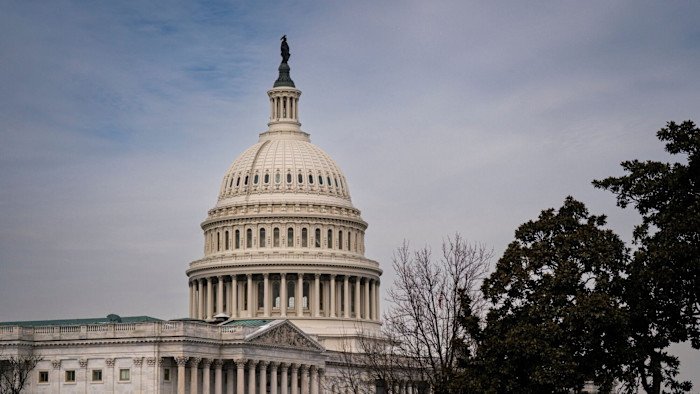
This article is an on-site version of our Trade Secrets newsletter. Premium subscribers can sign up here to get the newsletter delivered every Monday. Standard subscribers can upgrade to Premium here, or explore all FT newsletters
Welcome to Trade Secrets. Today’s newsletter is on what I identified in January as a likely development — that we have seen “peak tariff” for President Donald Trump, with his duties only becoming less popular and pushed further into retreat as the year proceeds. For now, it’s a question of what he can extract from other countries as the price of their removal. Charted Waters, where we look at the data behind world trade, is on windpower installation in the US.
Get in touch. Email me at alan.beattie@ft.com
Tariffs turning toxic
Scientists on Capitol Hill reckon they’ve found something: it’s almost invisible, even with a state-of-the-art electron microscope, but it might just be a trace of spine within the congressional Republican caucus.
The House of Representatives last week did what the US Senate, which has shown slightly more vertebral tendencies in the area, showed the way for last year. With three Republican representatives getting a rush of sanity to the head and remembering Article I of the US constitution, the House mustered a small majority to give itself the power to challenge Trump’s emergency tariffs. It went on to vote to lift the state of emergency that Trump had invoked to impose emergency IEEPA tariffs on Canada.
Now, the likelihood that congressional Republicans go on a sanity spree and actually overturn Trump’s absurd tariffs is extremely low. That would require veto-proof two-thirds majorities in both houses.
But the event shows the shifting political context in which the US president is operating. Trump is not popular and the tariffs have very few friends. Congressional Democrats — who can read opinion polls, even if they can’t do anything else — are against them. Businesses are against them. It’s now implanted in public discourse that American companies and consumers, not foreigners, are paying the tariff costs.
Congress waking up also puts the US Supreme Court case over the IEEPA tariffs in another light. The SCOTUS ruling could come at almost any time, this Friday being the next possible T-Day. If the US Congress does start rediscovering its muscle memory on trade policy, one of the Trump administration’s key arguments in the case — that broad executive authority over tariffs is justified because of congressional inaction — looks weaker.
Trump remains emotionally attached to tariffs. But administration officials at some level know they’re not popular and are removing them bit by bit in the cause of “affordability”. Last week saw two unilateral movements on that score:
-
The administration is rolling back aluminium (aluminum, whatever) and steel tariffs, stopping the expansion of lists of covered goods and granting exemptions.
-
Trump will give a big carve-out to all customers of chipmaker TSMC, including Amazon, Google and Microsoft, from his forthcoming semiconductor tariffs, assuming they happen.
I suspect there will be more.
Playing a weakening hand
In this light, the rush of bilateral “gunboat deals” is a high-stakes game of bluff, with the US holding a position that could weaken markedly. Trading partners surely know the US wants to get its tariffs down. It’s just a question of how much they will pay it for doing so, with the uncertainty heightened by the fact that a SCOTUS ruling could suddenly render these deals moot.
Governments are signing deals that quite clearly contradict their long-standing policies or other agreements they’ve made, such as with the EU. Evidently they’re planning to renege on as much as they can, or at least decide at a later date how much of the letter or spirit of the agreements with the US they will maintain.
The India deal agreed two weeks ago is an excellent example of the capacious amounts of room left for bluff and coercion when it comes to implementation. The agreement, such as it is, has been delivered through an iteration of changing announcements and factsheets backed by official statements with varying degrees of firmness and sincerity.
The US has made clear that it expects India to cease buying oil from Russia in return for lifting its 25 per cent punitive tariff. But India says that, while it sees the logic of diversifying away from Russia, commercial decisions to purchase oil are made by companies, not government. New Delhi has a long-standing defence relationship with Moscow that it isn’t going to toss away for nothing.
Since the US agreed to lift the tariff upfront, it would have to make a conscious decision to reimpose it. If I had to bet on the outcome, India will keep making high-level statements about diversifying towards US liquefied natural gas that Trump can present as a diplomatic victory, while any genuine move to wean itself off Russian oil will happen painfully slowly and via nudges and understandings. How much it gets away with this depends on Trump’s whim and political room for manoeuvre.
Elsewhere, the US’s ancestral hatred of the EU’s “geographical indication” (GI) protected food names has bubbled up again. The Trump administration is actively trying to undermine Brussels by getting countries, the latest being Argentina, to agree not to recognise them. If a government signs deals with the EU and US, which have flatly contradictory provisions (the EU-Mercosur agreement has GIs), whose rules is it going to follow? I presume the one that seems more expedient when it comes to the crunch. This will involve a calculation about which of the EU or US is more likely to retaliate, whose export market is more lucrative and which agreement is embedded in domestic legislation in a way that would make it harder to ignore. The US’s arbitrary exercise of power versus the EU’s rule of law; it will be an interesting match-up.
In this game of trying to make promises to the Trump administration as vague as possible, the country that seems to have miscalculated is Japan. As my FT colleagues’ excellent reporting shows, Tokyo bound itself into a promise to invest $550bn in the US economy with a sufficiently robust mechanism of measurement that it can’t just airily dismiss as an aspiration. Far better to promise something years in the future that isn’t really in your power to deliver anyway.
Charted waters
The extent to which Trump is ceding the green tech field to China remains almost beyond belief in its self-destructiveness.

Trade links
-
The FT opines on how the EU should deploy its “Buy Europe” procurement rules (narrowly and carefully).
-
The Rhodium Group consultancy looks at how German leaders have finally started talking openly about the risk of a major China shock, though without much of a plan to deal with it.
-
In two separate pieces, the Center for Global Development think-tank looks at how African governments reacted to the savage cuts in development aid and how a radically simplified Global Fund for Aids, Tuberculosis and Malaria might operate in the new environment.
-
Former Italian prime minister and European commissioner Mario Monti argues that the EU needs to drop its hypocrisy, encourage growth and strengthen the single market.
Trade Secrets is edited by Harvey Nriapia
Recommended newsletters for you
The AI Shift — John Burn-Murdoch and Sarah O’Connor dive into how AI is transforming the world of work. Sign up here
FT Swamp Notes — Expert insight on the intersection of money and power in US politics. Sign up here