dailynewsnblog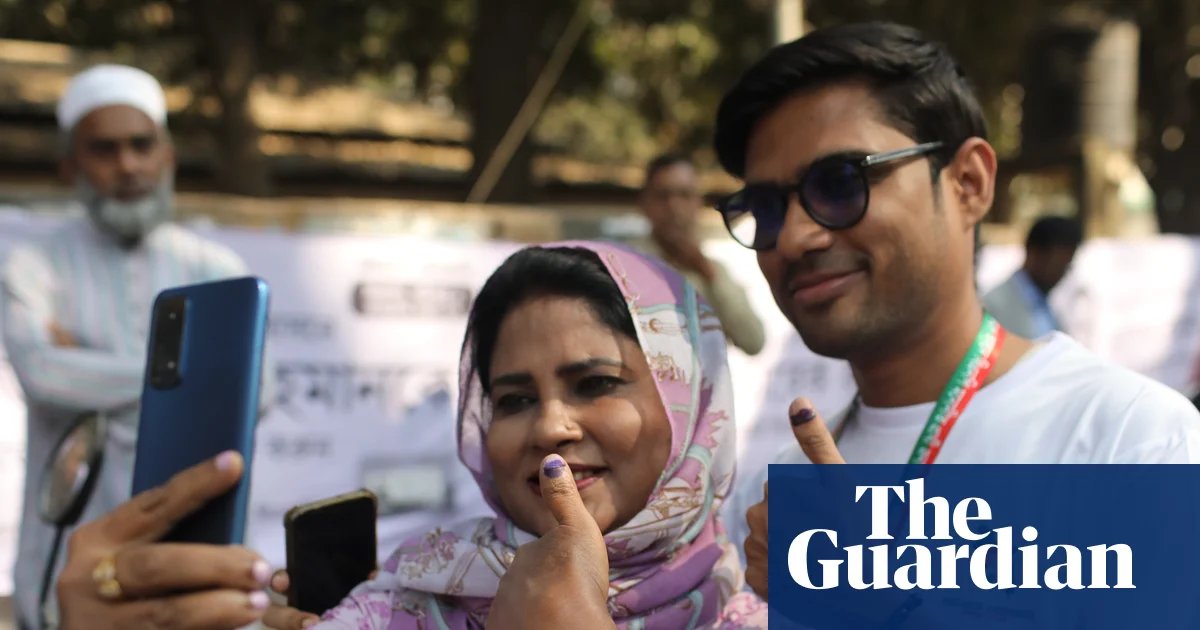
The Bangladesh Nationalist party (BNP), led by Tarique Rahman, has claimed a sweeping victory in the country’s first election since a gen-Z uprising toppled the autocratic regime of Sheikh Hasina.
“This victory was expected. It is not surprising that the people of Bangladesh have placed their trust in a party … capable of realising the dreams that our youth envisioned during the uprising,” said Salahuddin Ahmed, a leading BNP committee member.
“This is not a time for celebration, as we will face mounting challenges in building a country free from discrimination.”
The party also confirmed their victory in a post on X. “The Bangladesh Nationalist Party is going to form the government by winning the majority of seats,” they said.
The US embassy was the first to congratulate the party on its “historic” election victory on Friday morning.
Counting was still ongoing for the final result, which had yet to be announced by the election commission.
By around 4am local time, the BNP had secured 185 seats in the 300-member Jatiya Sangsad, or House of the Nation, TV channels showed, easily crossing the halfway mark for a simple majority.
The election was widely seen as the country’s first free and fair polls in more than 17 years. Under Hasina’s regime, the past three elections had been marred by widespread allegations of vote-rigging, the stuffing of ballot boxes and harassment and jailing of political opponents.
As counting continued, BNP leaders said the party was confident of winning 200 seats and securing a two-thirds majority. “Of course, BNP is winning, the majority of course, and it would even be a landslide victory,” Amir Khasru Mahmud Chowdhury, a BNP standing committee member, said. “Winning two-thirds of the seats is called a landslide victory, I think we would cross the 200-seat limit.”
Voting on Thursday was largely peaceful in what was seen as a crucial test of Bangladesh’s democracy after years of political turmoil, and turnout far exceeded the 42% seen at the last elections.
According to the election commission, nationwide voter turnout was recorded at 60.69% on Thursday. This was also the first election which had given the overseas diaspora an opportunity to vote. Postal votes, which also included officials in the country who could not return home to cast their ballot, saw a massive 80.11% participation rate.
The parliamentary election follows a student-led uprising that toppled Hasina after 15 years in power and left an estimated 1,400 people dead according to the UN, amid a violent crackdown by the state.
A clear outcome had been seen as crucial for stability in the Muslim-majority nation of 175 million after months of anti-Hasina unrest disrupted everyday life and hit major industries, including the garment sector in the world’s second-largest exporter.
The BNP is led by Rahman, the 60-year-old son of former prime minister Khaleda Zia and former president Ziaur Rahman.
Its campaign promises included financial aid for poor families, a limit of 10 years for an individual to remain prime minister, boosting the economy via measures including foreign investment, and anti-corruption policies.
Shafiqur Rahman, the head of BNP’s main rival, the Islamist Jamaat-e-Islami, conceded defeat, with his party on just 56 seats. Rahman said Jamaat would not engage in the “politics of opposition” for the sake of it. “We will do positive politics,” he told reporters.
The election had been seen as Bangladesh’s first truly competitive vote in years. Hasina’s Awami League party, which ruled the country for more than 15 years until her ousting, was barred from contesting.
More than 2,000 candidates – including many independents – were on the ballot, and at least 50 parties contested seats, a national record. Voting in one constituency was postponed after a candidate died.
Alongside the election, a referendum was held on a set of constitutional reforms, including establishing a neutral interim government for election periods, restructuring parliament into a bicameral legislature, increasing women’s representation, strengthening judicial independence and introducing a two-term limit for the prime minister.
There was no official word on the outcome of the referendum.
Hasina fled to India, a long-term ally, after a war crimes tribunal sentenced her to death for crimes against humanity, committed during the final throes of her regime. Her escape has frayed ties between Dhaka and New Delhi and opened the window for China to expand its influence in Bangladesh.
In a statement sent after polling stations closed, Hasina denounced the election as a “carefully planned farce”, held without her party and without real voter participation. She said Awami League supporters had rejected the process.
“We demand the cancellation of this voterless, illegal and unconstitutional election … the removal of the suspension imposed on the activities of the Awami League, and the restoration of the people’s voting rights through the arrangement of a free, fair, and inclusive election under a neutral caretaker government,” she said.
As documented for years by human rights groups and the UN, Hasina’s regime routinely suppressed dissent of its critics and opponents, thousands who were disappeared, tortured and killed in secret jails; many emerged only after Hasina was toppled. Freedom of the press and judicial independence was crushed and elections were reduced to a staged farce.
With Reuters