dailynewsnblog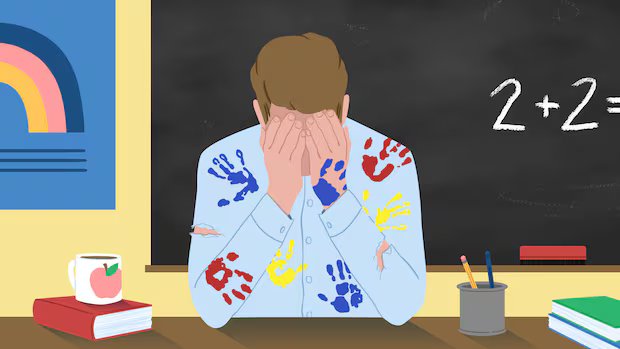

Alberta teachers say they face increasingly dangerous conditions at school, with the most common threat coming from their own students.
CBC News surveyed teachers across the province this year. Hundreds wrote about violence they experience on the job, including suffering concussions and other injuries; students kicking, scratching, punching and biting them; and regularly having to evacuate a classroom because of a student’s temper.
- What has been your experience with Alberta schools? Whether you’re a teacher, parent or student, we want to hear from you. Send an email to ask@cbc.ca.
- Read our Inside the Classroom series at cbc.ca/inside.
Many respondents detailed how classroom complexity can sometimes tie into disruptive and violent behaviour in their classrooms.
But some educators, as well as experts CBC interviewed, expressed that parents need to be more accountable for their children’s actions, and slammed school discipline policies for being too lax.
“It’d be unheard of, of any other profession, that your patrons are able to verbally assault you and physically assault you, and expect to have the services back,” said Dr. Salvatore Durante, a teacher turned registered psychologist in Edmonton. He qualitatively studied a group of teachers from B.C., Alberta and Saskatchewan who were each assaulted by students for his PhD thesis, after a student tried stabbing him while substitute teaching.
In January, CBC gathered more than 23,000 addresses from school websites in Alberta and sent a questionnaire, in order to learn about the feelings and experiences of as many teachers and educational staff as possible. CBC is not interpreting the survey results as having statistical certainty, as the questionnaire wasn’t sent to a scientifically-validated random sample, nor was it locked with a password for teachers only.

But of the more than 6,000 total responses received, a few hundred used the open response section at the end and their descriptions of complexity to recount their experiences with aggression in the workplace — which was a key issue during October’s provincewide teachers’ strike.
The responses echo the provincial government’s own findings last summer from front-line educational staff. Alberta’s Aggression and Complexity in Schools team reported increased staff injuries and medical leaves, and unsafe environments for students and staff.
Its report also says educators are concerned that students are “unsafe, unsuccessful and unsupported, with limited opportunities to learn,” and that classrooms are constantly managing crises “with no proactive ways to support students.”
The anecdotes align with what the Educator’s School Safety Network, a U.S.-based non-profit dedicated to school safety training, has been hearing more frequently through its work with teachers, according to Amy Klinger, its director of programs.
Most of the training American teachers and educational staff receive revolves around active shooter situations and trying to prevent them, said Klinger, an educator since the 1980s. But that has left them unprepared to deal with aggressive behaviour from students, parents and other community members who enter a school.
“You’re preparing people for the least likely thing they are going to encounter — which you absolutely must do,” she said. “But you also have to be able to walk and chew gum at the same time. So we also have to look at, ‘What are they actually going to encounter on, almost, a daily basis?’”
There’s scant publicly available data pointing to how violence impacts Alberta’s teachers.
Workers’ Compensation Board-Alberta data shows, from 2021 to March 7 of this year, about 700 public and separate school board employees provincewide have had to take time off work due to ‘Assaults/Violent Acts/Harassment.’ Such incidents caused the second-most lost-time claims for those workers in that span, and claims have risen since the pandemic.
But most teachers are excluded from those figures. Per Alberta’s Workers’ Compensation Regulation, only teachers involved in industrial education or home economics courses have WCB coverage.
When complexity escalates
In the teacher questionnaire, CBC asked teachers what classroom complexity looks like. Many described classrooms with multiple students who are neurodivergent or have learning disabilities, and youth dealing with trauma — like refugees — or who have tough family situations.
Some survey respondents said, when certain students’ emotions become dysregulated, they will scream, throw furniture and sometimes chase people in the class with sharp objects.
A veteran public school administrator in the Edmonton area recalled having coffee with 10 teachers last summer: They each had suffered injuries at work through interactions with students. One needed surgery.
The term ‘complexity’, they wrote, serves to hide the amount of violence in schools, which has reached levels they have never seen in their career.
The Alberta government, in the latest budget, earmarked $1.4 billion over the next three years specifically for class size and complexity, including $355 million this year.
The government has also committed “complexity teams” for 476 schools across the province, starting in kindergarten to Grade 6 classrooms. Their responsibilities include managing disruptive students.
Jolene Helgason, an Edmonton public school teacher, is hopeful about the government’s commitments.
“This job is very, very hard,” she told CBC News.
“Without the proper supports, it’s just going to continue being challenging.”
Helgason was diagnosed with ADHD a few years ago, and a lot of her downtime has since been spent immersed in neuroscience research — for herself and her classroom. That led to her delivering a seminar during a teachers’ convention in Edmonton last month, which taught a standing-room only crowd ways to respond to students acting out.

Complexity can show itself in various ways, such as students freezing and people-pleasing, Helgason told CBC. It can also be more aggressive, but she stressed that’s a survival response.
The key is to use techniques that can calm students down and regulate their emotions again, she said.
Jessica Benn, a special education teacher who attended Helgason’s seminar, said students also need to learn those skills.
“Learning to be calm and regulated is also as important as literacy and numeracy. They’re all parts of what they need to grow into healthy adults,” Benn told CBC News.
Need more than ‘sorry’
Experts and survey respondents told CBC that students need to be held more accountable — through tougher discipline at schools and from their parents.
An elementary school teacher in the Calgary area wrote to CBC that parents will sometimes blame schools for their child’s behaviour.
At the same time, they said there are few consequences for aggression, so it feels like teacher have little control when students get aggressive.
Klinger, of the Educator’s School Safety Network, described school discipline policies as a pendulum — and said it has swung from too strict to barely any consequences.
She and Durante, who studied assaulted teachers, called for a middle ground: a restorative approach that allows for empathy and a discussion about a student’s actions, but also leads to appropriate repercussions.

“We can’t have wishy-washy restorative justice where the student says, ‘Sorry,’ and they’re back in the classroom,” Durante said.
But correcting behaviour also requires co-operation from parents, Klinger said.
There has been a cycle of blame between teachers, parents and school administrators, she added.
“Kids are a reflection of the environment from which they come,” she said. “Schools need to work to fix themselves, but families and societies need to work to fix themselves.”
“Nobody wants to own this and nobody wants to collaborate to fix it, because everybody has to ask real hard questions,” she said.
Until the sides build relationships and start looking within, the root of the issue won’t be solved, Klinger said.
In the meantime, though, Bilal Ali, a high school social studies teacher, says he will keep striving to show up for his students as best he can.

He attended Helgason’s seminar last month, because teachers are experiencing “a lot of problems” with kids and adults, and how to manage emotions, Ali told CBC News.
“It might not be [on] a day-to-day basis, but it might be something you need to be ready to face in the classroom.”
But he remembers feeling like he had baggage as a student, he said. Some teachers added to it, but others helped — and he remembered those ones in a positive light.
“It inspired me to be a teacher who wants to do the same,” Ali said.
What do you think about our reporting on Alberta schools? What would you like to see us report on next? Send an email to ask@cbc.ca.