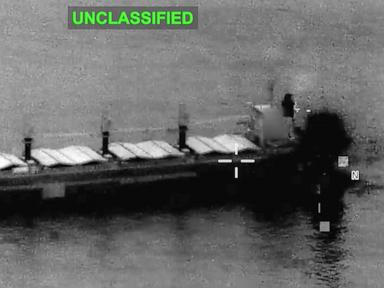
Early Thursday morning, a U.S. Navy Arleigh Burke‑class destroyer shadowed and ultimately seized a 12,000‑ton merchant ship attempting to navigate the waters that Iran has sealed off since early February. The vessel, registered in Panama and carrying containerized goods, was intercepted roughly 45 nautical miles south of the strategic Strait of Hormuz, a chokepoint through which nearly a fifth of the world’s petroleum passes.
The encounter unfolded under heightened alert after the United States elevated its maritime posture in response to President Donald Trump’s Feb. 28 proclamation of “major combat operations” against Tehran. Radar sweeps and aerial drones identified the target moving at a speed consistent with a breach attempt, prompting the destroyer’s crew to fire warning shots before boarding teams secured the ship and redirected it to a U.S.-controlled port for inspection.
Rear Admiral James Whitfield, commander of the Fifth Fleet, briefed reporters, stating the action was a lawful enforcement of international navigation rights and a necessary countermeasure to Iran’s unilateral blockade. Iran’s Revolutionary Guard condemned the seizure as “piracy” and vowed retaliation, while European maritime agencies called for de‑escalation and urged both sides to respect the United Nations Convention on the Law of the Sea.
In-Depth Analysis & Key Details
Iran’s blockade stems from a series of retaliatory measures launched after the United States withdrew from the 2015 nuclear accord and re‑imposed sanctions that crippled Tehran’s oil exports. Historically, the Gulf has seen similar flashpoints, notably during the 1980s Iran‑Iraq war, when both powers targeted commercial shipping to exert pressure. This latest enforcement by the U.S. echoes Cold War‑era doctrines that treat maritime interdiction as a tool of coercive diplomacy.
The legal debate centers on whether a nation can unilaterally restrict passage through an international strait without United Nations endorsement. While Iran cites security concerns, most maritime law experts argue that the Strait of Hormuz remains an open conduit under the UNCLOS framework, despite the United States not being a party to the convention. Economists warn that each interdiction adds a risk premium to oil futures, potentially nudging global prices upward by several dollars per barrel.
Regional security analysts, such as Dr. Leila Haddad of the Middle East Institute, note that the U.S. decision to expand its rules of engagement represents a calculated gamble to deter further Iranian aggression, yet it also raises the specter of a miscalculated encounter at sea. Naval strategists point out that the presence of multiple allied warships in the Gulf increases the probability of accidental escalation, a factor that policymakers must weigh against the strategic goal of maintaining free navigation.
"The blockade battle now hinges on whether diplomatic restraint can outpace the momentum of kinetic enforcement."
Why This Matters & What Lies Ahead
For consumers, any disruption in Hormuz traffic translates to higher gasoline and heating‑oil prices, while shipping firms face longer transit times and surging insurance costs, eroding profit margins across the supply chain.
The next critical juncture arrives at the U.N. Security Council meeting slated for early December, where member states will debate sanctions relief and possible resolutions to curb unilateral maritime actions.
Source: Reported by ABC News · Analyzed & Synthesized by DNB Newsroom