dailynewsnblog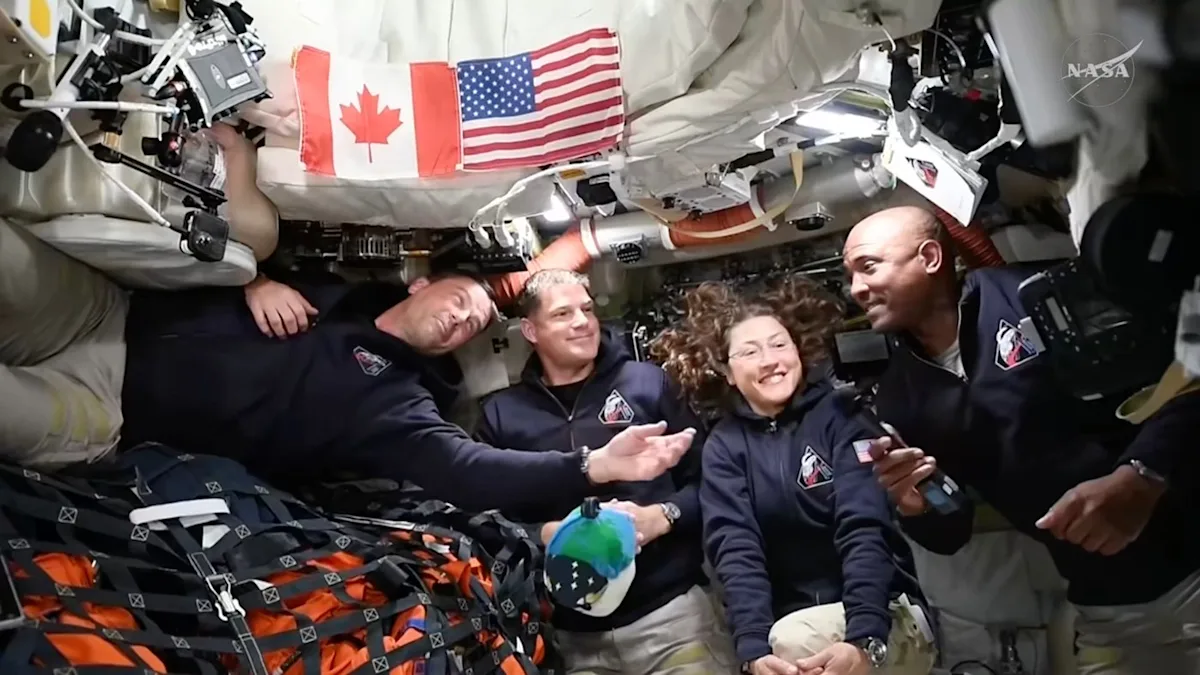
Jeremy Hansen, just days away from becoming the first Canadian astronaut to circle the moon as part of the Artemis II mission, gave the country yet another glimpse into life on the final frontier.
Hansen, along with American astronauts Reid Wiseman and Christina Koch, took part in a live question-and-answer session early Sunday from aboard NASA’s Orion spacecraft to answer questions submitted by Canadian kids.
The virtual event, the second of its kind, took place about four days into the 10-day lunar flyby mission.
One youth asked how food is prepared and eaten in space, while another wanted Hansen to pick a movie that best reflects what it’s like in space. Hansen responded with 1995’s “Apollo 13” starring Tom Hanks — save for its disastrous chain of events.
“That movie really shows you a lot what it’s like with just three humans trapped in a tiny capsule and surviving in space together,” the 50-year-old from Ontario said. “It’s one of my favourite space movies.”
Ahead of the Q-and-A, NASA announced on social media that the four astronauts were officially “moonbound” and were more than halfway there. The space agency also shared two photos of the moon, and one of the inside of the Orion capsule.
Artemis II is the first crewed mission to the moon since the Apollo flights of the 1960s and ’70s. It had been delayed a few times since February due to hydrogen fuel leaks and helium flow problems.
During Sunday’s event, one youth asked how human organs behave in microgravity.
Hansen said he doesn’t notice much of a difference, but he can feel the blood shifting from one part of his body to another.
“I’m sure my face is a lot (more) puffy now because there’s a lot more blood up in my upper regions of my body, because gravity is not constantly pulling it down,” he said.
“I can just sort of feel it in my head … It’s not bad. But it’s just slightly different.”
Koch said when astronauts spend a lot of time in microgravity, organs adapt to the environment. The heart doesn’t work as hard to pump blood to the brain. Due to the loss of gravity, she also said there’s risk of kidney disease.
Hansen was also asked whether the crew sees a crescent-shaped Earth, as those on the ground sometimes see a crescent moon in the night sky.
“The reality is we do,” he said. “We’ve seen a half-Earth, partial crescent Earth, we’ve seen a dark Earth.”
The four-person crew is expected to do a lunar flyby on Day 6 of the mission. They will zip around the moon in their capsule — about the size of a campervan — before coming home.