dailynewsnblog
When Allyson Bradley helps her young daughters with homework, each hunches over a computer, searching for instructions, resources and links, navigating a confusing patchwork of online platforms.
Gone are the days of poring over textbooks and workbooks.
“It’s just all of us sitting in front of laptops, it’s awful,” says the Mississauga mom. “I wonder how much of my kids’ brains are dedicated to understanding the software and not the actual content.”
For more than a decade, Ontario schools have been moving away from printed textbooks, replacing them with digital resources and teacher-made materials. The shift has put new burdens on teachers, students and parents, raising questions about the impacts on learning, variability across classrooms and deepening inequities for kids without access to devices at home.
The decline in textbook use, which accelerated during the pandemic, was largely because they are costly, become outdated and don’t meet diverse learning needs. While digital tools offer interactive content, real-time updates, diverse perspectives and more personalized instruction, there are concerns that without textbooks, students miss out on having information provided in a clear and sequential manner, making it easier to understand and review.
The transition has meant teachers spend a lot of time searching for content and adapting it to the curriculum; parents are unclear about what their children are learning; and students are left sorting through photocopied material and learning on devices — even as textbooks make a comeback in some parts of the world.
The tech pivot
In Toronto, Grade 12 student Victor Jiang prefers digital tools, including online textbooks, because for him they’re easily accessible. On a crowded bus headed to school, he can pull out his phone to study physics. It’s easier than lugging heavy books and flipping through pages — any physical textbooks are kept at home.
Another key advantage to studying online is that when he needs to better understand something, he can easily use generative AI or Google.
Several GTA school boards say the decline in textbook use comes as they try to keep up with technology. Digital platforms offer a range of learning materials. They promote accessibility though tools such as speech-to-text and screen magnifiers, stay current as curricula evolve, allow for remote collaboration and encourage deeper engagement with audio, video and interactive media. They also permit teachers to differentiate instruction — they can tailor a single lesson for English language learners, students with disabilities or those working below grade level. When asked about cost, boards either didn’t address it, said it wasn’t a factor or it was too hard to calculate.
At the York Region District School Board — textbooks are used in high schools, but not elementary — a senior source says lessons built around digital platforms and teacher-curated materials are “significantly better and more supportive of students” than textbooks, and that the curriculum, administrative oversight and teacher collaboration ensure consistency.
Preference for paper
Yet as boards move away from textbooks, some fear what’s being lost. Toronto ninth-grader Aisha Ab Shukor says textbooks are “so much easier to flip through and get information,” and digital tools are “quite janky” and difficult to navigate. And when she’s working on a screen, links and additional resources are distracting.
Carter Peios, a Grade 12 student in Courtice, says going online, even for schoolwork, makes him think “it’s scroll time, not necessarily learning time.”
“If I’m trying to really dive deep into an article or a piece of writing then having it on paper is just easier for me to highlight and annotate,” he says.
Mandy Wintink, whose son is in Grade 5, calls the disappearance of physical textbooks “terrible,” because their content is organized in a linear, intentional and progressive manner.
“There’s a huge reliance on loose papers and also on Google Classroom,” says the Toronto mom, who’s trying to limit her son’s screen use at home. “It all looks a little haphazard at times.”
Without books she has no idea how to help her son, who has “major” learning gaps in math, so she buys math workbooks noting, “If we didn’t supplement, I don’t know that he’d be getting an education.”
“I don’t blame the teachers,” says Wintink. “I feel like it’s a systemic issue: lack of budget, funding and support in the classroom.”
Similarly, several elementary teachers — the Star is not identifying them because they weren’t authorized to speak — say they worry the shift has hurt student learning, attention spans and even organizational skills.
One says they think the heavy reliance on technology erodes accountability and independence, saying homework now involves parents helping their kids log on or navigate a digital landscape. And some are uneasy about the growing use of gamified learning platforms — with points, sounds and visual effects — concerned they condition kids to give up on tasks when not instantly rewarded.

Victor Jiang, a Grade 12 student, at home studying for exams on his laptop and phone, rather than from a textbook. He says he prefers digital learning resources as they can be easily accessed anywhere.
R.J. Johnston/Toronto Star
Teacher workload
Moving away from textbooks has changed how lessons are designed. School and clinical psychologist Todd Cunningham is struck by the number of loose sheets found crumpled in his kids’ backpacks. What he sees in many classes is a “mishmash” of resources that can lead to a “disjointed” learning experience.
“Teachers are basically pulling stuff left and right,” says Cunningham, an associate professor in the teaching stream at the University of Toronto. “There’s no good scope and sequence that’s really allowing them to move through a process that allows a child’s brain to actually acquire these (foundational) skills.”
What’s key is returning to evidence-based instruction, be it through digital resources or traditional textbooks, that follows a clear progression.
Teachers aren’t against digital learning, but some worry that things have gone too far, leaving them without consistent, curriculum-aligned resources. They build lessons from scratch using online platforms, old textbooks and unapproved sites such as the popular Teachers Pay Teachers, where educators sell lesson plans. Some are also asked by administrators to limit photocopying because of the cost of paper.
“It’s created an awful lot more work,” said a teacher. “It’s just not efficient that every single person who teaches Grade 3 is searching around for their own things.”
Helen Victoros, president of the Elementary Teachers of Toronto, says teachers are desperate for more resources to deliver updated curriculum, both textbooks and digital resources curated by the board. The past decade has seen a “devastating erosion of supports, a massive escalation in workload and out-of-pocket spending to fill in the gaps.”
“What’s best for kids and learning? That should be the question that drives everything,” says René Jansen in de Wal, president of the Ontario English Catholic Teachers’ Association, who thinks the shift away from textbooks was driven by budget constraints.
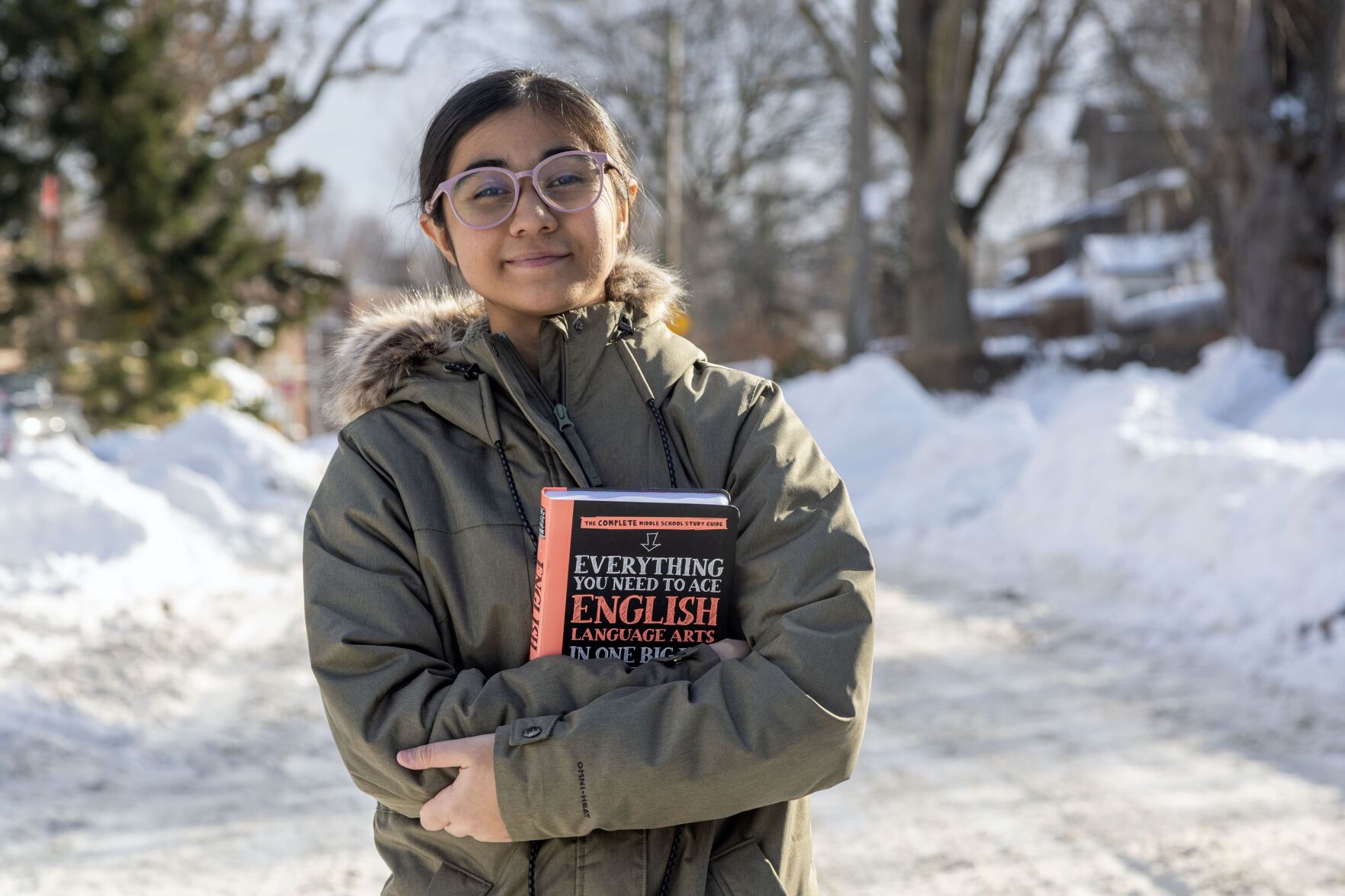
Aisha Ab Shukor poses near her home in Toronto. She prefers physical books to digital resources, which she finds difficult to navigate and distracting.
Andrew Francis Wallace/Toronto Star
Dollars, text and tech
While the province is allocating more money for education, that doesn’t mean boards have more buying power. According to the Ontario Public School Boards’ Association, per-pupil spending has risen from $12,282 in 2018 to $14,560 in 2025-26, but when adjusted for inflation there’s a $404 gap per student. Under the funding formula, the Learning Resources Fund is meant to cover classroom materials, Wi-Fi and cybersecurity, and support staff such as mental health workers. But with some non-negotiable costs, textbooks can lose out.
Cost pressures extend beyond printed books. One industry insider with experience in traditional publishing and education technology, speaking on background, says investing in digital infrastructure also strains budgets. The short-term, subscription-based nature of many digital resources can be problematic for boards with funding uncertain year to year.
How did classrooms get here?
How classrooms got to this point has been years in the making, driven largely by funding cuts and “the wholesale embrace of edtech and digital technologies in the classroom,” says Sachin Maharaj, assistant professor of educational leadership, policy and program evaluation at the University of Ottawa.
And as boards rolled out Chromebooks, carefully vetted and curriculum-aligned textbooks were replaced by a patchwork of digital platforms, creating “a lot of inconsistency” he says. There’s “good reason to believe” the transition has hurt learning, he says.
One Toronto public school principal, whom the Star isn’t identifying because he’s not authorized to speak, says in 2021 the board invested heavily in giving all students in Grade 5 and up a Chromebook, leaving less money for traditional resources. And “with two years of pandemic-related online learning under our belts, digital platforms and online content became more attractive than textbooks.”
At the same time, he says, teachers were encouraged to prioritize representation and inclusion and chose their preferred teaching tools. With limited funds, and challenges with choosing agreed-upon textbooks, many principals let teachers buy whichever licences they wanted.
The Ministry of Education says the issue isn’t about textbooks versus technology.
“What matters most to parents and teachers is student achievement, and giving educators the right tools,” says Emma Testani, spokesperson for Education Minister Paul Calandra. “Where textbooks and technology differ is in the consistency they provide in delivering curriculum to students. Our focus remains on improving student achievement through strong, structured learning that gives students the consistency they need to succeed.”
While the ministry sets learning expectations in the curriculum, principals oversee instruction and select learning resources. Textbooks (print or digital) must be chosen from the ministry-approved Trillium List and when none exist for a subject, principals can choose alternatives after consulting teaching staff and their board. Principals and boards decide how to use funding, which can differ based on school priorities and student needs.
Global trends
Debates over digital device use in schools are playing out worldwide, as research increasingly suggests that readers, especially children, understand and remember information better when reading on paper, and screen-based learning is more likely to encourage distraction, scanning and skimming, and reduced focus.
Sweden, Denmark and Norway, for instance, were early adopters of digital classrooms. However, they were stunned by declining scores on two key global benchmarks: the Progress in International Reading Literacy Study (PIRLS), which assesses Grade 4 students, and the Programme for International Student Assessment (PISA), which tests the reading, math and science skills of 15-year-olds. Results showed a decline in literacy skills, reading interest, and student focus, prompting those countries to reintroduce physical textbooks.
“Scores dropped quite markedly, but nobody knows whether that is about the text format,” says Andreas Schleicher, director for education and skills at the Organisation for Economic Co-operation and Development, which oversees PISA. Still, he says, there was a strong perception that textbooks would help, and the pivot back to print was driven more by public sentiment than clear evidence.
He hasn’t yet seen data on outcomes, but says the shift has generated “positive feedback from parents and teachers.” Still, some experts note that textbooks may not be a silver bullet, pointing to a broader attention crisis fuelled by excessive recreational screen use and less leisure reading.
More broadly, Schleicher says education systems are moving away from simply putting kids in front of screens, toward using technology to support more traditional teaching approaches. For example, in Shanghai, students use pen and paper to learn calligraphy, working on a smart desk while their work is analyzed by AI systems that provide real-time personalized feedback to students and teachers.
“When you take a photograph of the classroom, it looks very traditional,” he says. “There are very strict limits on screen time, but a very, very strong focus on producing new data in the classroom.”