dailynewsnblog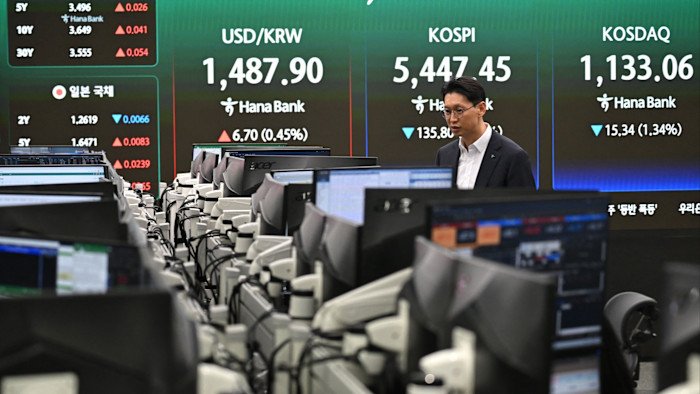
Unlock the Editor’s Digest for free
Roula Khalaf, Editor of the FT, selects her favourite stories in this weekly newsletter.
A senior bond trader in London admitted something unusual to me the other day: he’s scared. It takes a lot to spook really seasoned bankers who have survived more than their fair share of market crises and who know better than to panic. But the current market environment is deeply unnerving for him, not because the financial system is in freefall, but because it’s not.
Markets are, of course, on edge. The US-Israeli war on Iran has cranked the oil price higher and knocked both stocks and government bonds off their perch. Some arcane corners of the market ecosystem, like Korean stocks and short-term European government debt, have taken heavy blows and at times, bond trading has faced small interruptions.
Still, the key thing is how orderly it all is. This is alarming, the trader said. “There’s a degree of complacency. My biggest fear is the market is still working under the assumption that this will not get out of control.”
Everything hinges on whether the oil price sticks roughly where it is — $100 or so a barrel — or bolts even higher. Fund managers are looking to oil traders for answers. Oil traders are looking to geopolitical experts. Geopolitical experts are tracking the volley of contradictory statements from US officials, and wondering where Donald Trump’s limit on the oil price really lies. All of them are coming up with the same conclusion: we don’t know.
The key danger, of course, is that unlike the shock of supersized worldwide US trade tariffs nearly a year ago, Trump is not able to switch this off. Iran can very easily choke off global supplies of oil by keeping the Strait of Hormuz blocked, and its new leader, Motjaba Khamenei, has said he wants to do exactly that. Can he? Again, we don’t know.

This leaves investors dealing with scenarios rather than forecasts. Generally, oil at $120 to $130 a barrel is seen as a serious pain point for the global economy. Now, though, in a worst-case scenario, that could be just the start. “We have got economists modelling for $200,” said Kristina Hooper, chief market strategist at hedge fund group Man. “To me, markets are mispricing this. Orderly markets are masking vulnerabilities.”
Part of the problem is that history is at best a faulty guide. After all, Brent crude rushed as high as $139 a barrel in the surge after Covid and Russia’s full-scale invasion of Ukraine in 2022, and even higher in the Chinese economic growth surge before the financial crisis hit in 2008. We’re not even there yet, and we have not witnessed a near quadrupling in the oil price that was recession-inducing in the 1970s. Instead, we have something similar but different.
In fact, this is the case across several big strains in financial markets today. “In geopolitics, this is not the 1970s,” said Anton Eser, chief investment officer at Dutch asset manager Robeco. “In AI, this is not the dotcom boom. In private credit, this is not 2008.” He’s right. But we do have, he said, “a bit of each . . . That’s still not great.” And “you never have any idea what the trigger is” to flip investors from anxious to panicky.
It is well worth remembering that, pressing though the war in Iran is, it is not the only matter on investors’ minds. Doubts remain over whether AI represents an asset price bubble or a job-munching efficiency machine, or possibly even both, but we do know that the latest employment data from the US painted a worrying picture.
On private credit, the alarming headlines just keep on coming. Bad due diligence and lavish lending may still prove to be a feature rather than a bug of this industry, and news of funds blocking the exits of investors who want to get out is never a good look.
As one private markets executive stressed to me recently, the details matter here. There are good deals and bad deals, good managers and bad, and important intricacies around the terms under which end investors signed up for this debt. Babies are being thrown out with the bathwater, he said. That is all true. It is however also true that in a serious crisis, nobody cares. Any sentence that begins “actually, this isn’t like ‘08 because . . . ” is a bad place for any credit manager to be.
But perhaps the most alarming historical analogy is the most recent: the Covid crash of 2020. Then, crisis hit, markets recoiled and investors assumed the stress would quickly pass. Virus concerns were “fading”, sharp-suited Wall St analysts assured us, just a couple of weeks before disaster really struck. (As I noted at the time, the light at the end of the tunnel can turn out to be a train.)
In March 2020, with markets spiralling lower, the US slashed interest rates to zero on a Sunday night. The next day, US stocks dropped another 12 per cent.
It is not necessarily the case that we are in a similar Wile E Coyote moment now, dangling in the air waiting for gravity to strike. Hope springs eternal for a meaningful reopening of the Strait of Hormuz, and more importantly for peace in the Middle East. We do know one thing for sure, though: investors always think crises will blow over, and sometimes they don’t.
katie.martin@ft.com