dailynewsnblog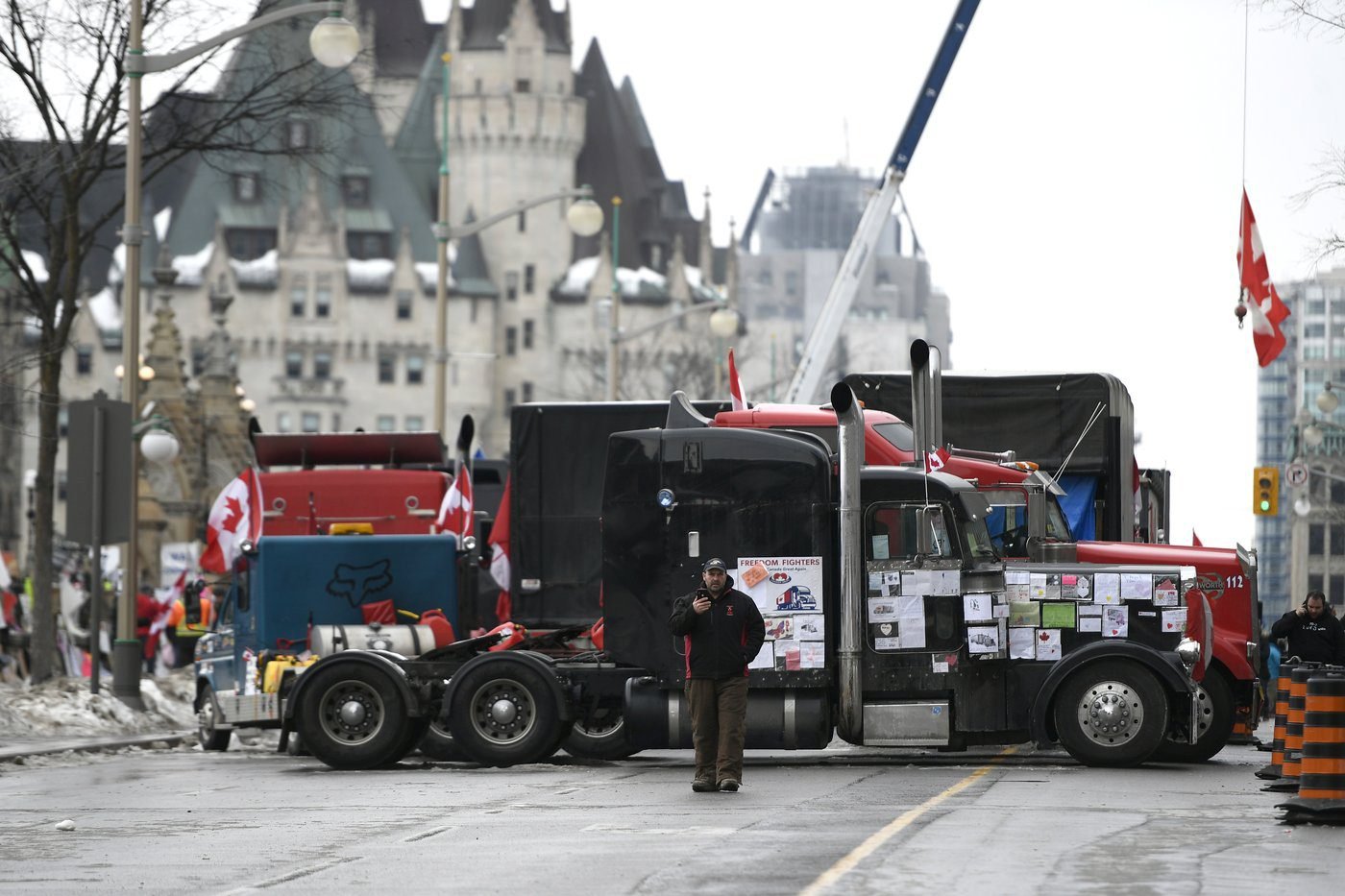
OTTAWA — The Federal Court of Appeal is set to rule today on whether it was reasonable for the Liberal government to use the Emergencies Act four years ago to quell protests in the national capital and at key border points.
For about three weeks in January and February 2022, downtown Ottawa was filled with protesters, including many in large trucks that blocked streets around Parliament Hill.
The usually placid city core was beset by blaring horns from big rigs, diesel fumes, makeshift encampments and even a hot tub and bouncy castle as protest participants settled in.
The influx of people, including some with roots in the far-right movement, prompted many businesses to temporarily shut down and aggravated residents with noise, pollution and harassing behaviour.
Trucks also jammed key border crossings to the United States, including routes at Windsor, Ont., and Coutts, Alta.
While many people demonstrated against COVID-19 health restrictions, the gathering attracted some with a variety of grievances against then-prime minister Justin Trudeau and his government.
On Feb. 14, 2022, the government invoked the Emergencies Act, which allowed for temporary measures, including regulation and prohibition of public assemblies, the designation of secure places, direction to banks to freeze assets, and a ban on support for participants.
It was the first time the law had been used since it replaced the War Measures Act in 1988.
In a Feb. 15 letter to premiers, Trudeau said the federal government believed it had reached a point “where there is a national emergency arising from threats to Canada’s security.”
The Public Order Emergency Commission, which carried out a mandatory review after the use of the act, concluded in early 2023 that the federal government had met the very high legal standard for using the law.
The Trudeau government’s move was also scrutinized in Federal Court.
The Canadian Civil Liberties Association and several other groups and individuals argued in court that Ottawa lacked sound statutory grounds to usher in the emergency measures.
The government contended the steps taken to deal with the turmoil were targeted, proportional and time-limited, and complied with the Charter of Rights and Freedoms.
Richard Mosley, the now retired Federal Court judge who heard the case, concluded the federal decision to issue the proclamation did not bear the hallmarks of reasonableness — justification, transparency and intelligibility — and was not supported in relation to the relevant factual and legal constraints.
Ultimately, there “was no national emergency justifying the invocation of the Emergencies Act,” Mosley said in his January 2024 ruling.
Mosley also said invocation of the act led to the infringement of constitutional rights.
The federal government appealed the decision.
Lawyer Michael Feder, representing the government, told the Federal Court of Appeal last February it was unfair of the judge to fault federal decision-making using “20/20 hindsight.”
That hindsight came during “the peaceful de-escalation that occurred in light of the emergency measures now being impugned,” he said.
“Who, outside of a courtroom, would seriously suggest the situation was going to get better in the absence of emergency measures?”
Feder said the government concluded it had reasonable grounds to believe the statutory preconditions for invoking the emergency measures were met.
The government’s conclusion “doesn’t have to be perfect,” he said. “It just has to be reasonable.”
This report by The Canadian Press was first published Jan. 16, 2026.
Jim Bronskill, The Canadian Press