dailynewsnblog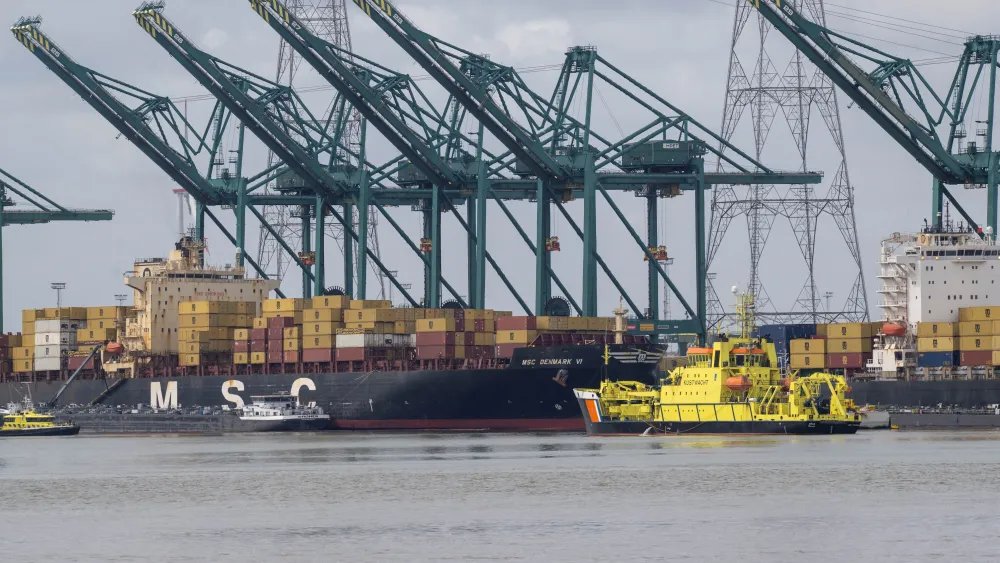
Shipping traffic in and out of Belgium’s Port of Antwerp-Bruges was heavily disrupted for several hours Friday morning after an overnight oil spill occurred at its largest container terminal.
The leak occurred during a bunkering operation in the Deurganck Dock involving the container ship MSC Denmark VI Thursday night. Despite initial containment measures, oil spread from the dock into the Scheldt River, completely blocking the access route from the port to the North Sea.
Due to the blockage, incoming and outgoing ships were at a standstill early Friday.
The Scheldt was reopened to shipping by 1:30 p.m. local time. As of 7:30 p.m. local time, 29 outbound and 25 inbound vessels were waiting to pass through, the port said.
However, the Deurganck Dock and its container terminal, the MSC PSA European Terminal, remain closed until further notice. The terminal has nine berths and over 12,000 feet of wharf, and has an annual handling capacity of 9 million 20-foot equivalent units (TEUs).
PSA’s Europaterminal and Noordzee Terminal were affected but remained open.
According to a statement, the port is prioritizing cleanup at all three terminals and the Berendrecht-Zandvliet lock complex, which also closed due to the oil slicks.
“Specialized vessels are actively engaged in cleaning up the oil,” the port said. “We are making every effort to safely and swiftly resume operations at these key locations and to minimize and resolve disruptions.”
The port hopes to be fully operational by Saturday.
“Normally, around 50 large seagoing vessels and a multitude of smaller inland vessels pass through daily, accounting for a total of about 100 to 200 ships per day. The economic impact is therefore significant,” Port of Antwerp-Bruges spokesperson Lennart Verstappen told Het Laatste Nieuws.
Several other Mediterranean Shipping Company (MSC) container vessels were in the vicinity of the spill, including the MSC Denmark V, the MSC Monterey V and the MSC Sara Elena, as well as several inland cargo ships. Directly involved oceangoing vessels were contained for active cleanup operations Friday morning, according to the port.
The CMA CGM Paranagua, MSC Anna Maria, and MSC Anshika VI were also berthed.
The Port of Antwerp-Bruges is the second-busiest gateway in Europe only behind the Port of Rotterdam, with total volume coming at 13.6 million TEUs in 2025. But the port has seen market share losses as more regional ports vie for competition as cargo flows increase.
According to Port of Antwerp-Bruges CEO Jacques Vandermeiren, the gateway saw its market share among rivals from Hamburg, Germany to Le Havre, France slip 1.2 percentage points to 29.3 percent. For the year, container volumes handled at the port only increased 0.7 percent.
Antwerp and Rotterdam have had to contend with more prevalent congestion woes in recent years amid increasing container volumes, ongoing labor unrest, as well as infrastructure strain responsible for inland transportation delays and bottlenecks.
According to a 2025 port performance survey released by supply chain emissions intelligence platform VesselBot in March, vessels remained at anchorage in Northern European ports 39 percent longer than they did the year prior.
That outpaced their Mediterranean counterparts, where vessels waited at anchorage 32.9 percent longer than in 2024.
Chinese and east Asian ports saw a 16.7 percent increase in time at anchorage, while the North American West and East Coasts saw the only decrease of the ports measure, with ships anchored for 21.7 percent and 9.5 percent fewer hours respectively, VesselBot said.
With hopes to relieve the congestion concerns, leadership at the Port of Antwerp-Bruges has said the recent disruptions have accelerated plans for about $6 billion in capacity expansion projects throughout the gateway.
In total, the port expects to add 7.1 million TEUs of container capacity, with construction expected to start this year, and finished by 2032.
The largest project is a second tidal dock that connects to the Deurganck Dock, as well as expansion of the Noordzee Terminal.
The port will construct at least five berths for inland container shipping, as well as an additional waiting area for trains and a new road. The project will also update nearby railways.
The Belgian government approved the rail and road infrastructure projects in October, but still must approve the construction of the container handling infrastructure. A decision is expected to be made this spring, with a public inquiry set to be organized after.