dailynewsnblog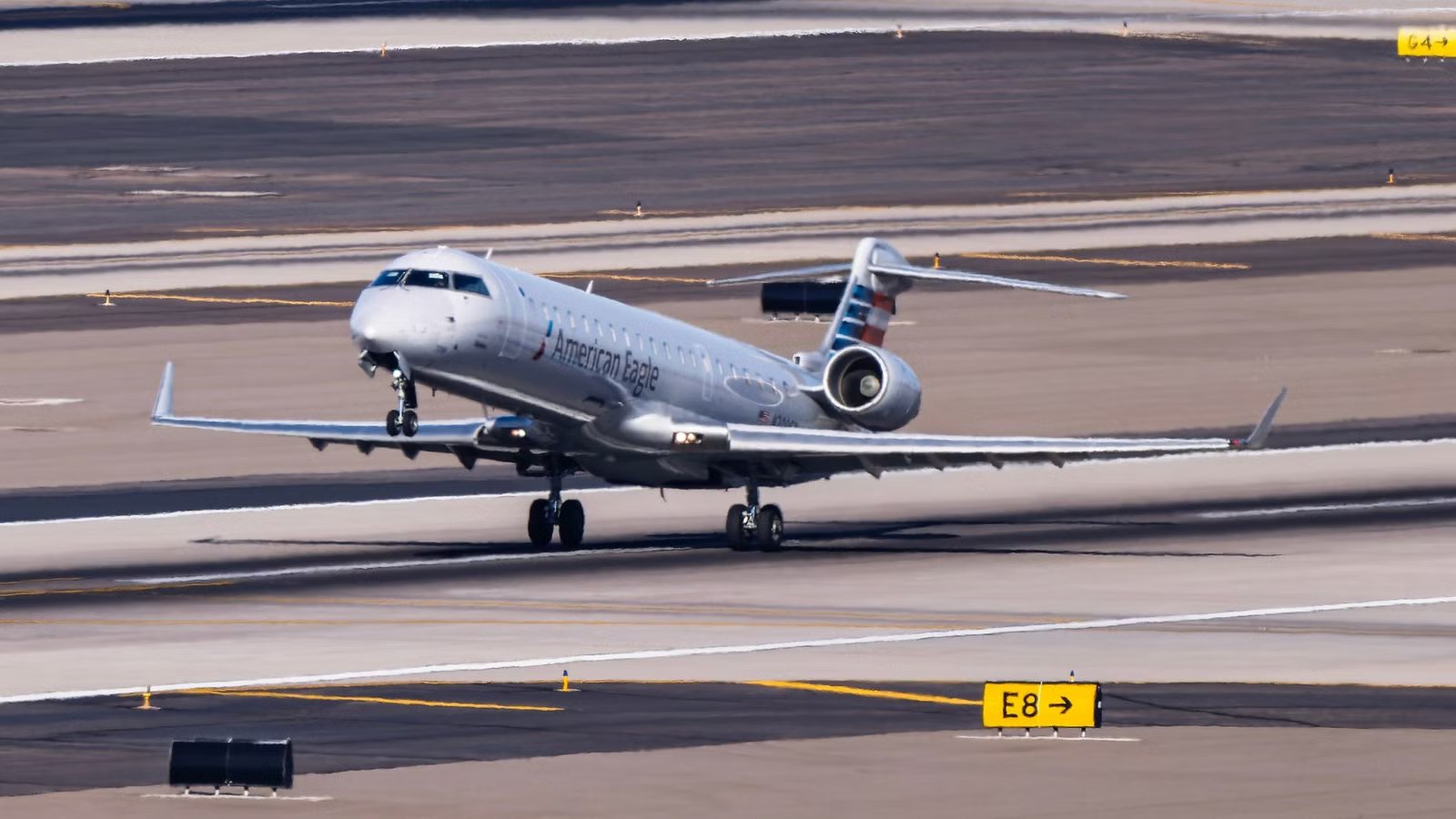
American Eagle Flight 5422, a regional service operated by a Bombardier CRJ700, turned a routine morning flight from Washington Reagan National Airport (DCA) to Portland International Jetport (PWM) in Maine into a scare when the aircraft diverted to Philadelphia International Airport (PHL). The emergency landing occurred not long after takeoff when the crew reported a nose gear steering issue.
The aircraft landed safely at Philadelphia International, with no injuries reported among the 64 passengers and four crew members on board.  American Airlines later said that customers were quickly reaccommodated on another flight while the aircraft was quickly removed from service for repairs. The incident appears to be a contained mechanical event rather than a major emergency, but it still shows how even minor landing-gear problems can quickly disrupt regional operations.
American Eagle Flight 5422 Timeline

The extremely basic timeline here is straightforward. American Eagle Flight 5422, a Bombardier CRJ700 operating from Washington Reagan to Portland, Maine, was originally scheduled to depart at 8:43 AM and touch down in Maine at 10:28 AM, but flight-tracking data shows that it actually departed slightly late from DCA, with a recorded wheels-up time of 9:16 AM. After departure, it appears that the crew reported a nose gear steering issue.
The FAA description of the incident that local coverage has cited refers to an extensive hydraulics problem, consistent with other descriptions. This issue then led the aircraft to divert to Philadelphia rather than continue on to Maine. Other reports have also said that the plane appeared to circle briefly before landing safely at Philadelphia International on Wednesday morning. No injuries were reported, 64 passengers and four crew members were onboard, and American Airlines has indicated that customers were later rebooked while the aircraft went in for repairs.
What Exactly Were The Impacts On Passengers Resulting From This Incident?

For airline passengers, the largest impact was disruption rather than direct physical harm. American has indicated in numerous reports that all 64 passengers and four crew members landed safely, but what should have been a short Washington-to-Portland regional flight instead turned into an unexpected and unplanned diversion to Philadelphia. This was likely not ideal for passengers who were hoping to get to Portland as quickly and efficiently as possible, especially business travelers on the CRJ700.
That would likely have meant understandable anxiety emerged in the cabin, especially once passengers realized that the mechanical issue was leading the aircraft to abandon its plans of continuing directly to Maine. Beyond the stress, this diversion also created a practical travel problem as people arrived in the wrong city, lost time, and likely missed ground transportation plans, meetings, or onward connections.
American has stated that customers were quickly provided with a new flight to Portland, which limited the longer-term fallout, but reaccommodation still means that customers had to wait, rebook, and deal with a much longer overall journey time than they had expected. In that sense, the human impact was mostly inconvenience, uncertainty, and overall delay rather than injury.

Disruptive Passenger Forces American Airlines Boeing 737 MAX 8 To Divert To Detroit
Disruptive passenger forces American Airlines 737 MAX 8 diversion to Detroit, prompting FBI response and highlighting rising unruly behavior trends.
A Fairly Standard Procedure

Based on multiple reports, the crew in this situation appears to have reacted in a normal manner. Once the aircraft experienced a nose gear steering problem after departing from Washington Reagan Airport (DCA), they chose not to press on to Portland. Instead, they chose to divert to Philadelphia, a large nearby airport with extensive emergency and maintenance support, and landed the CRJ700 safely. The aircraft is a workhorse for American Eagle.
That is exactly the kind of conservative decision passengers want to see in a mechanical event. They are instructed to identify the issue, stop the original plan, choose a suitable diversion field, and get the aircraft on the ground without taking on any unnecessary risk. The outcome in this scenario most certainly supports that reading.
All 64 passengers and four crew members managed to arrive safely, and there were no reported injuries. American was able to quickly reaccommodate customers while the aircraft was sent in for repairs. This all suggests a calm, procedural reaction to a fairly common kind of mechanical issue.