dailynewsnblog
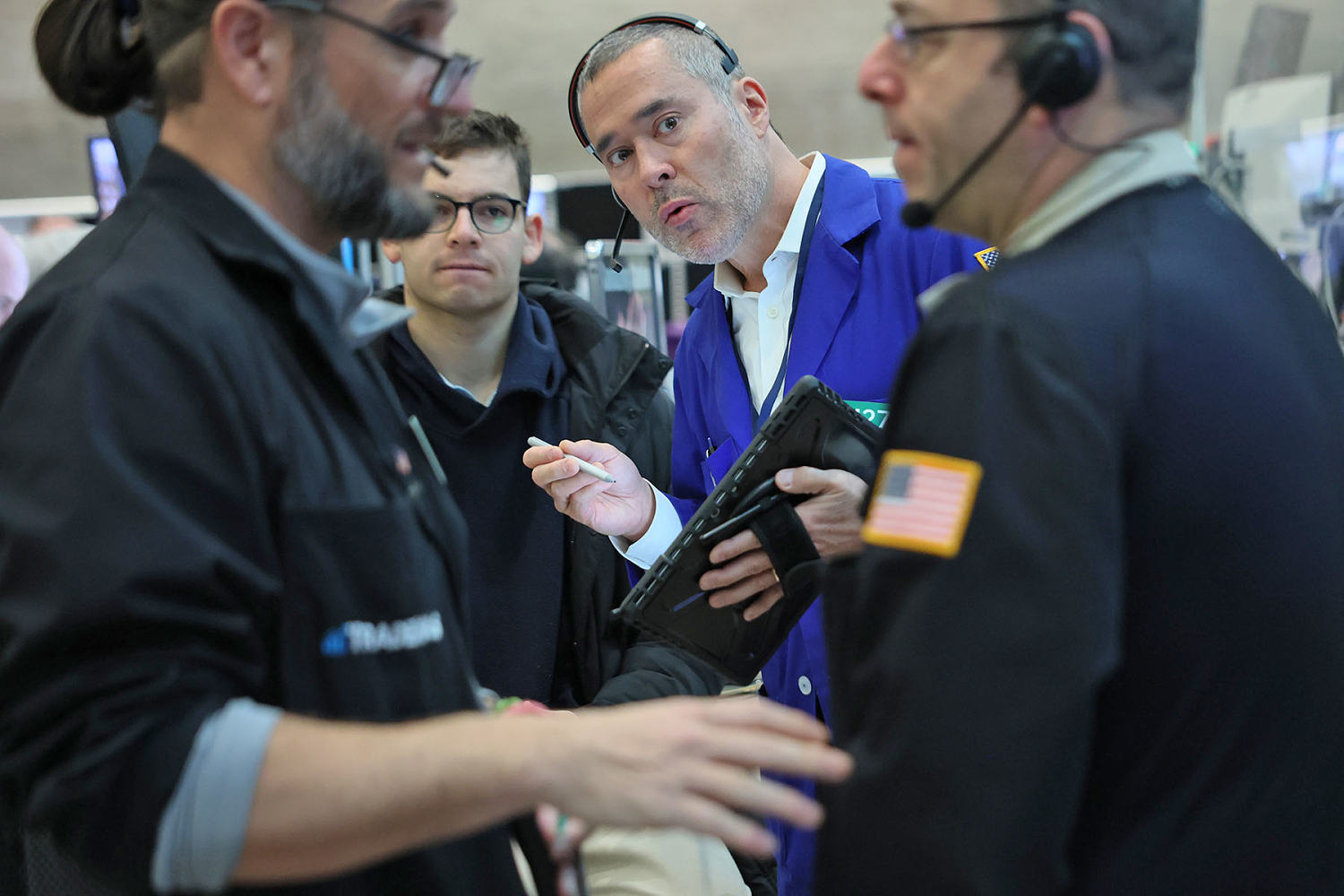
Stocks surged to records in large part because of hope — and hype — about artificial intelligence.
But in recent months, worries about aggressive spending on AI have rippled through Wall Street as investors question whether that spending will materialize into actual profits. And some industries wavered this week as anxieties about the technology intensified, underscoring how quickly sentiment has shifted since the start of the year.
Visa, Mastercard and IBM all fell sharply Monday, extending a broader bout of volatility across AI-linked names. Tuesday saw a modest bounce back across the markets as some software stocks also rebounded, thanks to new AI integrations announced by Anthropic. The benchmark S&P 500 index remains roughly flat for the year.
Since November, AI-powered coding systems such as Anthropic’s Claude Code and OpenAI’s Codex have surged in capabilities and popularity among software developers. Using these tools, complex software packages and products can now be developed in minutes or days.
The most recent sell-off came after a grim and now-viral weekend substack post by Citrini Research warned of an eventual stock market crash, a sharp pullback in consumer spending and widespread white-collar layoffs by 2028 as a result of AI.
Payment companies such as Mastercard and American Express were hit particularly hard as traders contemplated a future with lower spending. Both companies were mentioned as potential victims of the AI rush in the Citrini post.
While Citrini has published analysis about AI for years, Sunday’s post stood out for its intricate, dramatic description of a world with widespread unemployment and reduced economic activity.
On Monday, IBM suffered its worst, single-day drop since October 2000, during the height of the dot-com boom and bust. Part of the pressure followed Anthropic’s midday announcement that its Claude Code tool can be used to update a legacy computing language prized at IBM. Investors viewed the development as a potential threat to the kind of maintenance and modernization work that underpins IBM’s legacy business. Shares of Accenture and Cognizant Technology, two other consulting and professional service companies, fell in tandem.
The weakness in these individual stocks spilled over into the broader market. All three major indexes fell Monday, led by a more than 800 point drop in the Dow Jones Industrial Average. Five of the 11 S&P 500 sectors also closed in the red with financials and consumer discretionary leading the declines, down 3.3% and 2.2%, respectively.
It’s an irony not lost on Wall Street: The same force that’s fueled the tech sector’s explosive gains over the past two years is now driving investor hesitation.
Mona Mahajan, head of investment strategy and asset allocation at Edward Jones, said investors have been quickly pulling money out of sectors viewed as vulnerable to AI disruption, including financial services, real estate, transportation and logistics. She noted that despite the sharp moves in stock prices, the underlying businesses themselves haven’t materially changed, underscoring how much of the reaction remains speculative.
One standout in Monday’s sell-off was the consumer staples sector, home to companies such as Walmart and Coca-Cola, as investors put their money into stalwart businesses less likely to be disrupted by AI.
While Anthropic and OpenAI have seen their valuations soar in the past year, investors covering industries ranging from logistics and trucking to legal services are waking up to the fact that traditional barriers to entry for competitors might soon be dissolved by AI’s coding power.
Melissa Otto, head of Visible Alpha research at S&P Global, told NBC News that growing AI-focused capital expenditure and recent advances in the field threatened many existing business models.
“I think it has started to call into question how exactly software companies are really going to compete and provide something superior in this environment,” Otto said, highlighting that companies with more complex workflows and troves of unique data stand a better chance of withstanding the coming AI storm. “Data that underlies generative AI that has predictive qualities and is proprietary, that can potentially really give firms an edge.”
Beyond AI, markets are also contending with growing fears of war between the U.S. and Iran and the legal whiplash around President Donald Trump’s now-invalidated emergency tariffs. Still, some Wall Street analysts argue the latest trade developments could serve as a constructive distraction for U.S. markets in the near term.
“Investors have been ruminating on a number of AI concerns in early 2026, with concerns about cash flow, capex levels, and whether a number of different industries will survive the AI era,” Lori Calvasina, head of U.S. equity strategy research at RBC Capital Markets, wrote in a note to clients Monday.
“We generally have thought the existential concerns for industries other than software like wealth management and transportation/logistics have seemed overblown, and we think it would be healthy for the equity community to turn its attention to other topics for a while.”