dailynewsnblog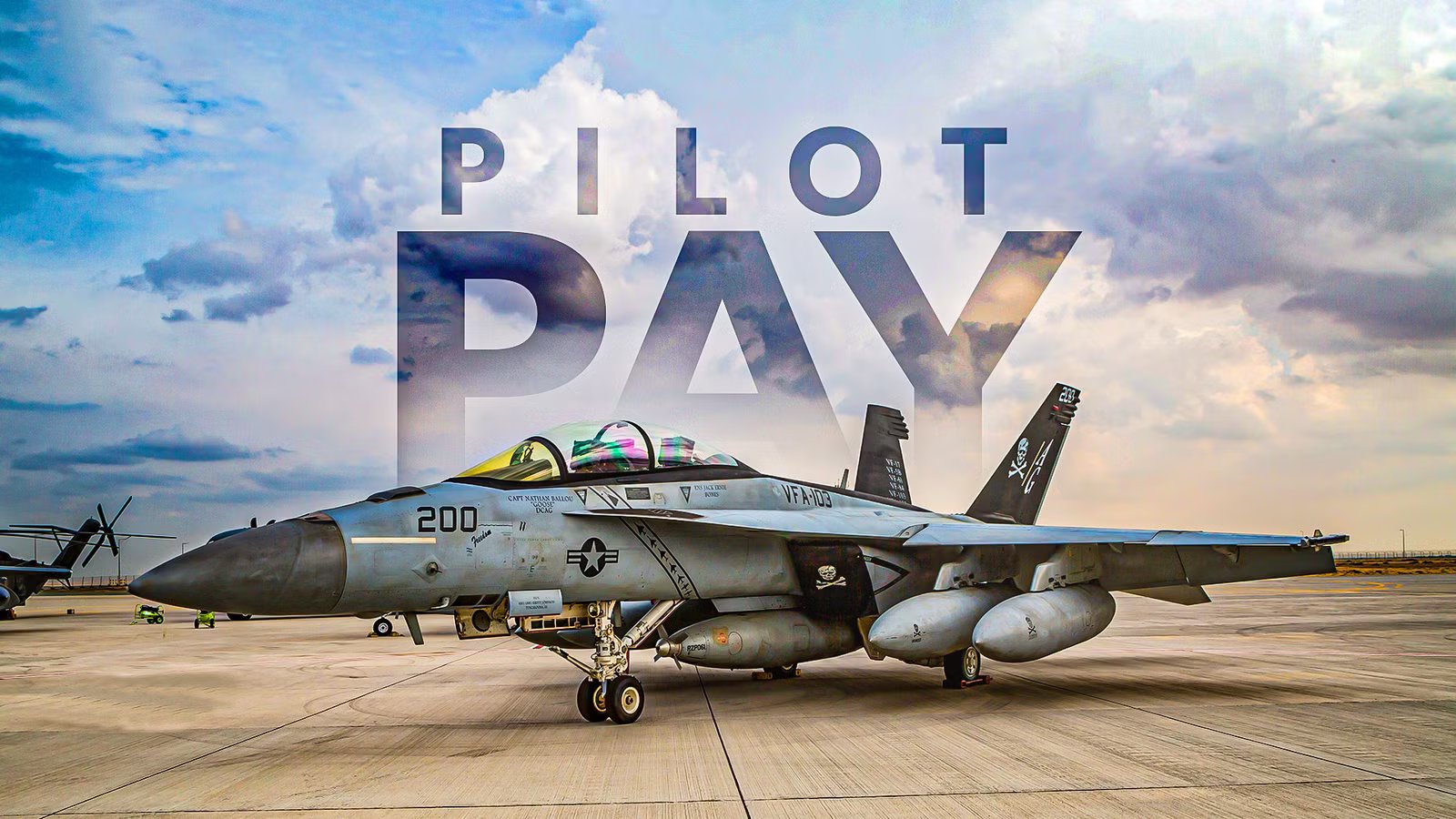
If you ask any pilot in the United States Navy, they would tell you not to join for the pay. When you sign on the dotted line to join the ranks of Naval Aviators, it is much more than just a job. Before you ever take the controls, there are years of training that come first in order to become a commissioned officer in the US Navy or Marine Corps. Even once you earn your ‘wings of gold,’ the duty of any Naval Aviator is to be a line officer first and a ‘fly boy’ second.
Donning the uniform is a commitment to the Constitution of the United States of America and a promise to honor hundreds of years of military legacy and tradition that come with it. The privilege that comes with being a Naval Aviator is flying some of the highest-performance and most cutting-edge aircraft in the world.
The service demands a great deal from every member in its ranks, but the reward is not only an experience that cannot be replicated any other way on Earth, but the pay isn’t bad either. Ultimately, before considering whether joining Uncle Sam is the right decision for you, you must consider many more aspects of the commitment than simply the paycheck or aircraft you may fly.
The Pros And Cons Of Becoming A Navy Pilot

Commercial airline pilots earn a higher salary ceiling than military aviators in general. At the same time, joining the Navy to fly has a nice entry-level value thanks to the strong starting salary combined with free flight training. The Navy invests roughly $1,000,000 per pilot for high-performance jet training. Meanwhile, civilian pilots often self-fund training, which can cost $100,000 or more, before earning enough flight hours to reach a major airline.
The price for that free flight school is the mandatory service requirement, which is longer than other military commitments as ‘payback’ for the free training that Naval Aviators receive after commissioning as officers in the US Navy or US Marines. Current Navy service commitments for aviation roles, effective March 2026, require a minimum of 8 years active duty for fixed-wing jet pilots and 6 years for other aircraft pilots (helicopters, propeller) and Naval Flight Officers (NFOs), calculated from the date of designation as a Naval Aviator.
Pilots and NFOs from Ensign (O-1) to Commander (O-5) rotate between flying tours and shore tours. That means that they will spend several months or longer on deployment every couple of years. They will also have to move to different bases and live for weeks or months at a time far from home on temporary assignments for training. Unlike the Navy, civilian pilots do not change geographic locations or job types every two or three years unless they choose to bid for new routes or bases.
By The Numbers: Monthly Pay Rates

While base pay is uniform across the Navy for a given rank, aviation-specific compensation includes Aviation Incentive Pay (AvIP), or ‘flight pay.’ Base pay is determined by rank and years of service. Flight pay is also based on years of aviation service and is not platform-specific. Aviation pay begins around $150 per month for new aviators and climbs to the maximum of $1,000 per month after a decade of flying in uniform.
Generally, there is no difference in base or flight pay based on the aircraft flown. A helicopter pilot and a fighter pilot of the same rank and seniority earn the same standard pay. Significant differences arise during mid-career retention phases. Fighter pilots (VFA) or specialized roles may occasionally be offered higher Aviation Bonus (AvB) amounts compared to other platforms, depending on current Navy manning requirements. Below are estimated monthly base pay ranges for typical aviation ranks:
|
Pay Grade |
Monthly Salary Range |
|---|---|
|
O-1 (Ensign) |
$4,150 to $5,222 |
|
O-2 (Lieutenant Junior Grade) |
$4,782 to $6,618 |
|
O-3 (Lieutenant) |
$5,535 to $7,737 |
|
O-4 (Lieutenant Commander) |
$6,294 to $8,332 |
|
O-5 (Commander) |
$7,295 to $9,250 |
Both pilots and NFOs are commissioned officers and receive the same base pay for their rank and the same flight pay rates based on their years of aviation service. Officers also receive non-taxable allowances for housing (BAH) and subsistence (BAS), which can add tens of thousands of dollars to total annual compensation depending on location. While their standard pay is identical, the AvB amounts offered at the end of initial service commitments may differ between pilots and NFOs based on the specific personnel needs for each community.
Life On The Flight Deck

Once you have officially reached the completion of all necessary training and officially joined an active squadron in the US Navy, the life of a fighter pilot is a balancing act between tactical proficiency and frontline leadership. It falls on every officer to drive for the greatest level of professional excellence as both a pilot and a leader of sailors and Airmen. Every officer in a squadron has a ground job.
As you promote, the weight of these jobs often eclipses your time in the cockpit. Workups to deployment on the carrier mean months of grueling training away from home in Fallon, NV, or on the ship to prep for deployment. Days are regularly 12 to 16 hours long. Deployment is nine months or longer on ‘the boat,’ or carrier, where you live in a stateroom the size of a walk-in closet with one to three other pilots.
The silver lining to all this back-breaking work is that flying in the Navy is one of the most elite professions in the world. Landing a fighter on a moving carrier at night in bad weather remains the most stressful part of the job, regardless of rank. Even the commanding officer feels the adrenaline going in for a ‘night trap.’
The Ready Room is the heart of the squadron. It’s a place of intense professional criticism and dark humor. After every flight, there is a debrief where rank is largely ignored; if the CO made a tactical error, a JO is expected to point it out. This ‘humble, approachable, credible’ culture is what maintains safety in a high-risk environment.

How Hard Is It To Become A Blue Angels Pilot?
Exceptional flying skills aren’t the only thing you need to be a part of the US Navy’s elite aerial demonstration team.
Life At The Pointy End Of The Spear: Navy Strike Fighters

Being a Navy fighter pilot is considered by many to be the pinnacle of aviation because it combines extreme physical environments with a high-stakes, intellectual chess match. Navy fighter pilots operate a diverse fleet of advanced jets, ranging from fifth-generation stealth fighters to specialized electronic warfare platforms.
As the latest and greatest to join the fleet, the Lockheed Martin F-35C Lightning II is the world’s first carrier-capable stealth fighter. Meanwhile, the legacy ‘Rhino,’ or Boeing F/A-18E/F Super Hornet, is still the backbone of the fleet as the workhorse multirole strike fighter. There is even a specialized version of the Super Hornet dedicated to electronic warfare, the EA-18G Growler.
Often described as a ‘controlled crash,’ landing an F/A-18 or F-35 on a pitching deck in the middle of a dark ocean is the ultimate professional benchmark. Accelerating from 0 to 170 mph in two seconds during a ‘cat shot,’ or catapult launch, is a physical sensation civilian pilots never experience. It is an ‘all-systems-go’ moment where you are a passenger to physics until the jet clears the bow.
Then there is the ‘TOPGUN’ school, officially known as the US Navy Strike Fighter Tactics Instructor (SFTI) program, a graduate-level course for experienced fleet aviators. The course currently lasts roughly 13 weeks and is constantly updated to address emerging global threats. After graduating and earning the red-and-blue TOPGUN patch, you do not immediately go to combat. Instead, you are sent back to the fleet or a specialized Weapons School to teach the latest tactics to your squadron.

What Is The Typical Salary For A Fighter Jet Pilot In The US?
Fighter pilots are exceptionally well-paid.
The Pipeline: Needs Of The Navy

The process of platform assignment is a merit-based system driven almost entirely by the ‘needs of the Navy.’ While individuals submit a ‘dream sheet,’ the selection is a bureaucratic exercise in data and personnel management. If you have always dreamed of flying a fighter jet, and you happen to pass through training at the wrong time, and there are no billets available, you will have no choice but to fly a different platform, and there is no recourse.
Similarly, even after advancing past platform selection, when it comes to choosing squadrons and locations, the dream sheet won’t get you very far if the Navy doesn’t agree. You may want to go to California or Japan, but those squadrons have full rosters, meaning you will be assigned to a squadron in Virginia, and there is nothing you can do to change it.
The initial selection process happens at the end of primary flight training, which is completed in the Beechcraft T-6B Texan II turboprop. A comprehensive score based on all the training evolutions completed up until this time, including academic tests and simulator performance as well as in-flight grading, is used to compare all students on a bell curve. The lack of control is often a shock for service members.
Students submit a list of their preferences, and on selection day, the training team is given a list of available slots from the Pentagon. You could be the top student in your class, but if there are zero jet slots available the week you finish primary, you will be assigned to a different platform regardless of your talent or desire. Once you are ‘pipelined’ into a platform, it is extremely rare and difficult to ‘cross-deck’ to another community (like jets) later in your career. You are effectively locked into that community for the duration of your service.

This Air Force Is The World’s Largest In Terms Of Pilots
The USAF commands the world’s largest pilot corps — 14,486 strong — and here’s how many aircraft they fly and how to join their elite ranks.
The Difference For Naval Flight Officers

The Naval Flight Officer (NFO) pipeline is a specialized, multi-stage training track that, while sharing a common starting point with pilots, quickly branches into distinct tactical specialties. All student NFOs (SNFOs) fly the T-6A Texan II at NAS Pensacola. Unlike pilots, who prioritize stick-and-rudder skills, SNFOs focus on visual and instrument navigation, communication, and basic airmanship from the back seat.
In many multi-crew aircraft like the Boeing P-8 Poseidon or Northrop Grumman E-2 Hawkeye, the NFO often serves as the Mission Commander, meaning they have tactical authority over the mission even though they are not flying the plane. NFOs follow the same promotion boards as pilots and can command squadrons, carrier air wings, and even aircraft carriers.
If you are a high-performing student who wants strike fighters, but the Navy is currently overmanned in that area, you will be assigned to a P-8 or E-2 slot regardless of your preference. This can happen as late as graduation day of a specific phase. While programs like the NFO-to-Pilot Board exist, they are extremely competitive, typically selecting only a handful of officers per cycle.