dailynewsnblog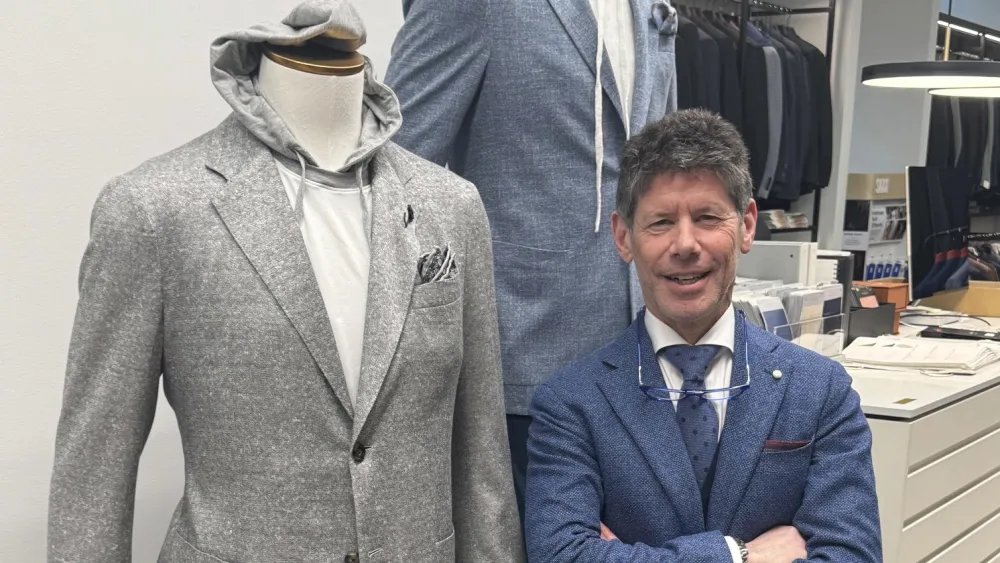
Like deep dish pizza and the Cubs, Syd Jerome is a Chicago institution.
The specialty store has dressed the men of Chicago since 1958, surviving the trials and tribulations that have taken down many of its competitors. Now in its second generation of ownership, the retailer attributes its success and longevity to creating lasting relationships with its customers, many of whom have been shopping at the store for generations.
Here, Scott Shapiro, son of the cofounder, talks about the store’s history, its unique positioning and his plans for the future.
WWD: Was there a real Syd Jerome?
Scott Shapiro: Sid was my father, Sid Shapiro. He had a partner, Jerome “Jerry” Frishman — they were introduced by vendors. Jerry worked for another men’s store. It was called Mac Turner’s on Morse Avenue. There were a few of those stores, but all under the Turner moniker. My father worked for a store called Smoky Joe’s — it was the hip store. You know, colored shirts that matched the suits that matched the shoes that matched the belt. People would line up on Saturday and Sunday and their Cadillacs would be out in front. You’d have all the hip-hop artists, actors — it was the place. After my father and Jerry met, they opened a small store at 46 South Clark Street, and they called it Syd Jerome. They changed the spelling of my dad’s name and used Jerome because it sounded a little more cosmopolitan, as opposed to a deli or an ice cream brand. That was in 1958.
WWD: How long did they work together?
S.S.: Around 1982, Jerry came to my father and said he wanted out. He had just recently gotten remarried, and she thought that Syd Jerome wasn’t glamorous enough, and wanted him to pursue something a little more fashion oriented. So they moved and opened up a store on Oak Street, which was where Ultimo was, and now has the Moncler and Prada stores — it was a small stretch of more “designer-esque” stores. My father, over a period of time, bought him out.

Syd Jerome founders Sid Shapiro and Jerry Frishman
Courtesy of Syd Jerome
WWD: Were you in the business at this point?
S.S.: No. I was working for the accounting firm of Coopers & Lybrand, which morphed into PwC. My older brother had just made partner in a law firm, and our younger brother was still in college. So I was the obvious victim. In 1984, I was the only one who was advanced enough in my career to make a change. My dad approached me and said, “I want you to come into the business.” We had two stores at the time and he said that if I would come into the business, we could both take it a little easier — we could take days off. We were open six days a week, and it was funny how it happened: He started taking days off, and I never got a day off and I don’t think I’ve had a day off since. But he worked up until the day he died in 2018.
WWD: Was it always a men’s-only store?
S.S.: Yes, it was always a men’s branded store. It’s a multibrand store. They started off in the ‘60s with Geoffrey Beene and Bill Blass, and all the brands of that era. As new fashion brands came out, they were always on the cutting edge. They brought in Yves Saint Laurent, Pierre Cardin, Tiger of Sweden — they were always ahead of it. And then the next wave of brands came out: Hugo Boss, Giorgio Armani, Zegna, Claude Montana, Romeo Gigli, Katharine Hamnett — I could go on and on, because they were never afraid to try something new. And we’ve tried to stay true to that mission: keep evolving, keep looking for new brands.

Syd Jerome has always been a men’s-only store.
Courtesy of Syd Jerome
WWD: You’re in Chicago, where there’s a lot of competition.
S.S.: Being in a major market, with all the department stores and the branded stores, I’m almost forced to go out there and find new and exciting brands. If you’re in a smaller market, you could cater to your clientele who are asking for those commercial brands because you don’t have a Neiman Marcus a half a mile away, or Saks or a Nordstrom or even a Nordstrom Rack. So every season I try to bring in something new. I like going to market. I get really excited when I find something new or create new projects. I guess that’s what keeps us interesting — although we still are committed to our major brands like Brioni, Canali, Etro. We have our core nucleus but for spring, I’m bringing in Stefano Ricci. I sat with Julian [Balea, executive vice president of the Americas] last year for about an hour and got the whole story about Ricci, which was fascinating. I don’t understand it, but it’s a cult, and it pairs well with what I do with Brioni.
WWD: So you bring in brands that work well within your existing assortment?
S.S.: Yes, I try to bring in brands that complement the brands I’m already carrying at the same price point. So you never have to trade a customer down. There are always complementary brands: for Canali, there’s Corneliani; for Isaia, it’s Armani Black Label; for Jack Victor, it’s Samuelsohn. If I don’t have a blue suit from Samuelsohn, I can’t trade the customer up to Canali. But I don’t have to. I put them into a Fedeli blue suit. That’s always been my philosophy.
WWD: How much of the business is still tailored clothing?
S.S.: If you’re considering sport coats and soft jackets, it’s probably still about 80 percent. We’ve established ourselves as a tailored clothing store. We still employ eight tailors. Most of my contemporaries have a hard time finding one tailor, let alone eight. And I’ve got a pool of part timers so I could comfortably support 10 tailors in my tailor shop — I have enough machines and workspace.
WWD: Even though tailored clothing represents the bulk of your business, what sportswear brands do you carry and is that a category that is gaining in importance?
S.S.: We carry elevated sportswear, or lifestyle pieces, that mirror tailored clothing. For example, Lardini offers a knit, double-breasted jacket that resembles a sport coat, or a collared overshirt or “shacket” can replace a sport coat in a formal setting. Maurizio Baldassari is a popular brand we carry. Brioni coined the term “Jardigan” for a jacket and cardigan. We’ll style a jersey jacket with no shoulder pads layered over a hoodie. These pieces are functional and relaxed, but still full fashion, so sportswear is a bit of a misnomer.
WWD: Over the years there have been a lot of other men’s stores in Chicago, but a lot have gone out of business. What has helped you survive?
S.S.: We’re the only multibrand, independent high-end store in the city of Chicago. But it’s not that dissimilar from New York. The business was cannibalized by the department stores and the brands opening up their own stores. What saved me is the fact that I’m in downtown Chicago, where we’ve created a weekday business and a daytime business. I probably couldn’t coexist if I was on Michigan Avenue because of the competition. But I’m downtown, and nobody wants to open a store downtown. It’s five days a week, no weekends, no evenings. Who in their right mind is going to open up a store with that kind of traffic? But because we’ve been there for so long, we’ve carved out this niche. We’re able to exist.
WWD: The city also designated a Syd Jerome Way. When was that?
S.S.: We’ve been at 2 North LaSalle Street since 2008. It was tied to our 50th anniversary.

The city designated Syd Jerome Way in 2008 in honor of the store’s 50th anniversary.
Courtesy of Syd Jerome
WWD: Is your customer the businessman?
S.S.: Unfortunately, we don’t have the same number of businessmen walking by the store on a daily basis that we did pre-pandemic. We’ve become more destination. But there are still enough legal, financial and corporate guys that still come to the office, that still dress, that have been customers for, in some cases, four generations. That’s what you see in this business.
WWD: You managed to survive the pandemic despite the fact that no one was going to their offices or dressing up.
S.S.: It was daunting during COVID. The big media push was to support your local restaurants. I had to figure out a way to get people to support me. So I sent out a letter talking about all the years we’d been there, and the relationships, and how we’re all in this together. I started a campaign where, if you purchased a gift certificate for $500 or greater, you would get a certificate for 50 percent off one item. I sold about $350,000 in gift certificates. People bought gift certificates in $10,000 denominations. I had one customer who would call me once every two weeks and ask me what he could buy. I told him, “I appreciate everything you’ve done for me, but there’s virtually nothing you need.” He came back and said, “Well, why don’t we give all my male employees a wardrobe allowance for Christmas?” At the time, it was $2,500. He said to give the guys the certificates in July and call it Christmas in July. Then his assistant called and said he wanted to give everybody $5,000. It was 20 guys. And he followed that up at Christmas with another $5,000.
WWD: That’s quite the loyal customer.
S.S.: He still does it to this day — every Christmas. Plus, he buys Brioni for himself. He’s my biggest customer.
WWD: How big is your store?
S.S.: It’s about 4,000 square feet of selling with another 3,000 square feet of support: storeroom, tailor shop. I also built out an event space with a bar. This is actually the fifth location we’ve had in downtown Chicago — all within a two-block radius. When you run events, you cater them or bring in lunch for trunk shows and you watch people walking around spilling things. So I built out this event space to bring food into and say: “Lunch is downstairs, don’t mess up.”

Syd Jerome has been in Chicago’s downtown for decades.
Courtesy of Syd Jerome
WWD: Did you ever carry womenswear?
S.S.: No. The only women’s I ever had was Canada Goose. We’ll showcase women’s with some of our vendors during trunk shows, but you’re either all-in or you’re not. I barely have enough time to buy men’s. And as we know from some of our contemporaries, women’s can be either great or awful. If I can’t be great at something, I sure as hell don’t want to be awful. You have to be committed, and I know my shortcomings. I’ve gone shopping with my wife and I don’t understand how women shop. I’ve always shopped like a man: I need to replace this shirt, so I go out and I buy that shirt. We have consumers, not shoppers. A shopper is somebody like my wife who will go into a store and look through a rack of stuff and say, “I don’t see anything I like.” And I say, “You didn’t look at anything. You didn’t pull anything out. You didn’t try anything on.” Our guy comes in and he stands there and we present things to him. He says, “Let me try that on. It fits great, what other colors do you have?” That’s the consumer mentality. I couldn’t deal with a shopper mentality.
WWD: With the fact that so many other stores are gone and the trouble with Saks and Neiman’s, have you seen an uptick in your business?
S.S.: Not yet. Everybody in the industry knew what was happening but the public didn’t know. January started off great, but then we got a white-out blizzard. That was followed by 30-below wind chill and then more snow, more wind chill. So it really impacted business after coming off a great December. But that’s the pitfalls of our business. We don’t know what tomorrow brings. The good thing about my business is the bad thing about my business: My customers have money, and they have the ability, when it gets cold, to say bye-bye. They go to their second home — or their third home.
WWD: Has business picked up?
S.S.: Chicago spring hasn’t come early this year, and any season that arrives early sells early. We have, however, been selling a lot of sophisticated knitwear and layering pieces. The sweater jacket by Ferrante is popular right now.
WWD: You mentioned that many of your customers are multigenerational.
S.S.: Yes, some of these people have been shopping with me for probably 30-odd years. I would say 90 percent of our business is relationship-based. It’s very rewarding. The campaign I started during COVID has morphed into a campaign around December that is like the restaurants, where if you spend $100, they’ll give you a $20 certificate. Well, I’ve taken it one step further. I’m not a Christmas store or a holiday store because we don’t promote, we don’t have Black Friday deals, we can’t get into the price game, so I do a gift certificate campaign. I start at Black Friday. For a $100 gift certificate, you get a $20 bonus. For $500 you get $125 and for $1,000 you get $300, so I have customers who will buy 10 $1,000 gift certificates. If a guy’s son is getting married, he knows he’s going to come in and buy a bunch of tuxedos, Friday night stuff and accessories. So he figures this way he’s got $300 off each tuxedo, because we make bonus applicable to one item. This December, we did probably close to $200,000 in gift certificates.

Sid Shapiro with Sam Zell
WWD: Where do you see the business in the future? Are there any other family members in the company?
S.S.: I’ll be 67 this year. My son is an assistant Illinois attorney general, and my daughter moved to New York and her goal is to go to Fordham for law school. So I don’t see either one of my kids coming into the business anytime soon. But I don’t plan on going anywhere. You know, I’m at this stage in my career where I do it for the enjoyment. I like the people. Last night, I was at dinner with Andrea Lardini, and he was at the store today. I went to visit the factory and I’m going back there. He wants to go fishing. I’ve been to Sant’Andrea, I’ve spent a weekend on the beach with the Ferretti family. I’ve gone to the American consulate in Florence. It affords us a lifestyle that we probably couldn’t have anything else. And it affords me relationships with customers that we probably wouldn’t have if we weren’t in the business. When my father was going through the buyout and money was tight, we used to stay at Sam Zell’s apartment in New York because Sam was a friend and a customer for years. His father, Bernie, used to shop with my father, and so Sam would just send over the keys every time we went to market. I still stay at Hyatts because of our relationship with the Pritzker family. Nick and Penny Pritzker shopped at the store, and all the Hyatt management shopped at the store. And to this day, we still have a relationship with the Hyatt people. Plus you eat well in this industry.
WWD: Do you have a mentor?
S.S.: My dad was my greatest mentor. I remember going to the Merchandise Mart with him and meeting other men’s fashion icons like [the late sales representative] Jerry Karm and [St. Louis men’s retailer] Sam Cavato, who also became mentors. All three had a passion for business that shaped the industry — true visionaries. Now I look up to Andrea Lardini — they’ve built an empire in such a short period of time as a manufacturer.

Scott and Sid Shapiro
Courtesy of Syd Jerome
WWD: Are there any retailers you admire?
S.S.: I just returned from a trip to Miami to meet with Stefano Ricci. We’ll be the only store in the Midwest to carry their brand, as they’re partnering exclusively with other premier retailers. I’m impressed with the direction they’ve taken their stores and their overall brand — and again, in such a short amount of time.
WWD: How do you stay relevant?
S.S.: Just keep evolving. But it’s hard — everybody’s an armchair quarterback. Everybody’s got their opinions of how to bring in business. Whether it’s marketing or social media or fashion shows, we’ve tried it all, but what works best is relationships. I’ve always said there are three forms of growth. There’s the generational growth I talked about with the weddings and bringing in their kids. There’s word of mouth from people you have relationships with who refer you. Then there’s the organic growth with people who find you on Google or walking by the store. But the strongest is the word-of-mouth and the generational growth because they already know the brands we carry. They know the price points. There’s no surprise or wow factor. You know they’re coming in strictly to buy. I’ve got a lot of people out there advocating for me. And it doesn’t hurt being a homegrown product. I was born in Chicago. My brothers were born in Chicago. My father was born in Chicago. I went to University of Illinois. My brother went to University of Illinois. I was president of youth groups. My younger brother had restaurants in the city. My older brother was an attorney. He’s now in private equity, and everybody knows him.
WWD: You really are firmly entrenched in the city.
S.S.: Yes, between the local affiliations, school or through business. When we were growing up, I went to University of Illinois. Why? Because it was cheap, and our parents couldn’t afford anything else. It was $418 a semester. My father said I could go to any state school I wanted to — I didn’t even know there were schools in Ohio or Kansas until my kids start looking at schools. I knew the Big 10, and the California schools, and the Ivy League, and that was about it. So everybody went to Illinois, and as a result, everybody came back to work right after, either at the Board of Trade or the Mercantile Exchange, a law firm, an accounting firm, a bank. My friends are retiring, leaving me behind. I could be the last man standing.