dailynewsnblog
When frequent flyers and corporate travelers evaluate transoceanic business class options, the rivalry between  Delta Air Lines and
 United Airlines is where the definitive battle for premium comfort is playing out. Choosing between Delta One and United Polaris directly impacts every facet of an international journey, from dedicated ground check-in hubs to airborne sleep quality. With both carriers rolling out major fleet enhancements, cabin upgrades, and ultra-lounge concepts in 2026, the product rivalry has never been stronger.
This article will explore the core differences in hard product architecture, ground lounge accessibility, and route consistency across both airlines’ fleets. Taking a look at recent cabin modernizations, such as United’s introduction of the Boeing 787-9 United Elevated interior featuring Polaris Studio suites and Delta’s expansion of dedicated Delta One Lounges, you will have a much better understanding of what the real differences are between these two giants.
Fleet-Wide Consistency

As is the case with any airline around the world, the true experience of any premium product depends heavily on the specific aircraft and route you book. Delta Air Lines maintains an edge in cabin-wide design consistency and ground hospitality on select flagship routes, led by Delta One Suites equipped with sliding privacy doors and ultra-exclusive Delta One Lounges at hubs like  New York JFK Airport(JFK) and
 Los Angeles International Airport (LAX), as reported by Simple Flying.
United Airlines counters with unmatched network breadth and massive international coverage, ensuring that its core Polaris product is widely available across its entire widebody fleet of Boeing 777s and 787 aircraft. Furthermore, United’s 2026 deployment of its United Elevated 787-9 interiors, featuring front-row Polaris Studio suites with 27-inch 4K screens and sliding privacy doors cleared by the FAA, closes the hard-product gap on premier global corridors like  San Francisco International Airport(SFO) to
 London Heathrow Airport(LHR), as highlighted by Business Traveller.
Historically, US legacy carriers have positioned long-haul business class as a simple seating upgrade over domestic economy, but the post-pandemic boom in premium demand was the spark that turned these cabins into flagship revenue drivers. Delta responded by investing heavily in bespoke ground infrastructure and privacy doors, while United focused on standardized direct aisle access and a robust network of six dedicated Polaris Lounges across major domestic hubs.
Product Or Routes?

Choosing between Delta Air Lines and United Airlines is really a case of pitching hard-product enclosure against network consistency and lounge availability, as highlighted in comprehensive analyses by Business-Class.com. While marketing materials often highlight the newest flagship suites, real-world experience depends heavily on specific aircraft assignments, hub positioning, and overarching travel priorities.
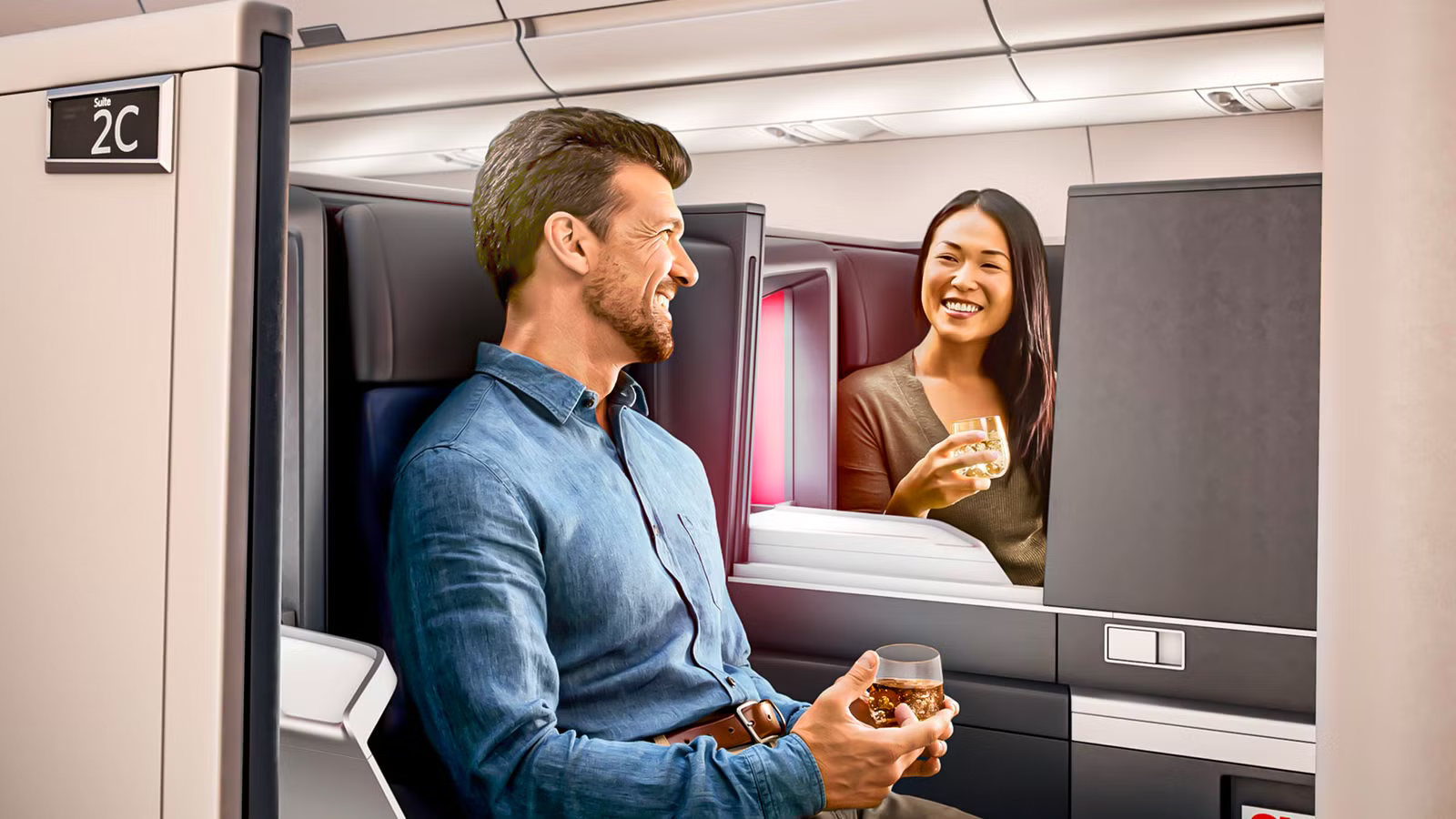
Delta One leans heavily into absolute cabin privacy and upscale boutique aesthetics, deploying fully enclosed Delta One Suites with sliding privacy doors on flagship aircraft like the Airbus A350 and A330-900neo, complemented by ultra-exclusive Delta One Lounges at JFK, LAX,  Seattle-Tacoma International Airport (SEA), and
 Boston Logan International Airport (BOS). In contrast, United Polaris emphasizes sleep-optimized consistency and expansive network availability, pushing its experience with a direct aisle access configuration across its entire long-haul widebody fleet and six dedicated Polaris Lounges across major hubs like
 Newark Liberty International Airport(EWR) and SFO, as noted by Simple Flying.
On a route such as  Chicago O’Hare International Airport(ORD) to
 Frankfurt Airport(FRA), United provides the immense advantage of a seamless Polaris Lounge experience right at its Midwestern hub and a highly predictable hard product on its 787 aircraft. Conversely, a premium passenger departing LAX for Tokyo on Delta can experience the pinnacle of enclosed suite luxury and fine-dining options at the LAX Delta One Lounge, provided their specific flight is scheduled with a modern A350 rather than a legacy configuration. These operational nuances demonstrate why examining specific route timetables and equipment types is essential before committing to an itinerary.
Positive Reactions To Both

Aviation industry analysts and airline executives both acknowledge that long-haul business class has shifted from a pure seat-pitch battle to a holistic ecosystem strategy. United Airlines executives have emphasized that the biggest strength of the Polaris brand is its predictability, a product that consistently gives long-haul travelers on widebody aircraft the same seat geometry regardless of whether they fly out of London, Tokyo, or San Francisco.
Reviewers at The Points Guy consistently point out that while United’s core Polaris seat lacks a door, its layout provides excellent ergonomics and reliable bed space. Meanwhile, Delta’s strategy is all about flagship luxury and offering the best ground hospitality, as demonstrated by the opening of its multi-story Delta One Lounge at New York-JFK. Reviewers praise the lounge’s high-end brasserie dining, wellness suites, and dedicated valet services, calling it one of the premier airport lounge experiences in North America.
For businesses seeking reliable schedule density and broad international reach across Europe and Asia, United Polaris would be considered the product of choice. Conversely, for premium leisure travelers and executives prioritizing absolute door privacy and top-tier lounge dining on specific flagship corridors, Delta One retains a compelling, high-end appeal.
Joining Up With Global Partners

Looking beyond the domestic rivalry between Delta Air Lines and United Airlines, both carriers operate within massive international joint-venture alliances that greatly shape their product delivery. Delta’s deep integration with  SkyTeam partners like Air France-KLM and Virgin Atlantic allows passengers booking a Delta One codeshare itinerary to fly on an
 Air France A350 featuring its newest business class suites or Virgin Atlantic’s A330neo Upper Class, as highlighted by Simple Flying. Similarly, United’s
 Star Alliance ties Polaris into seamless transatlantic and transpacific networks alongside partners such as
 Lufthansa, All Nippon Airways, and
 Singapore Airlines.
However, relying on joint-venture partners introduces the recurring challenge of hard-product inconsistency. While booking through Delta or United maintains familiar elite earnings and ticketing policies, traveling on an alliance partner’s widebody aircraft means encountering entirely different seat maps, dining concepts, and lounge access rules. For example, a traveler on a United-marketed flight operated by Lufthansa might end up on an aircraft with older business class seating angles, contrasting with United’s Polaris layout.
The global alliance network reinforces why both airlines continue investing in their proprietary US hubs.  American Airlines provides a strong alternative through its expanding Flagship Suite fleet, but Delta and United retain a firm lead in corporate preference due to their expansive feeder routes and exclusive, dedicated ground lounges across major US gateways.
The Last-Minute Swap

Booking a flagship business class itinerary with Delta Air Lines or United Airlines always promises a high-end experience regardless of the airline choice, but travelers do face real operational risks regarding aircraft swaps and sub-fleet variations, as detailed in Simple Flying analysis. The biggest drawback of relying on marketing promises is that older aircraft variants can replace state-of-the-art suites right at the gate. For instance, a passenger booking a Delta One ticket expecting a modern A350 with sliding doors can occasionally encounter an operational aircraft swap to an older Boeing 767-400 or older Boeing 767-300ER, which features an open, doorless staggered setup.
United Airlines has similar fleet realities across its widebody operations. While standard Polaris seats guarantee direct aisle access across all 777s and 787s, passenger experiences differ significantly between standard Polaris seats and the newly introduced 787-9 United Elevated cabin featuring front-row Polaris Studio suites. Additionally, as reported by Live and Let’s Fly, initial deliveries of United’s new 787-9 Polaris suites experienced short regulatory delays while awaiting full FAA door clearance, illustrating the unexpected hurdles that can accompany cutting-edge cabin launches.
Last-minute swaps are always challenging to deal with, as very little can be done from a passenger perspective. Despite this, checking seat maps 24 to 48 hours prior to departure can help keep track of any changes that may occur in the days leading up to the flight, so that you can remain fully informed of what product you will actually be met with. Identifying specific aircraft registration codes and seat configurations in advance helps manage expectations and prevents last-minute surprises at the boarding gate.
Two Of The World’s Best?

Ultimately, determining whether Delta One or United Polaris is the superior business class product in 2026 comes down to what a traveler wants. Delta Air Lines continues to deliver an exceptional, boutique business class journey for passengers routed through major hubs with dedicated Delta One Lounges and equipped with modern A350 or A330-900neo suites. For travelers who prioritize full-height sliding door privacy, refined lounge dining, and polished aesthetic design, Delta One is the clear choice.
Conversely, United Airlines wins on international scope and product predictability across broad global networks. With all long-haul international 777s and 787s featuring direct aisle access geometry, and the ongoing rollout of its premium-heavy United Elevated 787-9 fleet equipped with Polaris 2.0 sliding doors and front-row Polaris Studio suites, United offers a highly dependable product on almost any widebody flight.
The rivalry between both carriers will only intensify as fleet modernization programs accelerate. With United expanding its Polaris 2.0 rollout across major transatlantic and transpacific routes, and Delta preparing to introduce its next-generation suite product on incoming flagship Airbus A350-1000s, long-haul passengers stand to benefit from unprecedented privacy, upgraded 4K IFE screens, and incredible ground hospitality regardless of which airline they choose.