dailynewsnblog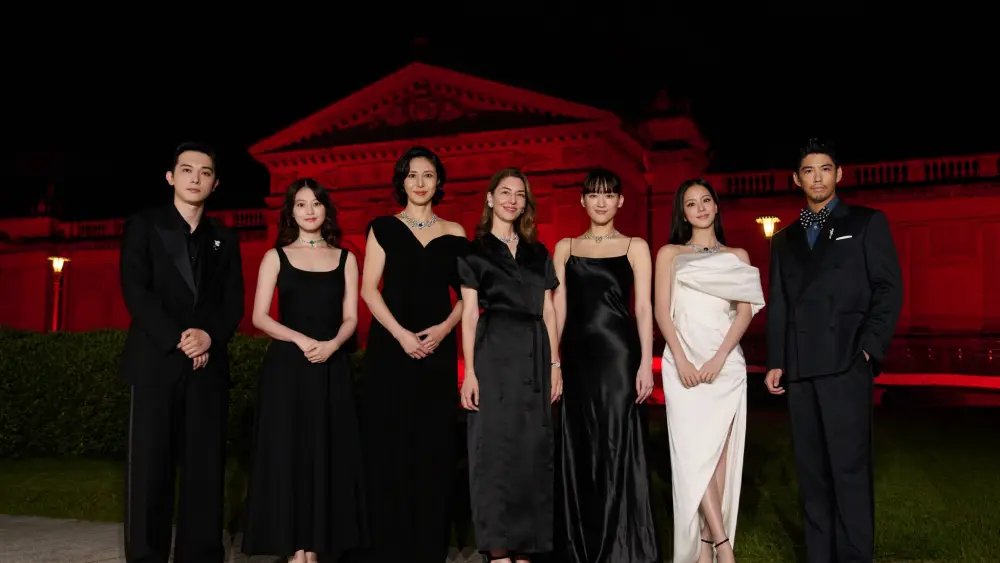
Gemstones continued to sing in Cartier’s “Le Choeur des Pierres” high jewelry collection, with a second chapter unveiled at the Kyoto National Museum.
Among the 46 new pieces that made their debut in Japan, one caught the most light: the Stellara necklace, with its 41-carat Ceylon sapphire set in a graphic openwork composition, worn by Jisoo’ at a dinner that drew Sofia Coppola, Japanese actresses Mio Imada, Nanako Matsushima and Haruka Ayase as well as their compatriots Ryo Yoshizawa and Kento Kaku.
It epitomized the exploration of color, form and the character of individual stones at the heart of a collection that is shaping up to be the French jeweler’s biggest lineup to date, with a total of 250 jewels, objects and timepieces by the time its third chapter is revealed next year in Hawaii. An initial 130 pieces were shown in April in Saint-Tropez.
Also taking pride of place in the second chapter were Patellia, earrings built around a pair of brown diamonds totaling more than 11 carats that were set with their pavilion facing upward, opposite of what is conventionally done, and Tipaza, which figures three strings of ruby beads finished with geometric alternations of diamonds and rubies that appear simply looped around the neck, two briolette diamonds for a cumulated 7.36 carats finishing off two of the strands.
There was also Fibria, which figured a two-strand braid inspired by decorative trimmings with rubies and turquoises set in a diamond-edged rope. Two emeralds finish the asymmetrical strands while a trio in ascending sizes forms a central motif.
For Tutti Chaya, there are the familiar multicolored glyptic motifs in emerald, rubies and sapphires, but this time, their profusion came woven into a geometric mesh paved with diamonds and accented with onyx elements that enhanced contrasts.
Some gemstones were also presented yet to be set, shining in all their own glory. Among the sampling at the Kyoto-based cultural institution were old mine cut diamonds, a 17-carat fancy intense yellow diamond made visually even larger by its elongated cut, a pair of kite-shaped rubellites, a Colombian no-oil emerald of nearly 15 carats and a rare trio of sapphires from Kashmir, thumb-sized pearls and strings of ruby beads. Other rubellites were carved into a profusion of leaves and rested on a sketch of their potential arrangement as a bracelet.
The presence of the K-pop star and Coppolla, who was also the star of a Cartier Cinema Club session staged in the wake of the high jewelry reveal, gave a global gleam to the moment.
But for Arnaud Carrez, chief marketing officer of Cartier, that does not signal a departure from Cartier’s traditional three-chapter sequencing for its high jewelry.

The “Stellara” high jewelry necklace
Sophie Tajan/Courtesy of Cartier
If anything, Choeur de Pierres’ focus, expressed in the play on the words for chorus and heart in French, made Japan a natural fit for this second-chapter showcase.
In addition to gems as the center of jewelry creation, “there’s also the idea of harmony across an extremely varied range of stylistic territories. Within those territories, we see very unexpected color palettes and combinations of stones that can be quite surprising,” he said. “This sense of beauty resonates perfectly with Japan — with its very essence and pursuit of beauty.”
For the jeweler, there’s also particular kinship with a country whose cultural emphasis on humility and the collective matches how it views its metiers, particularly high jewelry, as a shared creative endeavor.
“In Japanese culture, you put yourself forward less; you’re much more in service of a group,” he said. “That idea of the collective is very important to us.”

The Patellia earrings
Sophie Tajan/Courtesy of Cartier
What contributed to making the Kyoto moment a more visible one is also Japan’s longstanding attraction to visitors.
“Japan remains an extremely attractive country for a diverse range of clients,” Carrez said. He noted that Cartier has seen visitors from across Asia, Europe and the U.S. at its events in Japan over the years.
For Cartier, that international appeal sits alongside a longstanding relationship that began formally with the opening of a boutique in the Harajuku area of Tokyo in 1974.
The connection was further cultivated over the decades through events as well as exhibitions such as the “Cartier Design Viewed by Ettore Sottsass” traveling exhibition that landed at Kyoto’s Daigo-ji temple in 2004, “Crystallization of Time” with a scenography by artist Hiroshi Sugimoto and the “Half-Century of Cartier in Japan and Beyond: An Everlasting Dialogue of Beauty and Art” at the Tokyo National Museum.
Likewise with Ron Mueck’s recent solo show at the Japanese capital’s Mori Art Museum, which drew on his longstanding relationship with the Fondation Cartier pour l’Art Contemporain and closed a six-month run on Sept. 23 with around 500,000 visitors.
Another sign of the enduring relationship is the opening of the Ginza 4-Chome boutique in Tokyo last year, a four-story building in the upscale shopping neighborhood.

Earrings from the second chapter of “Le Choeur des Pierres.”
Sophie Tajan/Courtesy of Cartier
Behind a facade inspired by the traditional seigaiha wave motif are interiors that pair origami-inspired ceilings with a Versailles-style parquet floor. Japanese artists contributed works to the space, including a washi-paper wall by Eriko Horiki depicting a panther in a forest and another by Ryo Hikosaka that takes its cues from a 1907 diamond brooch.
Its top floor is home to Cartier’s first “Résidence,” a private salon and dining space with garden views, in the country.

The Tutti Frutti style came into play in Cartier “Le Choeur des Pierres” high jewelry collection.
But wherever it lands, Cartier’s enduring appeal comes from evolving without losing sight of its identity, the executive said.
The house has “always had the capacity to remain true to what it is while reinventing itself in an extremely dynamic way,” Carrez added. “We are not here to create disruption. We are more about evolution and continuity.”