dailynewsnblog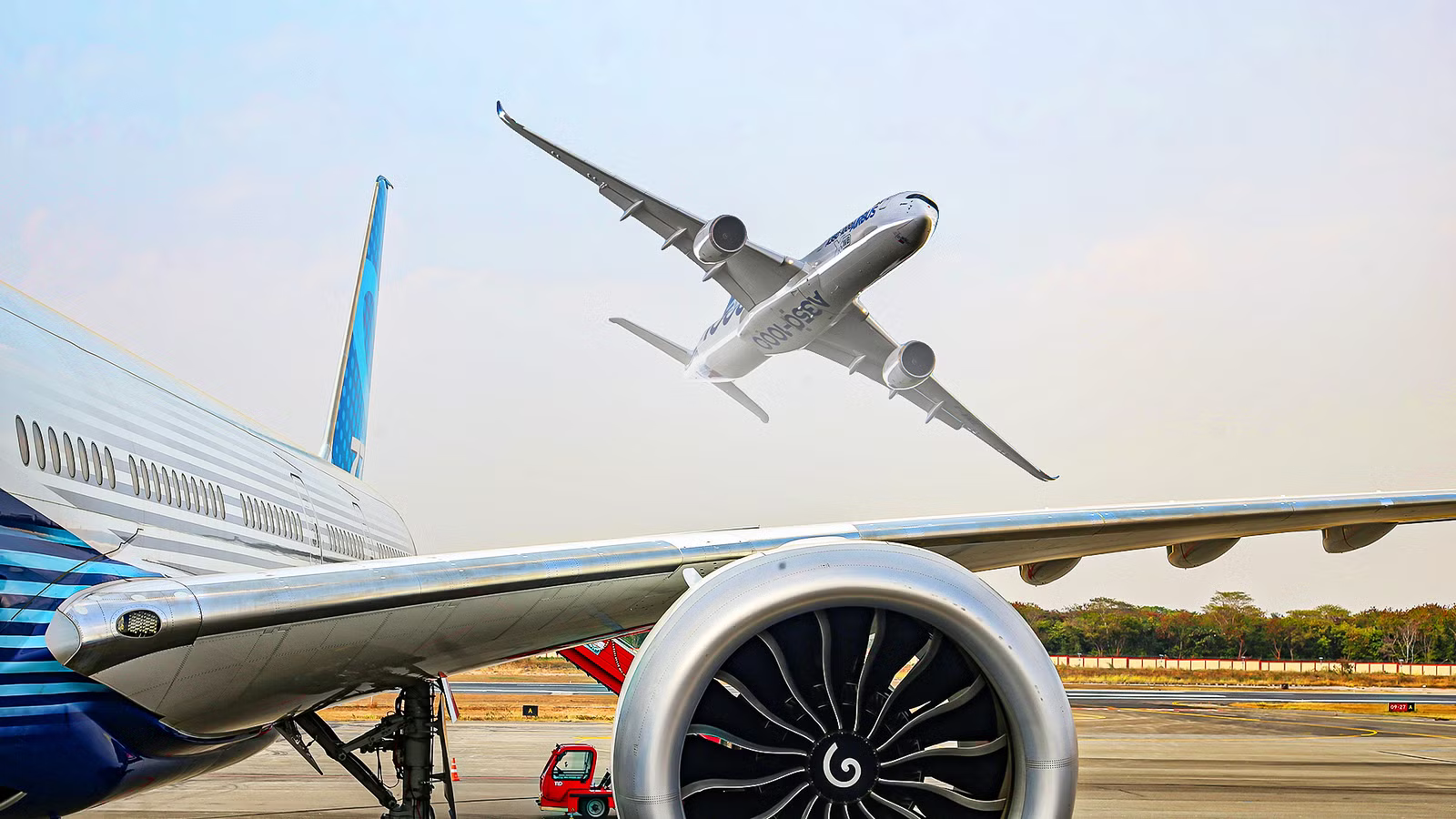
The Boeing 777X and Airbus A350 are at the forefront of next-generation long-haul travel. Designed to usher in a new era of more-efficient and long-distance point-to-point aviation, the two are the latest bids from each of the major aircraft makers to offer jets that will ultimately serve as the flagships of carriers’ fleets for years to come.
But despite their similarities — twin-engine designs incorporating advanced composite materials — variants from the two families boast differing strengths and were born from contrasting fundamental ideas. Namely, the characteristics of the power units selected for each widely differ.
Powering The Two Largest Next-Generation Airliners

In each case, such ambitions to create modern and more economical planes capable of serving ultra-long-haul routes called for specialist engine technology. That means between them, the GE9X and Trent XWB exclusively power these two largest, newest-generation commercial twinjets, respectively.
For Airbus, both variants from its A350 family run on models from Rolls-Royce’s purpose-built Trent XWB platform. The Trent XWB-84 powers only the smaller Airbus A350-900 variant, with the Trent XWB-97 utilized on the Airbus A350-1000 — or long-range leader in the European manufacturer’s own words.
On  Boeing’s side, the 777X and what is set to take the crown as the biggest twin-engine widebody ever flown commercially once certified, will use the GE9X from GE Aerospace. Both the longer-range Boeing 777-8 and higher-capacity Boeing 777-9 passenger variants will share this same engine model, which was itself approved for operations back in 2020. Against the already in-service Trent XWB variants, the GE9X has been built with a differing set of priorities in mind, and that is down to the needs of the A350 and 777X themselves.
The Airbus A350 XWB

Having officially launched the A350 program in 2006, Airbus set about creating its newest widebody from scratch using a clean sheet. That opened the door for the latest available technologies and materials to be used more widely, with over 70% of the A350’s airframe being built from advanced materials, for instance.
Notably, over half of each aircraft is made from carbon fiber reinforced polymer, with this used in the fuselage, wings, and tail to offer a lighter and non-corrosive alternative to the likes of aluminum. High-aspect-ratio wings, so those with a span similar to the A350’s length, that can also flex and morph during different flight phases are also among a string of features used to optimize aerodynamics with the aim of reducing drag and improving range. Alongside all of this, an Integrated Modular Avionics (IMA) allowed each A350’s systems to synchronize more effectively, in part for fuel optimization.
Core Airbus A350 passenger variant specifications:
Specification/Aircraft | Airbus A350-900 | Airbus A350-1000 |
Seats (three-class) | 300-350 passengers | 350-410 passengers |
MTOW | 591,000 lbs (268,000 kg) | 710,000 lbs (322,000 kg) |
Max range | 8,600 nautical miles (15,930 km) | 9,100 nautical miles (16,850 km) |
Length | 219 feet, 2 inches (66.8 m) | 242 feet, 0.7 inches (73.78 m) |
Wingspan | 212 feet, 5.2 inches (64.75 m) | 212 feet, 5.2 inches (64.75 m) |
Height | 55 feet, 11 inches (17.05 m) | 56 feet, 0 inches (17.08 m) |
Engine | Rolls-Royce Trent XWB-84 | Rolls-Royce Trent XWB-97 |
Combined with the Trent XWB, itself among the world’s most efficient large turbofan engines today, the work that went into the A350’s design helped to bring about a leap in the economic and environmental cost of flight when the A350-900 entered commercial service in 2015. According to Airbus, this was reflected in a 25% improvement in fuel burn and carbon dioxide emissions against “previous-generation aircraft”. Similarly, the 777X is on course to compete with the A350 on matters of efficiency when it is finally certified.
The Boeing 777X

Unlike Airbus, however, Boeing has largely developed its 777X through essentially borrowed features of former aircraft models. This includes aspects from both the Boeing 787 — Boeing’s own clean-slate next-generation widebody which launched commercially in 2011 — as well as the widely popular existing Boeing 777 family.
Specifically, this stretches to the flight control and computing systems of the 787, its high-lift design, alongside its engine nacelle design, per Boeing. The likes of composite floor beams and rear tail assembly, or empennage, have then been taken from the original 777, as well as its “highly reliable systems architecture,” as Boeing notes. Of course, though, a new aircraft always calls for fresh elements, and in the case of the 777X, high-span composite and foldable wings make for a major difference between it and its predecessors.
Boeing 777X passenger variant specifications, from Boeing:
Specification/Aircraft | Boeing 777-8 | Boeing 777-9 |
Seats (two-class) | 350-425 | 375-450 |
MTOW | 805,000 lbs (365,140 kg) | 775,000 lbs (351,530 kg) |
Max range | 9,500 nautical miles (17,590 km) | 8,000 nautical miles (14,820 km) |
Length | 232 feet, 6 inches (70.9 meters) | 251 feet, 9 inches (76.7 meters) |
Wingspan | Extended: 235 feet, 5 inches (71.8 meters) On ground: 212 feet, 9 inches (64.8 meters) | Extended: 235 feet, 5 inches (71.8 meters) On ground: 212 feet, 9 inches (64.8 meters) |
Height | 64 feet, 1 inch (19.5 meters) | 64 feet, 1 inch (19.5 meters) |
Engine | GE Aerospace GE9X | GE Aerospace GE9X |
Thanks to clean-slate GE9X engines too, Boeing boasts the 777X will offer a 20% cut in fuel use and emissions compared to the planes it is intended to replace. Importantly, the 777-9 and the larger of the family’s two variants are set to trump the A350-1000 by 10% in relative operating cost per seat. In part down to better aerodynamics through the likes of longer wings, that will also be thanks to more modern engine technology, according to Boeing.
Different Performance Priorities Of GE9X And Trent XWB

That does not mean the GE9X will be less fuel-thirsty on an absolute basis, but rather that it should better the Trent XWB when payload or passenger count is factored in. Indeed, the Trent XWB and GE9X differ substantially in their designs and, notably, in capability.
Where the Trent XWB is highly optimized for long- and ultra-long-range efficiency in relation to the relatively lightweight A350, the GE9X is geared towards carrying heavier payloads and 777X aircraft that boast higher capacities — note the 777-8’s maximum takeoff weight of 805,000 lbs (365,140 kg) versus the A350-1000’s 710,000 lbs (322,000 kg), for reference. In fact, the GE9X is the most powerful engine ever built for the commercial aviation industry.
Despite not having been flown commercially yet, the GE9X holds a Guinness World Record after testing in 2019 saw it achieve a maximum thrust of 134,300 lbf. In reality, the engine is rated to be operated at a more practical 110,000 lbf. Either way, that still trumps both the Trent XWB-84 and Trent XWB-97 by a fair margin, with these rated at 84,000 lbf and 97,000 lbf, respectively. As to why this is, the answer is in the differing design architecture of each.
Design Philosophies Differ Between GE9X And Trent XWB As A Result

Naturally, the GE9X is the larger of the two, having been developed around the requirements of the larger 777X family. At 134 inches (3.4 m) in diameter, the GE9X’s fan is not too dissimilar in width to a Boeing 737’s fuselage. This also means it holds the title of the largest commercial engine ever built, as well as the most powerful.
But differences extend into the entire architecture of each engine. Where Airbus and Rolls-Royce opted for a more complex three-shaft design housing 22 titanium-alloy fan blades, for example, the GE9X’s two-spool design encompasses just 16 blades, which are built from composite materials.
GE9X and Trent XWB specifications:
Specification | GE9X | Trent XWB |
Fan diameter | 134 inches (3.4 m) | 118 inches (3.0 m) |
Blades | 16 | 22 |
Bypass ratio | 10:1 | 9.6:1 |
Overall pressure ratio | 60:1 | 50:1 |
Max thrust | 110,000 lbf | 97,000 lbf* |
Dry weight | ~21,000 lbs (~9,525 kg) | ~16,643 lbs (~7,549 kg)* |
Design architecture | 2-spool axial flow | 3-spool axial flow |
*Figures given for Trent XWB-97 — thrust and dry weight differ between variants
Broadly speaking, the two engines pursue efficiency in different ways. For the GE9X, the emphasis is on its huge fan and high bypass ratio, allowing it to move large amounts of air with relatively little energy. Advanced compressor, combustor, and turbine technologies further contribute, while its higher 60:1 overall pressure ratio allows for greater compression of the air entering the engine’s core. In contrast, the Trent XWB’s three-shaft design allows its low, intermediate and high-pressure sections to spin at different speeds, helping each operate closer to an ideal speed and providing another means of improving efficiency alongside what is, realistically, a similarly high bypass ratio.
Airbus A350 & Trent XWB Have Edge As Proven Entities

All told, the GE9X looks as though it will be a serious contender to the Trent XWB once in service. But therein lies the key point: The Trent XWB has had years to prove itself, having launched with the A350 over a decade ago in 2015. That means Rolls-Royce can confidently back up claims that the Trent XWB has the “highest time on wing for a new generation widebody engine,” can “fly more than a million passengers between engine removals,” and so on.
Conversely, the GE9X has been awaiting its own entry into service for some time as Boeing has navigated delays within the 777X program. Like the GE9X, the aircraft was originally expected to receive certification in 2020. Six years later and counting, however, the 777X program is yet to get the final green light, with anticipation as it stands for this to come over the coming year.