dailynewsnblog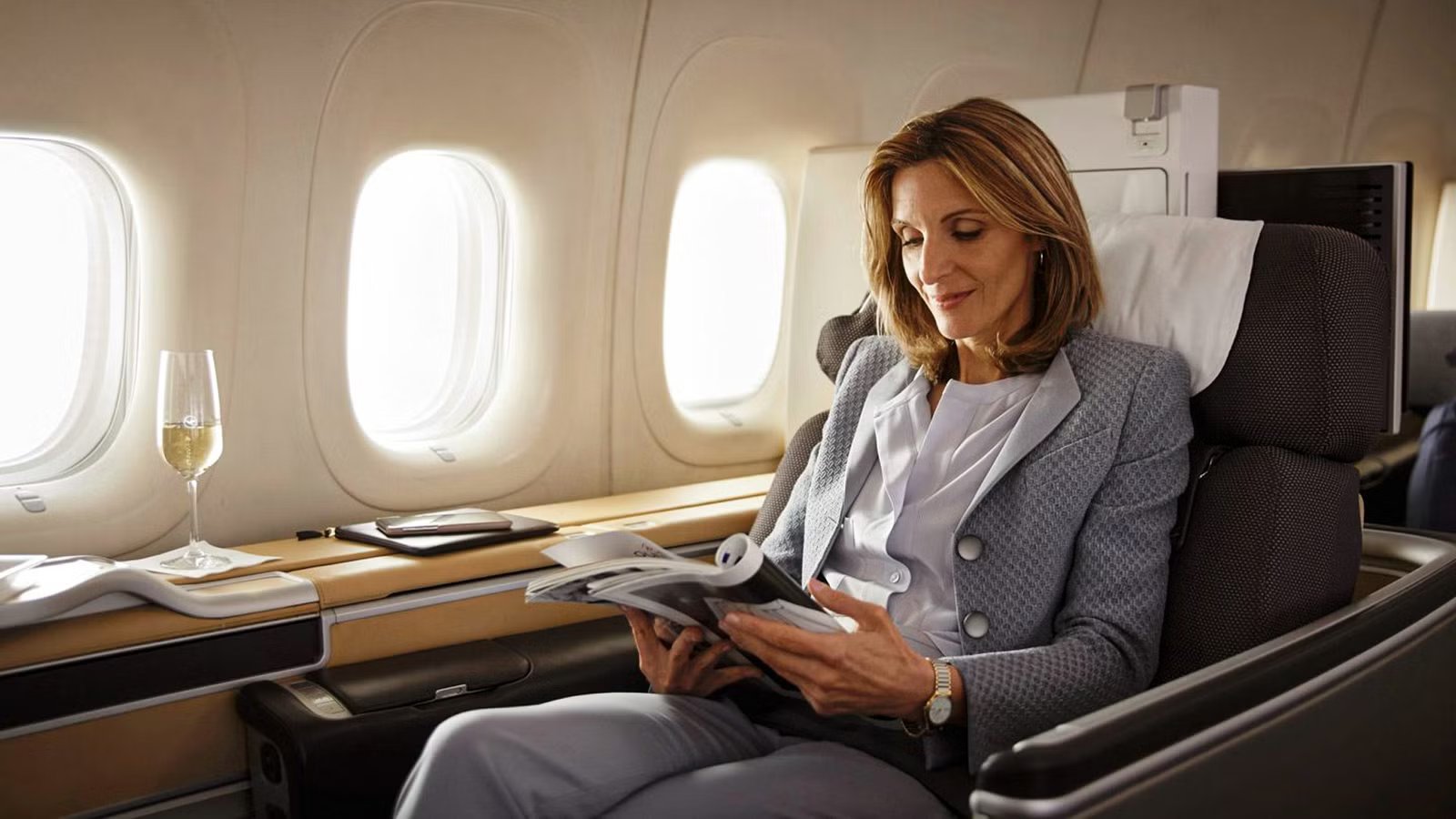
Despite being retired by many former iconic operators, the long-tenured ‘Queen of the Skies’ is still a fixture in global airspace and airfields alike. Although retirements have been initiated and completed by many airlines worldwide, many continue to offer a premium product onboard the Boeing 747. Aside from cargo and charter operations, the number of commercially configured examples is present only in four carriers’ fleets.
The upper deck of the 747 is commonly configured as a premium cabin because it is physically separate from the rest of the cabin. Additionally, the upper deck is generally stacked vertically on top of another premium-cabin segment, giving cabin crew an entire wing of the plane rather than a long, vertical cross-section. In these cabins, business class seats vary widely in quality, style, and size.
Where Did The 747 Go?

Wikimedia Commons | Simple Flying
As with any airframe program, the number of commercial 747 operators has melted away since retirements began in 1974 with  American Airlines. Regardless of the rationale, airlines consistently evaluate fleets to align them with current industry trends and offerings. The aerospace industry continually brings new technologies to airframe platforms. As a result, production ultimately ends in favor of newer, more innovative technology. In 2026, only four carriers have been able to make ends meet with regularly scheduled 747 passenger flights:
-
 Lufthansa
— 25 in service -
 Air China
— 9 in service -
Korean Air
— 4 in service -
Rossiya Airlines
— 6 in service
 Lufthansa
 Air China
The reasons for 747 retirements vary by airline. For American, the choice was made as the super jumbo did not fit its route strategy at the time. In more recent years, fuel-efficient alternatives such as the Boeing 777-300ER have landed in the marketplace, helping carriers reduce fuel burn and overall operating costs. Simple Flying’s Josh Lamb reported that the most modern 747 variants, the Boeing 747-400and the Boeing 747-8, burn approximately 8.83 to 12 tons of fuel per hour; the 777-300ER, by contrast, takes that metric down to 7.35 to 7.5 tons.
1,574 examples were completed across all variants during the 747’s production run. The first Boeing prototype, known as the City of Everett, is on permanent display at The Museum of Flight in Seattle, Washington. In contrast, the first official delivery was awarded to Pan American World Airways on December 12, 1969. This aircraft, N733PA, was later registered as 5N-THG, withdrawn from use, and stored at San Bernardino International Airport (SBD) in California in 1992, then scrapped by late 1993.
A Specific Subset of Destinations Remains

Each of the four remaining organizations flying the 747 for passengers will likely originate or terminate at its respective hub. To find a business class seat on a 747 in 2026, one must decide not only which seat offers the best dimensions and features, but also which destination best serves their situation.
South Korean nationals arguably have the most options when it comes to accessing a 747 business class seat in 2026. The flag carrier and largest airline of the country, Korean Air, still has a fully operational passenger-configured 747-8 fleet. Furthermore, Passport Index confirms that holding a South Korean passport also grants visa-free access to Germany, China, Russia, and, of course, South Korea.
In practice, passengers hoping to book a business class seat aboard a Boeing 747 will generally need to route through one of four airports that have become the type’s final major passenger strongholds.  Frankfurt Airport (FRA) serves as the global center of Lufthansa’s extensive 747 operation and offers by far the greatest number of daily departure opportunities.
  Beijing Capital Airport (PEK) remains the primary home of Air China’s small fleet of 747-8s, while Seoul’s
  Incheon International Airport (ICN) serves as the base for Korean Air’s passenger-configured 747-8 fleet. Meanwhile,
  Moscow Sheremetyevo International Airport (SVO) remains the principal gateway for Rossiya Airlines’ 747 operations.
- FRA with Lufthansa
- PEK with Air China
- ICN with Korean Air
- SVO with Rossiya
Frankfurt: The ‘Bay Of Plenty’

In Frankfurt on any given day, the apron is reminiscent of a museum exhibit of  Boeing‘s widebody history. No airline has committed more heavily to keeping the passenger 747 alive than Lufthansa, which still operates both the -400 and the newer -8 from its primary hub. As a result, Frankfurt is not only the easiest place to find a passenger 747, but also the destination with the most daily business class seats aboard the aircraft.
Lufthansa’s website outlines a consistent business class seat onboard its fleet of 747-400 and 747-8 aircraft. On the 747-8, the carrier currently operates layouts featuring either 80 or 92 business class seats spread across the main and upper decks. Published dimensions list the seat at roughly 20 inches (51 cm) wide, with a fully flat bed approaching 78 inches (198 cm) long. While those figures no longer lead the industry, the cabin’s selling point is the upper deck itself. Most aircraft carry just 32 passengers in the hump, creating an intimate environment that feels removed from the rest of the jet.
The main drawback is that Lufthansa does not necessarily offer the most spacious individual seat. Instead, it offers the most spacious cabin environment. Passengers choosing between airlines must therefore decide whether privacy comes from seat design or from the unique feeling of occupying the upper deck of a Boeing 747. That distinction becomes increasingly important when comparing Lufthansa’s product to Korean Air’s much newer business class offering.
Korean Air: The Strongest Individual Seat

If the goal is to identify the most spacious business class seat still available on a passenger Boeing 747, ICN is the place to be. Korean Air presents perhaps the strongest offering today. The carrier’s remaining 747-8 Intercontinentals continue to operate with 48 Prestige Class seats arranged across the main and upper decks, utilizing the highly regarded Apex Suite design.
Korean Air’s website illustrates specifications with a seat width of approximately 21 inches (53 cm) and a fully flat bed measuring roughly 75 inches (191 cm) in length. More importantly, the Apex Suite design places a large side console between many passengers and the aisle, creating a sense of personal floor space that exceeds what simple width measurements suggest.
While Korean Air’s seat pitch beats Lufthansa’s by one inch, seat architecture further alters the passenger experience. Korean Air does this without reducing cabin size, keeping 48 business class seats in a 368-seat aircraft. For travelers specifically chasing the most modern premium experience available on a Boeing 747 in 2026, Korean Air remains hard to beat.
Air China: Space Through Cabin Geography

Air China’s remaining Boeing 747-8 fleet takes a noticeably different approach. Rather than focusing solely on seat dimensions, the airline uses the aircraft’s unique geometry to create additional exclusivity. Its business class cabin occupies both the upper deck and parts of the distinctive forward fuselage.
As displayed on Air China’s 747 fleet page, business class seats are roughly 21 inches (53 cm) wide with fully flat beds. These figures are broadly similar to Korean Air’s offering, but the experience varies considerably depending on seat selection. The nose section of the aircraft narrows toward the cockpit, creating a smaller, more private compartment than the main cabin. On the upper deck, meanwhile, just 30 business class seats occupy the hump, creating one of the lowest-density premium environments available in the open market.
This configuration suggests that dimensions alone won’t classify one singular best 747 premium seat option. Air China’s offering is in a more intimate cabin than Korean Air or Lufthansa. Fewer seats also add a bit of exclusivity to the cabin. As a result, service can be more tailored and curated for each business class passenger.
Rossiya: The Wild Card

Rossiya represents perhaps the most unusual way to experience business class aboard a Boeing 747 today. Operating former Transaero aircraft, the St. Petersburg-based airline maintains one of the world’s last substantial passenger 747 fleets outside the major global network carriers. The cabins were designed for a different market environment and reflect an earlier era of premium travel.
A Snapshot of Each Available Offering
Airline | Aircraft | Business Class Type | Published Strength |
|---|---|---|---|
Korean Air | 747-8I | Apex Suite | Direct aisle access, strong privacy |
Lufthansa | 747-8 / 747-400 | Lufthansa Business Class | Upper deck exclusivity |
Air China | 747-8I | Flat-bed business class | Low-density premium cabin footprint |
Rossiya | 747-400 | Legacy business cabin | Rare passenger 747 experience |
Because of Russia’s vast size, Rossiya deploys the 747 on key domestic routes, primarily from SVO. For that reason, Rossiya does not necessarily compete on seat innovation. Instead, it consistently offers a business class seat on the 747 domestically to key Russian economic centers such as Sochi International Airport (AER). Rossiya currently does not have published seat dimensions.
The long-term test for Rossiya, and arguably for the passenger 747 itself, is not whether travelers enjoy the aircraft. The test is whether sufficient economic justification remains to support four-engine passenger operations when twin-engine alternatives can achieve similar range with significantly lower fuel consumption. That calculation has already removed dozens of passenger 747 fleets worldwide. Rossiya must also bear in mind the burden of a deteriorating 747-400 supply chain, and more specifically, international sanctions on Russia due to the ongoing war with Ukraine.
Catch what other trackers miss
Emergency squawks, holds, NOTAMs — live signals, no signup.
Open tracker
Catch what other trackers miss
Emergency squawks, holds, NOTAMs — live signals, no signup.
Open tracker