dailynewsnblog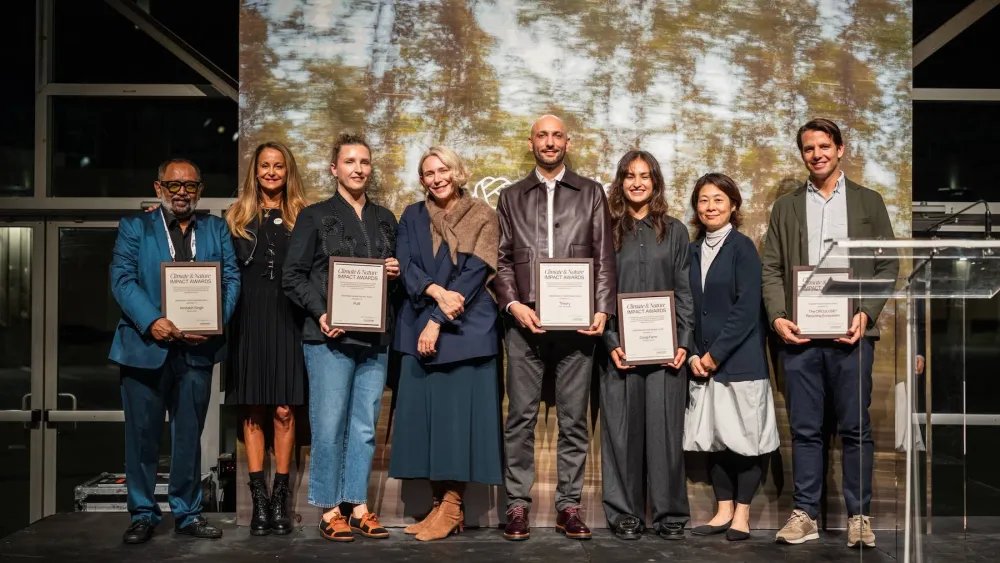
A sheep-feed trial, a textile recycling network and a model for financing farm improvements were among the projects recognized at Textile Exchange’s 2026 Climate and Nature Impact Awards.
The organization announced five winners Oct. 14 during its annual conference in Vancouver. Textile Exchange CEO Claire Bergkamp and board chair Marci Zaroff presented the awards at the Rocky Mountaineer Station, honoring work across raw material production, waste recovery and investment.
Theory and Congi Farm won the Collaboration for Global Impact Award for a wool project involving Theory parent Fast Retailing, environmental technology company Sea Forest and Italian mill Botto Giuseppe.
At Congi Farm in New South Wales, Australia, 2,000 Merino sheep received SeaFeed for 120 days. Textile Exchange put the resulting reduction in methane from digestion at 43 percent, equivalent to about 54.5 metric tons of carbon dioxide emissions avoided. The trial measured that part of wool production’s climate impact, leaving the finished garments’ footprint unassessed.
Wool from the project was used in Theory’s spring 2026 Regal Wool collection.
“The results of the pilot were encouraging, but perhaps even more important were the lessons we learned together regarding implementation, measurement, traceability, cost, and scalability,” Gonzalo Pertile, Theory’s vice president of sustainability, said in a statement.
The Textile-to-Textile Ecosystem Award went to the Circulose Recycling Ecosystem, commending the brand commitments and fiber-producer partnerships supporting the Swedish company’s industrial restart.
Circulose makes a pulp from recycled cotton textiles that fiber producers can turn into new materials. According to Textile Exchange, volume commitments from 11 brand partners helped establish demand to support reopening its Ortviken plant. Agreements with Tangshan Sanyou, Aditya Birla/Birla Cellulose, Jilin Chemical Fiber and China Textile Academy Green Fibre provided downstream partners to convert the pulp.
“This award belongs as much to our brand and fiber-producer partners as it does to us. Together, we’ve worked through the hurdles and found the solutions it takes to make textile-to-textile recycling real,” Circulose CEO Jonatan Janmark said.
Green Worms founder and CEO Jabir Karat won the Ryan Young Climate Leader Award for work to reduce emissions from fiber and raw material production. The award honors Young, Textile Exchange’s late chief operating officer.
Green Worms works across waste collection, sorting, processing and recovery, with an emphasis on employment and the conditions of waste workers. Karat used the announcement to outline plans for a mechanical textile-to-textile recycling facility in Tamil Nadu.
“Next quarter, we are setting up a mechanical textile-to-textile recycling facility in Tamil Nadu; we invite the fashion ecosystem to join us to co-create, co-invest, share the risk and accelerate circular solutions together,” he said.
The Regenerative Land Leadership Award went to Amiha Agro director Amitabh Singh. Textile Exchange said the organization has helped about 8,000 cotton farmers adopt regenerative farming practices across 35,000 acres.
“At Amiha, we believe regenerative agriculture must go beyond environmental improvement. It must place farmers at the center by building their knowledge, reducing production risks, improving soil health, strengthening climate resilience, and creating dependable market opportunities for responsibly produced fibers,” Singh said.
Pur received the Removing Economic Barriers Award for its approach to financing regenerative wool production. Its programs combine brand investment and producer agreements with technical assistance, implementation planning and outcome monitoring.
The French B Corp’s programs have directed $350,000 to producers to put regenerative practices into use, according to Textile Exchange. Since 2020, the work has reached 16 Responsible Wool Standard-certified producers farming nearly 17,000 hectares. The funding figure excludes additional spending on technical assistance, oversight and tracking results.
“For Pur, this recognition is particularly meaningful because it validates something we believe is essential to scaling regenerative agriculture: producers should not be expected to carry the cost and risk of transition alone,” said Hannah Crone, Pur’s animal fibers lead.