dailynewsnblog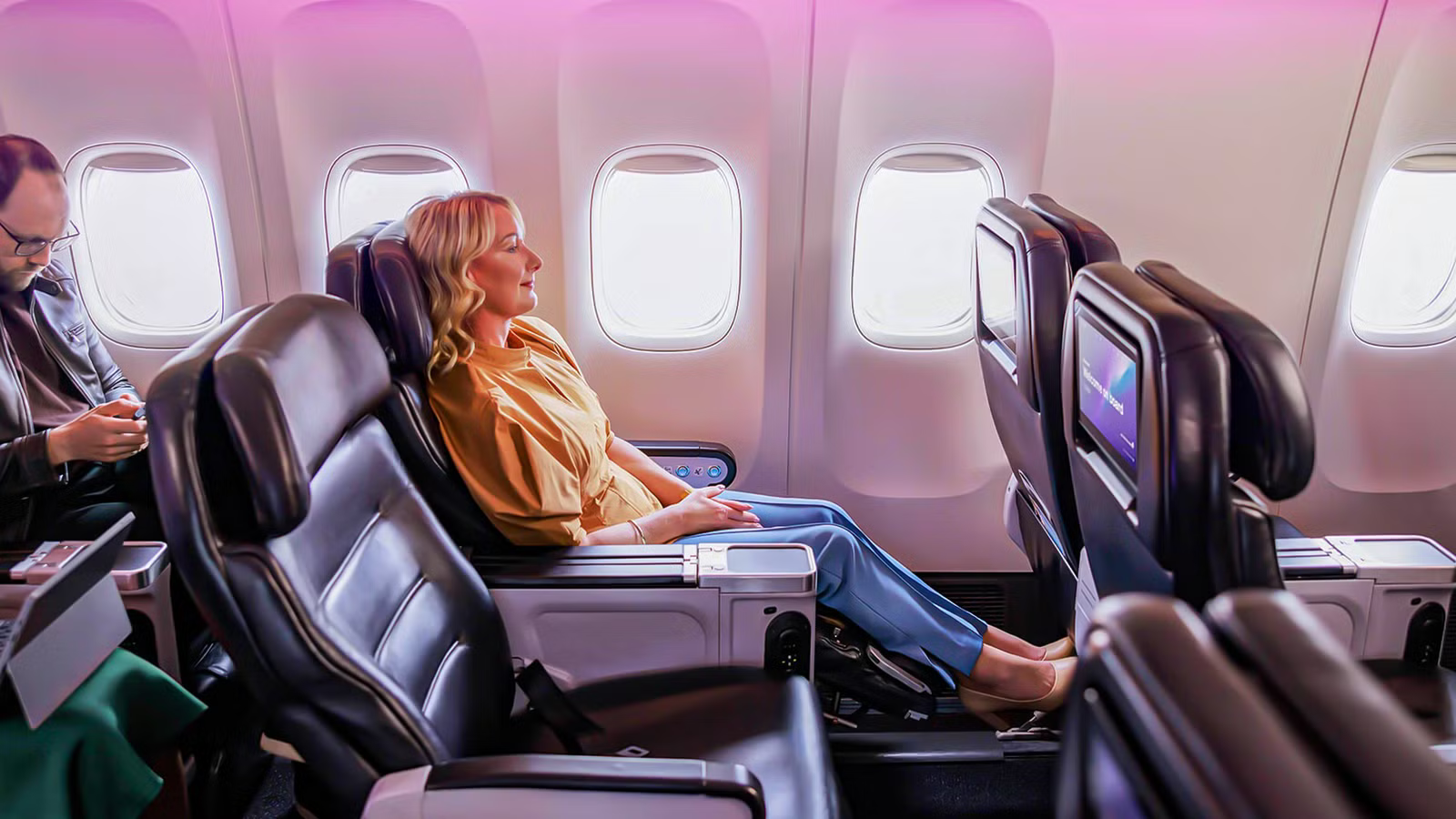
Traditionally, business class was for the business traveler, aimed at those who wanted more space and privacy but didn’t need first class. More recently, the advent of lie-flat seats has allowed passengers to get a good night’s sleep on the plane, while inflight WiFi has enabled customers to work on the plane. Meanwhile, as business class seats become more innovative, they’ve increasingly become similar to older first class seat models, while premium economy has emerged as a new middle offering between business class and economy.
This is the newest mainstream travel class, and it’s becoming increasingly popular with airlines worldwide because of the cabin’s strong economics. However, although business travelers don’t always favor this cabin, it is emerging as a compelling choice because it still offers many benefits over business class without the high price tag. With corporate bookings generally flat and price-sensitive premium leisure customers rising, premium economy has become crucial to airlines’ long-haul commercial strategies.
Virgin Atlantic & Air New Zealand

Virgin Atlantic first introduced premium economy in 1992, while Air New Zealand rolled out premium economy in 2005. Both airlines were early adopters, and Virgin Atlantic in particular was among the first to debut the cabin, introducing it the same year as EVA Air. Beyond being trendsetters, both airlines also favor large premium economy cabins; Virgin Atlantic’s cabins range from 35 to 56 seats, while Air New Zealand installs up to 54 premium economy seats, depending on the type and configuration.
Beyond cabin size, Virgin Atlantic and Air New Zealand are product leaders in this segment within their respective regions. Virgin Atlantic is ranked by some sources as offering the best premium economy product in Europe, with praise being particularly directed towards the quality of the service and onboard catering. Meanwhile, Air New Zealand is known for offering a generous seat pitch in premium economy with good recline and consistent service.
Neither product matches a lie-flat business class seat, but more importantly, they cost less. On the route between New York and London, business class may cost three or four times as much as a premium economy ticket, while the price difference between premium economy and economy might be much smaller. Customers and corporations are taking notice, and premium economy has exploded in popularity over the past few years.
Changing Customer Demographics

Business class seats have traditionally been filled largely with passengers traveling on corporate contracts. These are usually negotiated between the company and the airline, and cover a specific volume of flight bookings. Post-COVID, however, many companies have cut their travel budgets and are stricter on premium bookings. Corporate bookings in premium cabins remain lower than pre-COVID levels, but for some companies, premium economy has emerged as a suitable substitute.
On the other hand, premium leisure travel has become extremely popular post-COVID. These customers remain price-sensitive but are willing to pay extra for added comfort, and although premium leisure customers routinely book business class, premium economy is still highly appealing. Fundamentally, premium cabins are appealing because of the extra space, upgraded catering, and more personalized service, and premium economy still offers this even if the experience isn’t as elevated as business class.
In large part, premium cabins sell because many find economy to be cramped and unpleasant, and premium economy addresses almost all of the concerns that customers have with economy. Altogether, premium demand is on the rise overall, and premium economy is uniquely well-positioned for customers who are relatively price-sensitive while also appealing to an increasing number of corporate travelers. For airlines that have committed strongly to premium economy, like Virgin Atlantic and Air New Zealand, these circumstances are favorable.
The Economics Of Premium Economy

On the demand side, customers want to fly premium economy, and airlines that have focused on the cabin are seeing higher sales. However, the cabin also works well from a cost standpoint, because its seats are significantly more space-efficient than business class seats. Seat pitch in premium economy typically ranges from 38 to 42 inches (96.5 to 106.7 centimeters), while business class usually ranges from 42 to 50 inches (106.7 to 127 centimeters).
But in addition to the pitch, modern lie-flat business class pods usually offer direct-aisle access, resulting in a four-abreast layout in nearly all cases. Premium economy layouts depend on the aircraft, but usually range between six-abreast (on the Boeing 767) and eight-abreast (on most Airbus A350s, the A380’s main deck, the Boeing 747, and the 777). In some cases, airlines can fit more than twice as many premium economy seats as business class in the same space.
Aircraft | Economy Layout | Premium Economy Layout | Business Class Layout |
|---|---|---|---|
Airbus A330 | 2-4-2 or 3-3-3 | 2-3-2 | 1-2-1 or 2-2-2 |
Airbus A340 | 2-4-2 or 3-3-3 | 2-3-2 | 1-2-1 or 2-2-2 |
Airbus A350 | 3-3-3 or 3-4-3 | 2-3-2 or 2-4-2 | 1-2-1 or 2-2-2 |
Airbus A380 | 3-4-3 (main) 2-4-2 (upper) | 2-4-2 (main) 2-3-2 (upper) | 1-2-1 or 2-2-2 |
Boeing 747 | 3-4-3 (main) 3-3 (upper) | 2-4-2 | 1-2-1 or 2-2-2 or 2-3-2 (main) 1-1 or 2-2 (upper) |
Boeing 767 | 2-3-2 or 2-4-2 | 2-2-2 | 1-1-1 or 1-2-1 or 2-1-2 |
Boeing 777 | 3-3-3 or 3-4-3 | 2-4-2 | 1-2-1 or 2-2-2 or 2-3-2 |
Boeing 787 Dreamliner | 2-4-2 or 3-3-3 | 2-3-2 | 1-2-1 or 2-2-2 |
Airlines report that premium economy is now their most profitable cabin on a square-footage basis, since the revenue difference between premium economy and business class (what used to be an airline’s most profitable cabin) is smaller than the seat-count difference. While suppliers still produce business class seats with more seats per row, these come with a much higher seat pitch and are not necessarily more space-efficient than lie-flat seat models.
How Premium Economy Has Evolved Within Airlines’ Product Portfolio

Premium economy has existed for only about 34 years. While some airlines have long offered a middle product between business class and economy, it has typically been economy seats with extra legroom. Early adopters of premium economy generally followed a similar formula to what you see today, but it was somewhat experimental. Carriers weren’t sure whether to position it as economy with a larger seat or as a ‘lite’ version of business class, and many airlines were unclear what demand looked like for this new product.
Airlines fundamentally rely on past data to set fares and determine how much supply to offer, but that data is scarce for a cabin class that has long been new. Airlines needed to figure out if premium economy would stimulate new demand, whether demand would come from business class customers, or if most passengers booking the cabin were upgrading from economy. Because airlines lacked substantial data on premium economy bookings in the past, most carriers were conservative about cabin sizes.
Premium economy started becoming mainstream in the 2010s, and as it spread across the industry, airlines became much better informed about passenger demand for the cabin. With premium demand on the rise, carriers have increased the size of business class and premium economy cabins, while fares have generally held up well for airlines. It’s become a core offering for dozens of long-haul airlines around the world and a major source of profit. However, while it’s generally been popular with passengers, the value proposition isn’t always as strong as it seems.
When Premium Economy Isn’t Worth It

Premium economy is positioned as the middle ground between economy and business class, but the actual experience is closer to economy. You get a wider seat with more legroom, more recline, and a larger screen, but that’s essentially it in terms of the hard product. A modern business class seat almost always reclines fully flat into a bed, while many newer seat models offer direct aisle access with no seatmate, and some even include a sliding door.
In addition, business class tickets usually include lounge access, significantly upgraded onboard catering, and thorough amenity kits. Very few airlines grant lounge access to premium economy passengers, and while the onboard catering and amenity kits are upgraded from economy, they’re usually a step below what business class offers. There is a much bigger difference between premium economy and business class than premium economy and economy, which is fine when premium economy is priced closer to economy.
This often happens in many markets, but surprisingly often, premium economy tickets are priced significantly closer to business class. This happens because many airlines tend to have conservatively sized cabins, creating a supply shortage relative to true market demand. However, these prices also represent comparatively poor value relative to other cabins and what they include, contradicting the common belief that premium economy is the value buy over business class.
Airlines that have performed cabin retrofits have typically enlarged the sizes of their premium economy cabins as demand has proven itself. As this becomes more common across the industry, extreme prices for this cabin will fade as supply increases. However, given that premium economy remains as popular as ever, prices should stay relatively strong as airlines continue to sell these seats easily.
Catch what other trackers miss
Emergency squawks, holds, NOTAMs — live signals, no signup.
Open tracker
Catch what other trackers miss
Emergency squawks, holds, NOTAMs — live signals, no signup.
Open tracker