dailynewsnblog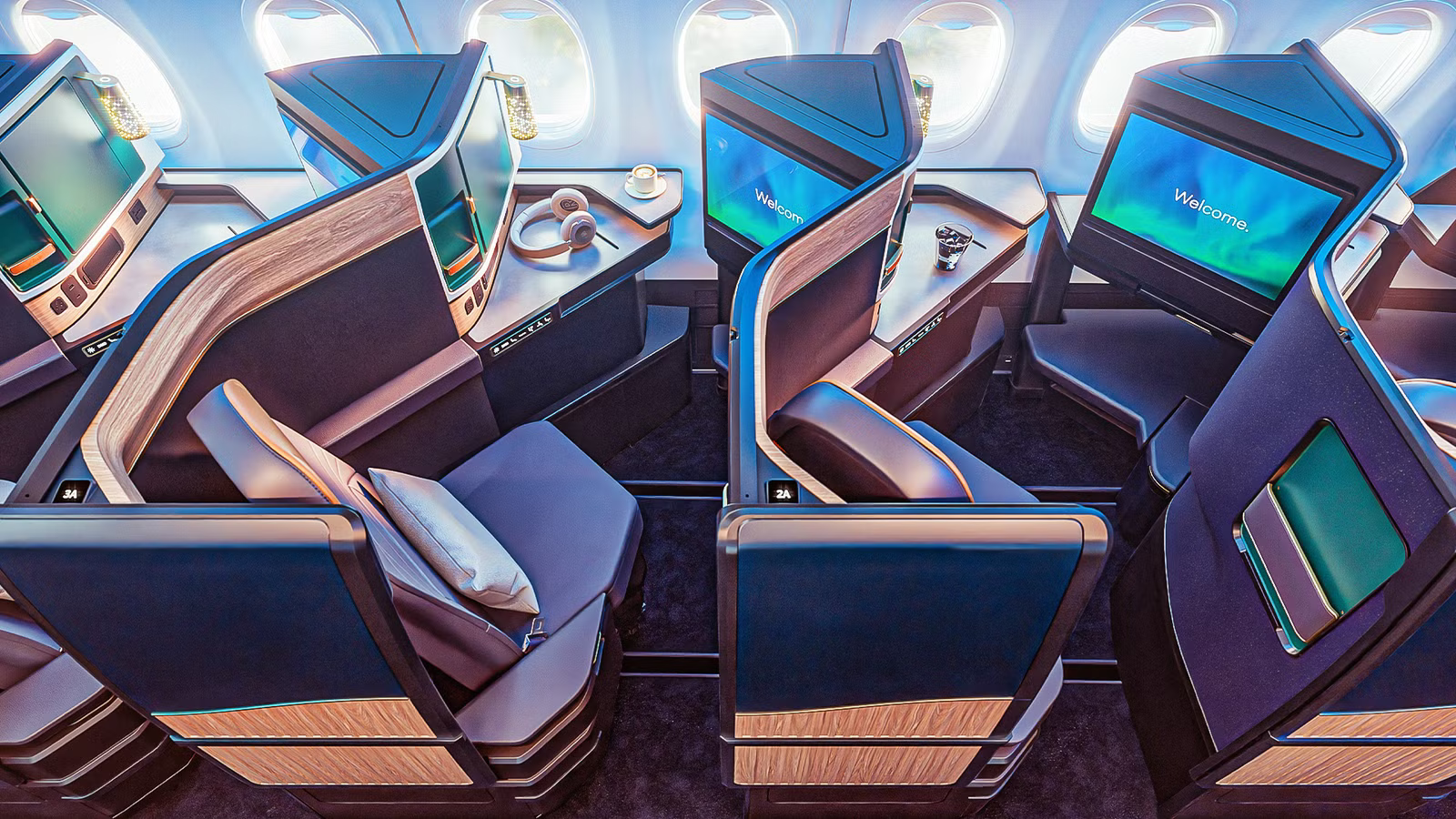
 Alaska Airlines is preparing to become the first airline to put a true lie-flat business-class product on the Boeing 737 MAX 10, with 12 Aurora Suites planned for at least 25 aircraft beginning in 2028. The move is part of Alaska Air Group’s larger cabin overhaul, which will also introduce a new Premium Reserve cabin on Alaska and Hawaiian aircraft. Rather than treating premium travel as a single upgraded product, the group is building a four-cabin structure spanning lie-flat suites, premium economy, Premium Class, and Main Cabin.
The MAX 10 will not simply be a narrowbody with a few better seats. Alaska says the aircraft will be configured specifically for select transcontinental and other markets where demand supports a premium-heavy layout. Each Aurora Suite will provide a fully lie-flat bed, a 19-inch 4K screen, charging, storage, and direct aisle access. The broader strategy is designed to increase revenue generated outside the Main Cabin from 53% today toward 60% over time, although that target also includes international, loyalty, and cargo revenue.
MAX 10 Gets A Widebody-Style Front Cabin

The significance of Alaska’s MAX 10 configuration is not simply that the seat reclines farther. A fully lie-flat bed changes the proposition of a narrowbody flight, particularly on long transcontinental sectors where travelers can spend several hours aboard a single-aisle aircraft. Alaska plans to use Aurora on select transcontinental services, allowing it to sell a premium experience without requiring a 787 for every high-value city pair.
At least 25 MAX 10s will receive the new cabin, with 12 Aurora Suites and 12 Premium Reserve seats. Alaska has not announced every route or the final delivery sequence, so the product should not be interpreted as a fleet-wide MAX 10 standard. Its emphasis on select transcontinental flying indicates that aircraft assignments will be driven by demand and network economics rather than simply by aircraft type.
The suites will include features associated with a contemporary international business class. Alaska says passengers will receive fully lie-flat seating, direct aisle access, convenient storage, 19-inch (48.3 cm) 4K entertainment screens, Bluetooth, wireless and USB-C charging, and AC power. The airline also plans chef-led dining, on-demand meals, and Starlink connectivity for eligible Atmos Rewards members.
Premium Reserve May Matter More To Most Travelers

The more consequential change for Alaska’s economics may be Premium Reserve. The group is introducing the cabin because not every traveler wants, or will pay for, a lie-flat suite. On the MAX 10, Premium Reserve will contain 12 seats alongside the 12 Aurora Suites, giving Alaska a concentrated premium offering at the front of an aircraft that will still depend heavily on mainstream demand.
Premium Reserve is designed to provide a meaningful step above standard economy without requiring the space of a bed. The seat will offer 38 inches (96.5 cm) of pitch, a wider seat, enhanced recline, and a leg and calf rest. Passengers will also receive a 16-inch (40.6 cm) 4K OLED screen, Bluetooth, AC power, USB-C charging, larger tray tables, and additional storage. Alaska plans upgraded dining and amenities as part of the product.
That creates a four-cabin ladder: Aurora Suites, Premium Reserve, Premium Class, and Main Cabin. Premium Reserve will also appear on Alaska’s Boeing 787-9 and Boeing 787-10 aircraft, with 35 seats on each, while Hawaiian’s Airbus A330s will receive 28. The cabin is scheduled to open for sale in summer 2027 before entering service in 2028. The structure gives Alaska more ways to monetize the same flight. A traveler who would not purchase a lie-flat seat may still pay for additional space, a better seat, and an enhanced entertainment system. That potentially expands the premium market instead of relying exclusively on high fares at the very front of the aircraft.
Alaska Is Reworking Its Widebody Flagships Too

The MAX 10 announcement is part of a much larger fleet transformation. Alaska’s 787-9s will receive 34 Aurora Suites, while future 787-10s will have 40. On the updated 787-9, premium seating will account for about 46% of the cabin, compared with 38% today. Alaska is therefore increasing not only the quality of its premium product, but also the amount of aircraft capacity devoted to higher-value seats.
Hawaiian Airlines is receiving a parallel treatment for its 24 Airbus A330s. Beginning in 2028, the aircraft will be redesigned from the first row to the last, with 22 Leihōkū Suites (pictured above) and 28 Premium Reserve seats. The suites will offer lie-flat beds, direct aisle access, privacy doors, 19-inch 4K screens, Bluetooth, and multiple charging options. Hawaiian expects premium seating to rise from about 30% to roughly 40% of the A330 cabin.
The distinction between the two brands is deliberate. Aurora is tied to Alaska’s Pacific Northwest identity, while Leihōkū, meaning “lei of stars,” draws from Hawaiian navigation and cultural themes. Both products extend beyond the seat through dedicated airport services, upgraded dining, and lounge access. That creates a clearer division within the combined group. Alaska can use Aurora to support its expanding Seattle international operation and premium transcontinental network, while Hawaiian can position Leihōkū around Honolulu’s role as a gateway between Hawaii, the US mainland, Asia, and the Pacific.
Product Strategy Matches Alaska’s Network Expansion

Alaska is not investing in these cabins in isolation. The company expects long-haul flying to increase from about 8% of capacity today to approximately 15% by 2030, while its Seattle operation is planned to grow from seven intercontinental destinations to at least 15. That expansion creates more opportunities to sell higher-value seats across longer stages, where space, privacy, and onboard service can influence purchasing decisions.
The MAX 10 fills a different role. Alaska describes it as a premium-oriented narrowbody for transcontinental and other markets with strong demand fit. This allows the carrier to put lie-flat inventory into markets that do not justify a widebody, potentially improving schedule frequency while preserving a differentiated front cabin. The economics also extend beyond ticket sales. Alaska Air Group says revenue outside the Main Cabin has increased by five percentage points in two years, reaching 53%. Management wants diversified revenue to approach 60% of total revenue by 2030. That figure includes premium products, international flying, Atmos Rewards, and cargo, so it should not be read as a 60% premium-cabin target. The company separately expects premium revenue to exceed 40% of total revenue by 2030, up from 35% today. This broader definition shows why Premium Reserve matters. The group is building several revenue channels at once, with the new cabin architecture serving as one component of a larger effort to reduce reliance on traditional economy fares.
Alaska Is Betting On A More Layered Premium Market

The four-cabin approach gives Alaska more flexibility when assigning aircraft to different markets. A route with substantial corporate demand can support a larger Aurora presence, while a leisure-heavy transcontinental flight may generate stronger returns from Premium Reserve and Premium Class. Because the MAX 10 will carry both lie-flat and premium-economy seats, the aircraft can serve several customer segments without requiring separate aircraft types for each premium strategy.
The approach also gives Alaska a way to compete with larger US airlines on the experience rather than solely on network breadth. The carrier has historically been strongest on the West Coast, but the combined Alaska-Hawaiian operation is now supporting a broader international strategy. Premium cabins can help attract travelers who have alternatives through Seattle, Honolulu, or connecting hubs operated by larger network carriers.
There is also a practical constraint. Lie-flat seats consume significantly more cabin area than conventional domestic First Class seats, and the MAX 10 has less physical space than a widebody. Alaska therefore has to demonstrate that the 12-suite configuration produces enough revenue to justify the reduced number of seats available elsewhere. The inclusion of Premium Reserve seats suggests the airline is trying to balance that tradeoff rather than filling the entire front of the aircraft with the most expensive product. Sales for Premium Reserve are scheduled to begin in summer 2027, ahead of the 2028 rollout. That period should reveal how Alaska prices the two premium tiers and which routes receive the Aurora MAX 10s. Those decisions will be more revealing than the cabin renderings because they will show where the airline believes customers will actually pay for each level of service.
The MAX 10 Is Becoming Alaska’s Premium Test Bed

Alaska’s decision to install lie-flat suites on the 737 MAX 10 is a notable aircraft milestone, but the larger development is the revenue architecture surrounding it. The airline is not simply adding a better First Class seat. It is creating a graduated product system that lets passengers choose among four distinct levels of comfort while allowing Alaska to price those choices according to demand.
The MAX 10 could become the most interesting part of that strategy because it brings the Aurora brand into markets where a 787 would be excessive. If the 12-suite layout performs well, Alaska could gain a repeatable model for deploying premium narrowbodies on long domestic routes and other high-value sectors.
The bigger test arrives in 2028, when the new cabins enter service alongside Alaska’s expanding international network and Hawaiian’s A330 transformation. If travelers consistently pay for Premium Reserve without undermining demand for Aurora, Alaska will have demonstrated that premiumization does not require every passenger to want a lie-flat bed. It only requires the airline to offer the right product at the right price for the route.