dailynewsnblog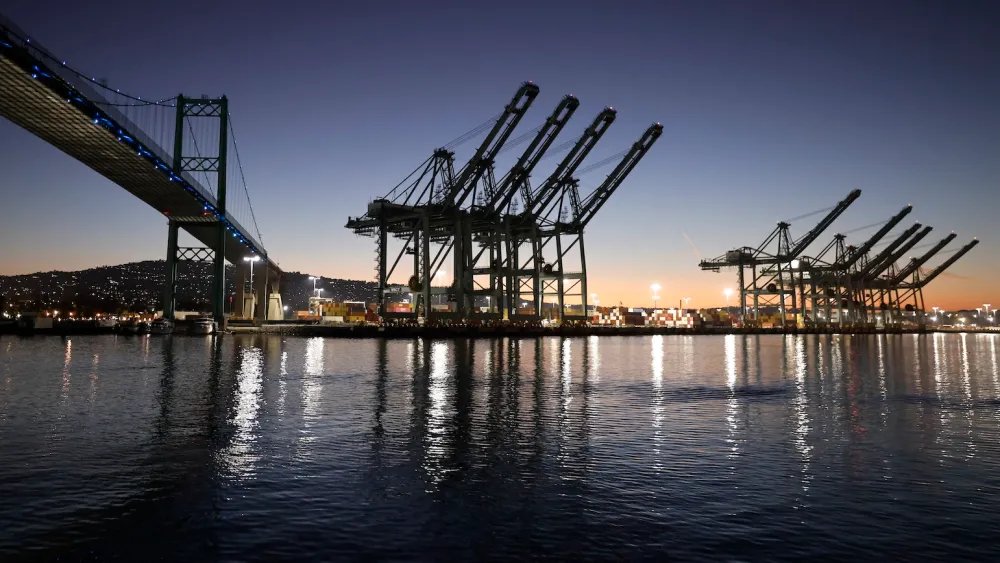
California’s neighboring ports of Los Angeles and Long Beach just closed the busiest month in the combined history of the San Pedro Bay gateway, handling 2.04 million 20-foot equivalent units (TEUs) in September as importers saw more tariff-related cost certainty and routed around turmoil at the Panama and Suez Canals.
The Port of Los Angeles moved 1,042,652 TEUs in September, the busiest month in its 118-year history and more than 20,000 units above its previous record, set in July 2025.
Loaded imports hit 545,696 TEUs, up 18.6 percent from last September—the 10th time the port has topped 500,000 loaded imports in a month, according to executive director Gene Seroka. Loaded exports rose 9.6 percent to 125,751 TEUs, while empties escalated 20.4 percent, hitting a record 371,206 TEUs as carriers rushed boxes back to Asia.
The Port of Long Beach was writing its own record book, moving 997,177 TEUs last month, beating its previous busiest month of October 2024 (987,191 TEUs) and jumping 25 percent from September 2025’s 797,537 TEUs.
Imports surged 31.3 percent to 509,390 TEUs, exports rose 7.8 percent to 91,747 TEUs and empties climbed 22.1 percent to 396,040 TEUs. Through September, Long Beach has handled 7,675,255 TEUs, up 3.9 percent year over year. The L.A. port is at nearly 8.1 million containers moved, up more than 3 percent.
Combined between the twin ports, loaded imports totaled 1,055,086 TEUs, up 24 percent year over year.
Looking ahead to cargo readings for this month, Seroka expects the L.A. port to process around 900,000 TEUs in October, and by early November most holiday merchandise should be in the country. The October projections, at minimum, would represent a 6.1 percent increase in containers handled over last year’s 848,424 TEUs.
During a media briefing Friday, Seroka attributed the swell of converging forces: tariffs running lower than earlier this year, giving importers more cost certainty; resilient consumer demand; and cargo allocated to Los Angeles at origin as shippers navigate “continued challenges along other global trade routes.”
In August, Seroka projected Panama Canal congestion and Middle East uncertainty could divert an additional 5 percent of volumes to Los Angeles. This month, he upgraded that figure, saying “it’s probably going to be a little bit more than that.”
Meetings with shipping lines, third-party logistics providers (3PLs) and manufacturers in South Korea and Singapore confirmed carriers are shifting “even more of their traditional allocation that would normally go through the canals” to Los Angeles, Seroka said.
The port director also noted that vessel fuel prices have doubled in eight months amid the war in Iran and the adjacent Middle East conflicts, making shorter transits more of a priority for shippers.
Helping the growth numbers, both major California ports continue to see more cargo flowing in from other markets.
Vietnam has leapfrogged to the No. 2 trading partner for the Port of Los Angeles behind China, Seroka said, with Vietnam-to-L.A. volumes quadrupling over the past decade. Thailand also has cracked the port’s top five origin countries for the first time, he noted.
At Long Beach, Vietnam is now the second-largest trading partner as well, with furniture, apparel and footwear leading the way—and China’s share of the port’s cargo has fallen from 70 percent six years ago to 55 percent last year.
Harvard Business School professor Willy Shih, who joined Seroka for the briefing, urged caution on declaring the China era over.
China’s direct share of U.S. imports has fallen from 21 percent in 2017 to just 9 percent by 2025, but the share of Chinese value added in those imports has “barely moved,” he said. Shih noted that many products out of Vietnam and Mexico are still reliant on Chinese intermediate goods at the product assembly stage.
“Companies, in some sense, are rearranging the final assembly step while the upstream dependence remains,” said Shih. “It’s not necessarily transshipment, because what we’re seeing is the assembly processes are moving and they’re shipping in components. An assembly has value added. It’s really at the core about dependence on suppliers who are often unique or lowest cost, and that’s going to take time to change.”
China’s shifting role in the U.S. supply chain followed the recent meeting between Presidents Donald Trump and Xi Jinping, in which the countries enacted a framework in which each government would scale back tariffs on $30 billion in imports.
“People are going to continue to want to preserve optionality. People need a longer horizon where they can have some stable framework, a stable set of rules to engage in their planning,” said Shih, noting that the old annual calendar model has shifted due to the volatile U.S. trade policy. “Until our leaders get together and get some stability, we’re just going to have to be in an environment where people are planning contingencies and creating options.”
Regardless of how and where the product is shipped to the U.S., the port continues to keep an eye on diesel fuel costs. As of Friday, California’s average diesel price reached $7.87 a gallon, up 62 percent since late February.
Those are costs small drayage operators can’t easily pass on, he said, and two-thirds of the port’s cargo leaves by truck. According to Seroka, more than half the truckers registered at the port run five rigs or fewer.
“If you’re a small business competing with larger companies that can absorb some of this shock, that’s a tough spot to be in,” said Seroka. “We’re trying our best to help support these folks, getting them clear and clean runs every day so they can make more turns, which means more money for those truck drivers.”