dailynewsnblog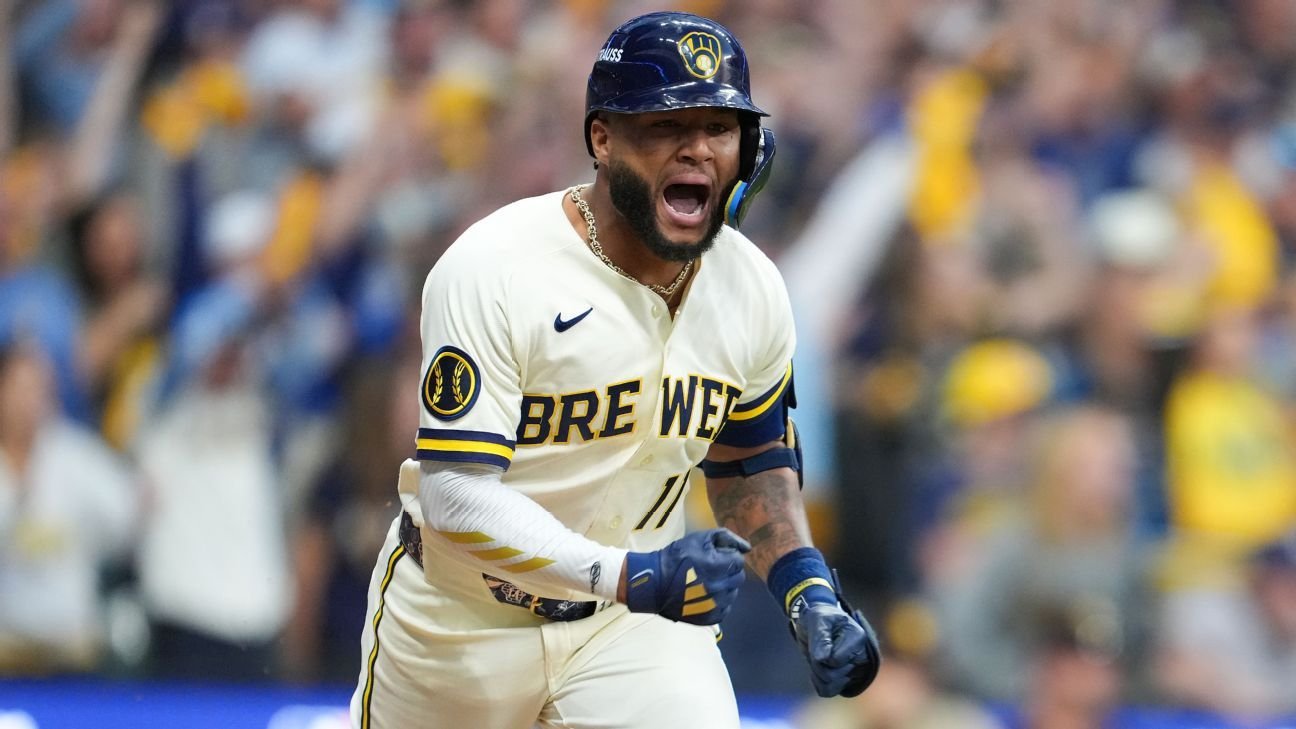
We are now a week into the 2026 MLB playoffs, with two games completed in all four division series.
In the small-sample-size sprint of the postseason, it might seem to be enough time to know a lot. But in a sport that follows 162-game seasons with a chaotic October format, things can change in a hurry.
As we do early in every MLB regular season, we asked our MLB experts to go all-in on one thing that has stuck out to them by giving us their boldest prediction for the rest of the playoffs based on the early action.
Some went bold, whereas others took a milder approach. But all of them have a chance of becoming red-hot by the time the World Series trophy is raised — or could end up ice-cold.

The Year of the Brewers?
Jackson Chourio will become the 10th player to win LCS and World Series MVPs
I am known for one-year-too-early predictions, so …
Why doubt the Milwaukee Brewers now? They’ve enjoyed a magical run to this point and have looked great at the onset of the division series. Chourio has been quite the table setter — OK, more of a run producer this time around, with a homer and four RBIs in the first two games — and he’s one of the game’s budding superstars. This October is his breakout party. For real this time. — Tristan Cockcroft
The Brewers will trail in every playoff game en route to a championship
I’ve already gone on record as being a “Brewers believer.” Jackson Chourio and Brice Turang might not be as good as Paul Molitor and Robin Yount, but the current Milwaukee team is ready to win the franchise’s first World Series crown.
But it won’t be a walk in the park. Though the Brewers have a 2-0 series lead on the San Diego Padres in the NLDS, Milwaukee has had to come from behind in both of those wins to protect home-field advantage in the series. I think that trend will continue, with the Brewers falling behind in each of their postseason contests.
Some of those games will end in defeat, but they’ll mount a comeback in just enough of them to get by, winning the series in five, seven and seven games. — AJ Mass
Miz & Co. will combine for a World Series no-hitter
It isn’t as bold as it might seem to predict a combined World Series no-hitter. After all, the Houston Astros pulled this off in 2022. RHP Cristian Javier and three relief pitchers shut down the Philadelphia Phillies in Philly’s ballpark in Game 4, a tasty precursor to winning the championship.
Watch the Brewers achieve something similar this postseason. Strikeout machine Jacob Misiorowski permitted a .157 batting average this season! He is hard to hit. This feels like Milwaukee’s year (finally), so let’s go even further and predict The Miz, along with RHPs Abner Uribe and Trevor Megill, completely shut down whichever AL foe they face in Game 1 of the World Series. — Eric Karabell
The other teams we’ll be talking about most
Mason Miller will get another shot at closing out the Brewers — in Game 5
It’s hard to remember a team absorbing consecutive heartbreaks as the Padres did in Milwaukee. One could excuse them for feeling defeated. But it’s also easy to envision a path for them to get back into this series: playing back-to-back games in their raucous home environment, where they are 23-5 since the start of August, and facing the soft spot of the Brewers’ rotation.
The Padres’ offense will come to life at Petco Park over these next two nights, forcing a close, winner-take-all Game 5 that will be decided late — with Mason Miller on the mound once more. — Alden Gonzalez
The Dodgers won’t win another game this postseason — or a series next October
Walt Weiss’ master strategy of holding back Chris Sale will pay off in Game 3 and then the weight of the world will be on the Dodgers for Game 4. It’ll end there. Then, they’ll start to show their age while the lockout next season prevents them from managing their oft-injured pitchers properly this winter or in a normal spring training. Adding insult to injury, River Ryan and Zyhir Hope star for the Tigers as the Dodgers’ dynasty comes to an abrupt halt. You asked for bold … right? — Jesse Rogers
The White Sox will win the American League
Sure, this declaration might look silly in a few days, but the White Sox are undoubtedly this year’s fun team, and sometimes, all you need are those good vibes to ride the October wave.
Of course, it helps that the AL is so mediocre, helping to create an opening for the White Sox. But there are baseball reasons to like them. They hit home runs, and homers win games in October. Will Venable has quickly learned an important October lesson: win today, then worry about tomorrow.
An example of this is his usage of Grant Taylor, his best relief pitcher, who pitched 2⅓ innings in one game against Houston and then four innings to close out Game 1 against Cleveland (throwing just 42 pitches). That’s not easy — ask Mason Miller — but if Taylor can keep doing this, a White Sox miracle is possible. The emergence of rookie lefty Hagen Smith as an opener — three scoreless against the Astros, 2⅔ scoreless against the Guardians — is another positive.
It won’t be a conventional approach, but it can work. And we can hope for Munetaka Murakami’s ALCS-clinching postgame interview. — David Schoenfield
The themes that will rule the month
A homerless postseason for two MLB superstars
We will go through October without a home run from either of the preeminent sluggers in the sport, Aaron Judge or Shohei Ohtani.
Judge might return sometime this month, but as he demonstrated in his brief time on the roster in September, he has some catching up to do with his swing.
And Ohtani, also trying to rebound from injury, looks off-balance. One veteran MLB hitting guru noted that his mechanics now look like Bryce Harper’s in those stretches when Harper has struggled. “He’s got his butt in the first-base dugout,” he said. And it won’t get easier for Ohtani anytime soon; he faces Chris Sale in Game 3. — Buster Olney
Pitch tipping will become a defining theme of this postseason
For those of you who dwell in the bowels of the internet, as I unfortunately do, you’ve likely already seen it theorized that Jackson Chourio’s game-winning knock against Mason Miller came after Chourio took a slider that he knew was coming. That’s because, as the online sleuths will have you believe, Miller’s wrist orientation gave it away, and Sal Frelick communicated the tell with a hand-to-neck gesture while leading off second base.
Zooming out, teams have invested more time and resources into detecting pitch tips than ever before. I fully expect managers and players to start fielding questions about it in earnest and, in response, paranoia to set in. — Paul Hembekides
A new pitch will take over the playoffs
Last year, the splitter became the pitch of the postseason. This year, it will be the changeup. We already saw Rays ace Drew Rasmussen flummox the Yankees’ lineup, which featured eight left-handed hitters, with a marked increase in changeup usage in Game 1 of the ALDS. He’s far from the only Rays player to rely on the pitch as an effective weapon; starters Nick Martinez, Ian Seymour, Freddy Peralta, and closer Bryan Baker all ranked in the top 26 in changeup run value across baseball during the regular season.
Other prominent users in the postseason: Dodgers star Tarik Skubal, Guardians rookie sensation Parker Messick; and the Padres’ Michael King, Bradgley Rodríguez and Robbie Ray. Quite the list. — Jorge Castillo
Or … the fastball will dominate the month
The death of the fastball has been greatly exaggerated — and its resurgence has arrived this postseason with a little extra mustard on it. Fastball usage (four- and two-seam) dropped to an all-time low last postseason at 47.2% of pitches. It was the fourth year of the last five that it had been below 50%. This postseason, the number has spiked to 51.2% — the highest since 52.5% in 2018. Why? Fastballs have gotten better. The average postseason four-seamer lived around 95 mph from 2019-23. It ticked up to 95.5 in 2024 and 95.9 last year. The leap this season has been profound: four-seamers are averaging 96.6 mph. And considering the petrol the remaining postseason starters are flinging – not to mention the proliferation of triple-digit bullpen arms — pitchers are going to lean on the heater more than they have in recent times. — Jeff Passan
Starter, opener — what’s the difference anyway?
This is a little esoteric to be considered a hot take, but hear me out: This postseason is proving, and will continue to prove, that the difference between a starting pitcher and an opener is slim and getting slimmer.
When Ray Kerr throws 2⅔ and Blake Snell throws 3⅔ in Game 2 of the NLDS, the result is the same — a bullpen game for both teams. This is now routine. Hagen Smith, the White Sox opener, went 2⅔ in Game 1 of the ALDS; Parker Messick, the Guardians’ starter, went 4⅓.
The number of starters who are trusted by their managers to get through even the slightest bit of trouble is down to one or two per team. The rest, no matter what they’re called, are merely openers, and nearly every game is a bullpen game. — Tim Keown
Young pitchers will dominate October
This round will be defined by relatively inexperienced pitchers who are in their rookie or second big league season spread across all four series: Jacob Misiorowski, Cam Schlittler, Parker Messick, Logan Henderson, Grant Taylor, Didier Fuentes, Hagen Smith, and Bradgley Rodriguez.
Through the first two days of division series games, these pitchers combined for 25⅔ innings, 13 hits, six earned runs, 10 walks, 31 strikeouts and a 2.10 ERA — and that’s before Schlittler made his Game 2 start. Those combined numbers are basically the peripherals of Taylor in relief during the regular season — one of the top dozen or so relievers in the sport, who pitched 1-2 innings at a time — from an even mix of starters and multi-inning relievers doing it in the biggest games of the season.
Misiorowski is the only pitcher in this group who ranked in the top half of a top-100 prospect list while in the minor leagues, and he barely made it; some of these players were still considered prospects earlier this season, and they are dominating in the postseason, peppered with nine-figure contracts and mixed results. — Kiley McDaniel