dailynewsnblog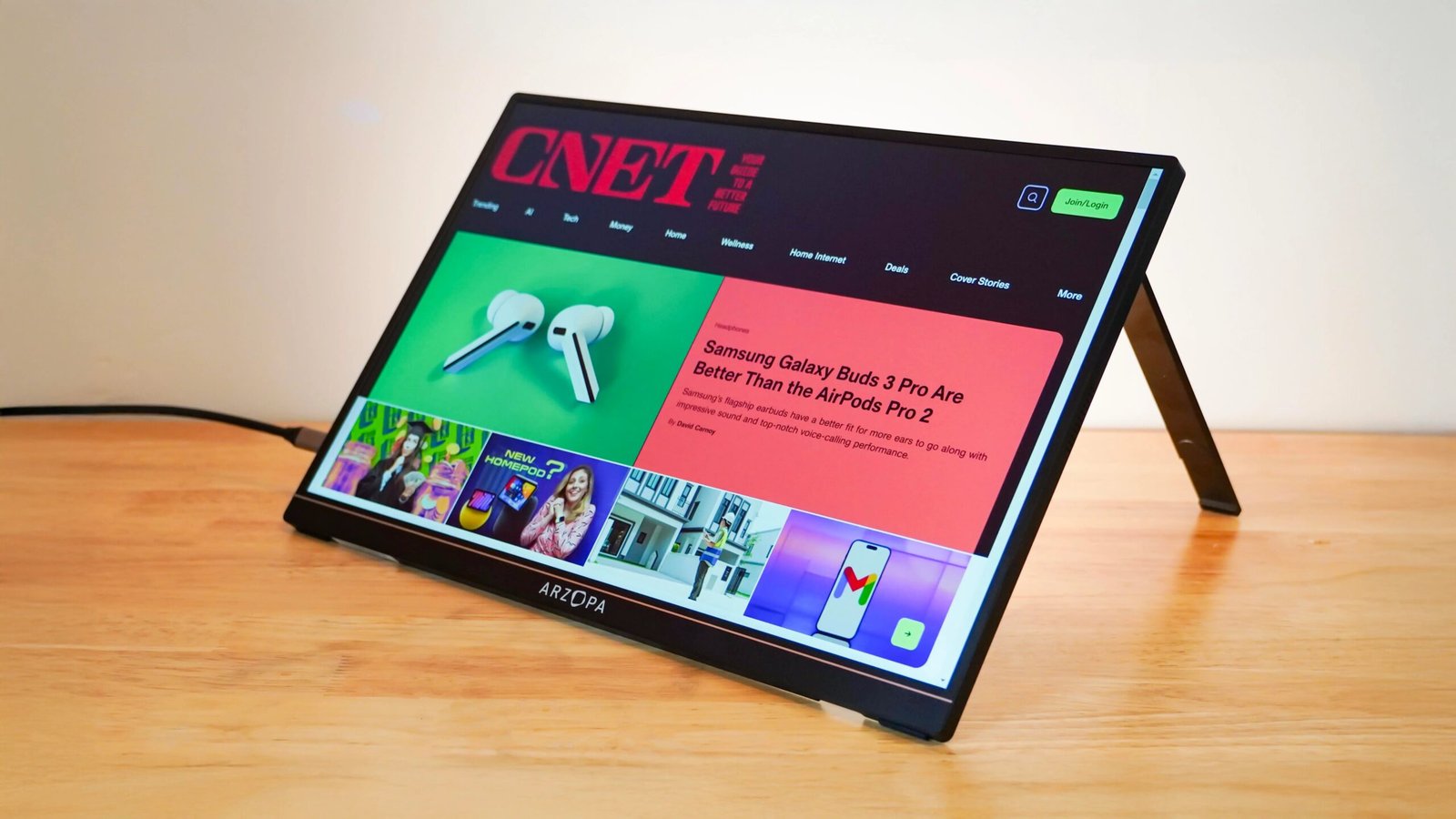
Portable monitors are a simple way to instantly increase your screen space almost anywhere. Ranging in size from 13 to 21.5 inches, they can connect to a laptop with a single USB-C cable for picture and power or via an HDMI cable. There are many models to choose from, from big names like Lenovo, ViewSonic and Asus as well as smaller, unfamiliar brands. Features, design, build quality and image quality can vary, as can prices, with options starting under $100 and going up to hundreds of dollars. Extras like speakers, a built-in battery or even touch and stylus support add to the cost. The best portable monitor I tested, though, delivered the best balance of performance, features and price.
Our Picks

Bottom Line
Of the portable monitors I’ve tested recently, the Arzopa Z1RC leads the way in many respects. Its affordable price cements its place as a lea…
Pros & Cons
-
Solid performance, features for the price -
Versatile built-in stand
-
Brightness short of rated specs -
Don’t bother with HDR

Bottom Line
If you’ve spent any time shopping for a portable monitor, you’ll have seen many that look nearly identical to the UPerfect BE16CU. To stand ou…
Pros & Cons
-
Bright, matte display -
High-resolution panel -
Colorful -
Supports pass-through power
-
Occasional diagonal screen door-like pattern -
Falls short of advertised specs -
Bland design -
Poor speakers -
Needs auxiliary power for max brightness

Bottom Line
If you prioritize a generously sized screen over small and light and like the idea of a 100Hz refresh rate for slightly smoother visuals, the …
Pros & Cons
-
18.5-inch display with 100% sRGB coverage -
All necessary cables, power adapter included
-
Disappointing brightness -
Might need additional power

Bottom Line
The MP165 E6 doesn’t offer much in the way of features, but at well under $100 it’s not as frill-free as you’d think, either. A 15.6-inch IPS…
Pros & Cons
-
Bargain price -
Thin and portable -
Strong anti-glare -
Decently bright
-
Very small color gamut -
Basic panel specs

Bottom Line
It would be easy to write off the M14t Gen 2 based on its 14-inch size and high $350 price. And if you’re just after a small, cheap portable m…
Pros & Cons
-
Slim, lightweight design -
Touchscreen with active pen support
-
Expensive if you’re not a corporate buyer

Bottom Line
The Asus ZenScreen MB229CF pushes the boundaries of portability at 21.5 inches, but its versatile design and included accessories make it a to…
Pros & Cons
-
Versatile design -
Power via USB-C or included adapter with 60-watt pass-through
-
Too large for travel -
Merely average display performance
What is the best portable monitor overall?
The 16-inch Arzopa Z1RC is the best portable monitor I’ve tested, checking off almost every box for what makes a good everyday portable monitor. It’s got slim bezels and a lightweight design, so you don’t have too much extra to carry. I don’t just rank the Z1RC at the top of the pack for its design, though: It has good technical specifications and delivers on performance, too. Around $100, it’s also one of the most affordable options I’ve tested.
Read more: Best Gaming Monitors
If you need advice on whether a particular type of monitor is right for you, there are some answers to common questions at the bottom of the list and a lot more guidance available in our general monitor and gaming monitor buying guides.
What we updated: Sept. 2026
Added the UPerfect BE16CU 16-inch 4K-resolution portable monitor.
Best portable monitor overall
Arzopa Z1RC
-
Solid performance, features for the price -
Versatile built-in stand
-
Brightness short of rated specs -
Don’t bother with HDR
Of the portable monitors I’ve tested recently, the Arzopa Z1RC leads the way in many respects. Its affordable price cements its place as a leading option for general-purpose use.
From its 16-inch size to its versatile kickstand to its slim, lightweight build, the Z1RC is impressive for its price. The 2,560×1,600 resolution helps keep everything sharp at this size — that’s about 188 pixels per inch — with a 16:10 aspect ratio to match many newer laptops. It covers a surprisingly large chunk of the P3 color space, as much as 94% (which encompasses the sRGB space). It’s not the brightest display, but at over 360 nits, it’s impressive for a portable monitor, and combined with an anti-glare finish, it’s easy to see in most conditions. The Z1RC is flexible in how you set it up, too. It has two USB-C ports and can run off a single-cable connection with a compatible device. Its second port is handy if you need auxiliary power or when you need broader compatibility with its mini HDMI input. A built-in kickstand also makes it easy to prop the monitor up horizontally and vertically, without the inevitable “yikes it’s going to topple” moments you get with the less rigid folding stands.
The biggest caveat is that while 350 nits is good for the price, it’s far short of the 500 nits Arzopa rates it at, and not great in direct sunlight. That doesn’t mean it can’t hit that peak, but it could mean that the only way to hit it is under very specific, infrequent circumstances. It also means that it’s not really an HDR monitor, regardless of what it’s marketed as. Even 500 nits is very low for HDR.
- Size
- 16 inch
- Resolution
- 2,560×1,600
- Gamut coverage (as tested)
- 100% sRGB, 94% P3
- Refresh rate
- 60Hz
- Connections
- Mini HDMI, USB-C (x2)
Brightest portable monitor
UPerfect BE16CU
-
Bright, matte display -
High-resolution panel -
Colorful -
Supports pass-through power
-
Occasional diagonal screen door-like pattern -
Falls short of advertised specs -
Bland design -
Poor speakers -
Needs auxiliary power for max brightness
If you’ve spent any time shopping for a portable monitor, you’ll have seen many that look nearly identical to the UPerfect BE16CU. To stand out from the pack, a lot of the manufacturers, including UPerfect, tout some attention-grabbing specs. What sets the BE16CU apart is its promise of ultrahigh brightness — up to 1,200 nits — for a 16-inch 4K-resolution panel.
While it doesn’t quite reach the advertised brightness, it is the brightest portable monitor I’ve tested at 1,053 nits. It needs a discrete power source to reach that brightness, but if you want a display you can use in all kinds of lighting, this is a good pick. However, there are a couple of caveats.
Other aspects of the display are hit or miss. So much so that I ended up testing two of them — one that came straight from UPerfect and a second from Amazon. Both performed well enough, but the results were different, so you’ll want to be sure it meets your needs out of the box. It might be fine if you only care about brightness and resolution, but if you care about contrast and color, you’ll be spinning a roulette wheel for what performance you might get.
- Size
- 16 inch
- Resolution
- 3,840×2,400
- Gamut coverage (as tested)
- 100% sRGB, 98% P3
- Refresh rate
- 60Hz
- Connections
- Mini HDMI, USB-C (x2), 3.5mm audio
Best large portable monitor
InnoView INVPM501
-
18.5-inch display with 100% sRGB coverage -
All necessary cables, power adapter included
-
Disappointing brightness -
Might need additional power
If you prioritize a generously sized screen over small and light and like the idea of a 100Hz refresh rate for slightly smoother visuals, the InnoView INVPM501 should get the job done without blowing your budget.
At 18.5 inches, it’s larger than most laptop or portable displays, The package includes all the necessary cables, a sleeve for carrying the monitor and even a power adapter in case your laptop can’t pump enough juice to power the monitor, since bigger screens need more than smaller ones. If your device’s USB-C can output 20 watts to power the monitor and can send a video signal over USB-C (known as Alt Mode), you can run it off a single cable, though if you use the power adapter then connecting over mini HDMI is also an option. The stable built-in stand gives you positioning flexibility, too. Across all its main picture settings, it maintains a respectable color gamut, hitting 100% coverage of the sRGB color space and a passable 90% of the P3 color space, allowing for vibrant visuals.
Its 100Hz refresh rate might help for some gaming, as long as a game doesn’t require fast, clear visuals. The panel has typical old-school IPS pixel response time and exhibits notable ghosting in Blur Busters’ UFO test. It’s also not especially bright, and its 1080p resolution means the picture isn’t very sharp for its size.
- Size
- 18.5 inch
- Resolution
- 1,920×1,080
- Gamut coverage (as tested)
- 100% sRGB, 91% P3
- Refresh rate
- 100Hz
- Connections
- Mini HDMI, USB-C (x2)
Best portable monitor under $100
MSI Pro MP165 E6
-
Bargain price -
Thin and portable -
Strong anti-glare -
Decently bright
-
Very small color gamut -
Basic panel specs
The MP165 E6 doesn’t offer much in the way of features, but at well under $100 it’s not as frill-free as you’d think, either. A 15.6-inch IPS 1080p IPS display that gets bright enough for some outdoor work, it has both HDMI and USB-C connections — including 60W power delivery — plus minimalist speakers and a headphone jack. It even has a built-in kickstand rather than a flimsy foldable cover to prop it up. It’s made of plastic, but still reasonably sturdy.
The biggest corner it cuts is the cheap panel, which only achieves about 64% coverage of the sRGB color gamut. That’s really low. If you only need the monitor for basic work where color doesn’t matter, it shouldn’t be a problem. You can always use your laptop’s screen when washed-out colors may be an issue.
- Size
- 15.6 inch
- Resolution
- 1,920×1,080
- Gamut coverage (as tested)
- 47% P3, 64% sRGB
- Refresh rate
- 60Hz
- Connections
- 1 x HDMI 2.0b, 2 x USB-C (60W PD)
Best portable display for travel
Lenovo ThinkVision M14t Gen 2
-
Slim, lightweight design -
Touchscreen with active pen support
-
Expensive if you’re not a corporate buyer
It would be easy to write off the M14t Gen 2 based on its 14-inch size and high $350 price. And if you’re just after a small, cheap portable monitor, you’d be right to keep looking. However, once you consider its specs, design and feature set optimized for business travel, you’ll understand why this costs more than others.
For starters, the compact, lightweight display (it weighs under 1.5 pounds) has a higher 2,240×1,400-pixel resolution (almost 200 pixels per inch) than you’ll find on cheaper options this size; that’s really nice if you want some flexibility for making elements on the screen larger. It’s also a touchscreen with support for an active pen, so you can use it as a portable whiteboard for presentations, a notepad or a sketchbook. An active pen is an extra expense, but it includes a passive stylus along with a felt case. The display’s attached kickstand can tilt the screen at any angle from 0 to 90 degrees, and the screen can be rotated to use the base as an elevated support while drawing or writing. The base can also lift the display up 0.4 in/11mm. A USB-C port is available on each side of the base so that it can be powered or connected from either side. The USB ports support 65-watt power delivery, too, allowing for pass-through charging of your laptop with a single power adapter. You’ll also find two USB-A ports.
The one place it falls short is on brightness. In my tests, brightness maxed out at 267 nits, which is OK indoors but not quite bright enough for outdoors, especially with its glossy coating. It does have excellent contrast for an IPS LCD, though — that’s the upside of gloss on a dim display — and covers 100% of sRGB color gamut.
Since it’s intended primarily for business, you’re more likely to get one from your IT department, which buys in bulk at a lower cost. If you don’t need the pen or touch capabilities, the ThinkVision M14d is available and cuts the price to about $270.
- Size
- 14 inch
- Resolution
- 2,240×1,400
- Color gamut (as tested)
- 100% sRGB, 79% P3
- Refresh rate
- 60Hz
- Connections
- USB-C (x2), USB-A (x2)
Best portable office monitor
Asus ZenScreen MB229CF
-
Versatile design -
Power via USB-C or included adapter with 60-watt pass-through
-
Too large for travel -
Merely average display performance
The Asus ZenScreen MB229CF pushes the boundaries of portability at 21.5 inches, but its versatile design and included accessories make it a top pick for setting up a small office anywhere. The MB229CF may not be the most mobile monitor you can get, and it’s not the best desktop monitor for the money, but its ability to serve in both capacities makes it a unique and compelling option for those who need its kind of flexibility plus a better-than-usual 100Hz refresh rate.
The sturdy, built-in metal kickstand allows for a wide range of angles: Flipping the kickstand all the way up to the top of the display lets you hang it on the bundled hooks to fit over standard partition walls, giving you more desk space in a cubicle. The monitor has a quick-release mount that works with an included C-clamp desk stand, so you can quickly set it up like a regular desktop monitor. There’s also a standard VESA 100×100 mount to put it on an arm or generic stand. For connections, it has a USB-C port that can handle power and video or provide 60 watts of pass-through charging to a device when the monitor is powered by the included 90-watt adapter. It even has a full-size HDMI port for broader compatibility. There are built-in speakers if you need audio in a pinch; there’s also a headphone jack. Plus, it has a three-year warranty.
The screen itself has room for improvement given its roughly $300 price; it’s not terribly bright and its low 1080p resolution (around 100 pixels per inch) means the screen isn’t especially sharp, and while its 97% sRGB color-gamut coverage is fine for most office work, it’s disappointing for the money.
- Size
- 22.5 inch
- Resolution
- 1,920×1,080
- Gamut coverage (as tested)
- 97% sRGB, 79% P3
- Refresh rate
- 100Hz
- Connections
- USB-C (60-watt PD), HDMI 1.4, headphone jack
Other notable portable monitors we tested
Viewsonic VG1656N: This is a pretty mediocre monitor, especially given its $300-plus price tag, but the VG1656N does have one notable feature you may care about: It’s wireless. It’s not particularly good wireless, with noticeable compression artifacts in displayed content and no way to tell how much power remains in its 3-hour battery, but if you’re desperate and your company is paying, it’s an option.
HP Series 5 Pro 514pn: The 514pn is a thin, light and well-constructed 2,560×1,600 14-inch display which also performs quite well. It covers 100% of both the P3 and Adobe RGB gamuts, can hit over 400 nits brightness for when you need to work in bright light (with solid contrast) and has decent color accuracy with a Delta E of under 3. The downside is its price, about $300, especially since it doesn’t have any audio or HDMI for use in a pinch.
Uperfect A17 DS15607: The A17 may be far from an exceptional monitor, but for the money, it has relatively strong brightness and clarity in a package that’s solid for on-the-go productivity. On one hand, the 4K 15.6-inch panel delivers almost 285 pixels per inch, so the screen can be exceptionally sharp. Uperfect backs that up with a solid brightness level of about 427 nits (a touch shy of its 450-nit rating) and surprisingly high 1610:1 contrast ratio. That pairs well with a strong matte finish for easy visibility. Regardless of how the monitor fails to meet the bars that Uperfect set for the A17, it manages good performance for a budget portable monitor (priced at $220 at our last update).
The design isn’t elegant, but it’s simple and effective. For the most part it’s just a big plastic slab nearly half an inch thick with no integrated kickstand, just a magnetic cover that protects the display when it’s packed and tilts it at a few different angles when in use. There are two USB-C ports and an HDMI port, and though it can run off a single-cable connection, like other monitors we’ve seen, that’s not always reliable. At maximum brightness and using the monitor’s (bad) built-in speakers, it requires too much power for a single-cable connection and will begin to power cycle. Simply foregoing the use of the speakers was enough to get over that hurdle in our testing. Just how much you can use will also depend on your system’s port, as we had a better experience using Thunderbolt 4 and more power cycling on USB4.
Minisforum MDSA156: Like the dual-screen Acer PD163Q I reviewed, the MDSA156 is one of few dual-display portable monitors, offering more screen real estate than a single does. It folds up like a laptop, but when opened turns into two 1080p screens connected by a hinge. But they’re disappointing displays with limited color gamuts (far short of full sRGB), and the color and brightness shift dramatically when viewed off angle. The contrast is fine, and they hover around 300 nits of max brightness, though the upper display is notably dimmer, while the lower display has weaker contrast.
On the plus side, runs both off a single USB-C cable connection. At max brightness, though, they use too much power for many devices (30 watts) and can require a second cable. At least the antiglare finish proves fairly forgiving while running the displays at lower brightness. It’s also decently built with a beefy kickstand, plus the hinge between screens holds the monitors at a variety of angles for considerable flexibility. The chassis and kickstand of the monitor is also all metal. It all adds up though: The monitor weighs 3.3 lbs (1.5 kg), as much as a lot of laptops. It includes speakers that can be useful in a pinch, though they don’t sound good. Minisforum also includes two USB cables, an HDMI cable, and a small power brick to pretty much cover all the bases of what you might need for connectivity. You do get a lot for the money; at $216, it’s a nice price compared to the Acer PD163Q.
How we test portable monitors
Measurements are taken using a Spyder X2 Ultra colorimeter using DataColor’s Spyder X2 software for SDR. Color accuracy measurement results are reported in Delta E 1976 using Datacolor’s 48-color patch test.
In addition, HDR results are gathered using the VESA DisplayHDR Test app’s patterns to display 100% and 10% windows for brightness measurements as well as RGBW values, again measured using the Spyder X2 Ultra, to get CIE xyY color values and compared against the DCI-P3 color space’s xyY color values to calculate HDR gamut coverage using this gamut calculator.
On the most basic monitors, we may stick with just brightness, contrast and color gamut, while on more capable displays, we may run tests of most user-selectable modes for gaming or color-critical usage, uniformity and so on. For the color work, we may also run tests to verify how white point accuracy varies with brightness. We also use Blur Busters’ motion tests to judge motion artifacts (such as ghosting) or refresh rate-related problems that can affect gaming.
Keep in mind that individual results can vary from a manufacturer’s reported results for a variety of reasons. For instance, you can be using a different set of color patches for the accuracy tests (as I do), a different colorimeter (as most individuals do), a different way of calculating (such as determining gamut using RGB and CMY primaries rather than the more common RGB only), monitor settings (manufacturers rarely provide the OSD settings used for its tests) and so on.
It is also not uncommon for testing results to be off from the manufacturer’s advertised specifications. For example, the brightest portable monitor I tested was also one of the farthest off the mark. The UPerfect BE16CU advertised 1,200 nits of brightness, but I measured it at just 890 nits. It was so far off that I did extensive retesting to make sure I wasn’t missing some setting that was holding it back. I even got in a second unit that managed to run brighter at 1,053 nits, but that’s still 12% short. Nonetheless, it is the brightest portable monitor I’ve tested, which is why the UPerfect BE16CU landed on our list of best portable monitors.
Things to know about portable monitors
Connections
There’s no universal rule about what connections portable monitors have to offer. From one to the next, you can find any combination of ports. Some portable monitors rely on just a single USB-C connection for power and video, and others may need auxiliary power. Many of the best options include a USB-C port to handle all your needs, so you only need one cable. Most also include an HDMI or mini HDMI port, which provides broader compatibility. Newer laptops can handle display output over USB, while game consoles, older laptops and desktops might not, so having any kind of HDMI port is useful.
Power
Some portable monitors can draw all their power from the same USB-C cable they get their video signal. Bigger, brighter and higher-resolution monitors typically need more power, and this can be too much for USB ports. In these cases, the monitor may have a second port for auxiliary power. Unfortunately, the matter of powering portable monitors is incredibly variable. Some laptop USB ports can supply enough power for a portable monitor, but another port on the laptop might not. Some monitors I’ve tested will work fine with a single USB connection to a laptop but then turn off if the brightness is set too high. Given the variability, it’s important to check each monitor’s specific power requirements and try to ascertain whether your computer has a port to meet the requirement. If you’re particularly concerned about power on the go and using fewer cable connections, some portable monitors include built-in batteries.
Size
Size is an important consideration for a portable monitor. You want to maximize the additional screen real estate you’re getting on the go, but you also want to avoid ending up with a monitor that’s so big that it limits mobility or uses too much desk space. You’ll generally find a listed size with each monitor that indicates the diagonal size of the display area only. So, to make sure the monitor you’re looking at will actually work for you, be sure to also check the physical dimensions of the monitor.
Color
Just like size and resolution, color gamut is an important consideration. Put simply, it’s a measure of the range of colors a monitor can display, and it’s presented as a percentage of a specific color space. Lower ratings will mean a less vibrant, more drab monitor. Higher ratings mean more lifelike colors. If you’re just doing office work and want extra space for spreadsheets, just about any monitor will do, regardless of color gamut. A 95% or more rating for the sRGB color space is good for entertainment and general web work. Monitors that cover 95% or more of the DCI-P3 color space can display a wider range of colors, making photos, videos and games more enjoyable, but these will generally be more expensive options. For professional use, you’ll want to check for a measurement of color accuracy, too; a value of Delta E≦2 is optimal. Most portable displays are not color-calibrated out of the box and can look significantly better after calibration with a colorimeter. Short of that, you can use tools in MacOS and Windows to improve image quality manually.
Portable monitor FAQs
What’s important if I want to travel with a portable monitor?
Portable monitors, unlike laptop displays, don’t all have built-in protection. When you travel with your laptop, you close it, in turn protecting the display. The rest of the laptop covers the display and adds some structural rigidity to it. Portable monitors don’t have these benefits. So, if you take a portable monitor with you, it’s a good idea to have a sleeve or cover for the screen itself to protect it from scratching, and you’ll want to ensure it won’t get bent in your bag. Thankfully, many portable monitors come with covers and sleeves. Most also include some sort of stand, so you can prop them up easily wherever you go.
Can I use a portable monitor with my phone?
This depends on a couple of factors. Many phones don’t support display output, so you won’t be able to use your phone with these monitors. Some phones, such as recent iPhones, support display output over their USB-C port. But these are unlikely to supply enough electricity to power the external monitor. That means while you can still use the portable monitor, you will likely need auxiliary power for the monitor itself.
Are portable monitors good for gaming?
Portable monitors don’t have any inherent advantages for gaming. Many are built with lower-quality display panels and have low refresh rates. Many I’ve tested suffer from some ghosting, which doesn’t impact day-to-day use heavily but negatively affects gaming. Low refresh rates also keep games from looking as smooth. That said, plenty of portable monitors have special gaming optimizations. You can find models with fast 120Hz and higher refresh rates, and some even offer OLED panels, which exhibit almost no ghosting. That said, most portable monitors are larger than the screens on mobile gaming devices like the Steam Deck or Nintendo Switch, which alone can be worth it.
Can I use a tablet as a portable monitor instead?
If you own a tablet, there’s a good chance you can use it as a portable monitor. Many iPads work with more recent Macs as extra monitors. Some Android tablets will work similarly with Windows PCs, either with their own tools or with third-party software, like SuperDisplay, an app I’ve used to run a Galaxy Tab S7 Plus as a portable monitor for my Windows laptops. Many tablets have high-quality displays that rival portable monitors. They also offer touch controls and are also tablets when not connected to a computer. There can be drawbacks, though. Wireless connections aren’t always reliable. Plus, in my experience with SuperDisplay, video signal compression hurts moving visuals and the software comes with a bit of latency that rules out gaming.