dailynewsnblog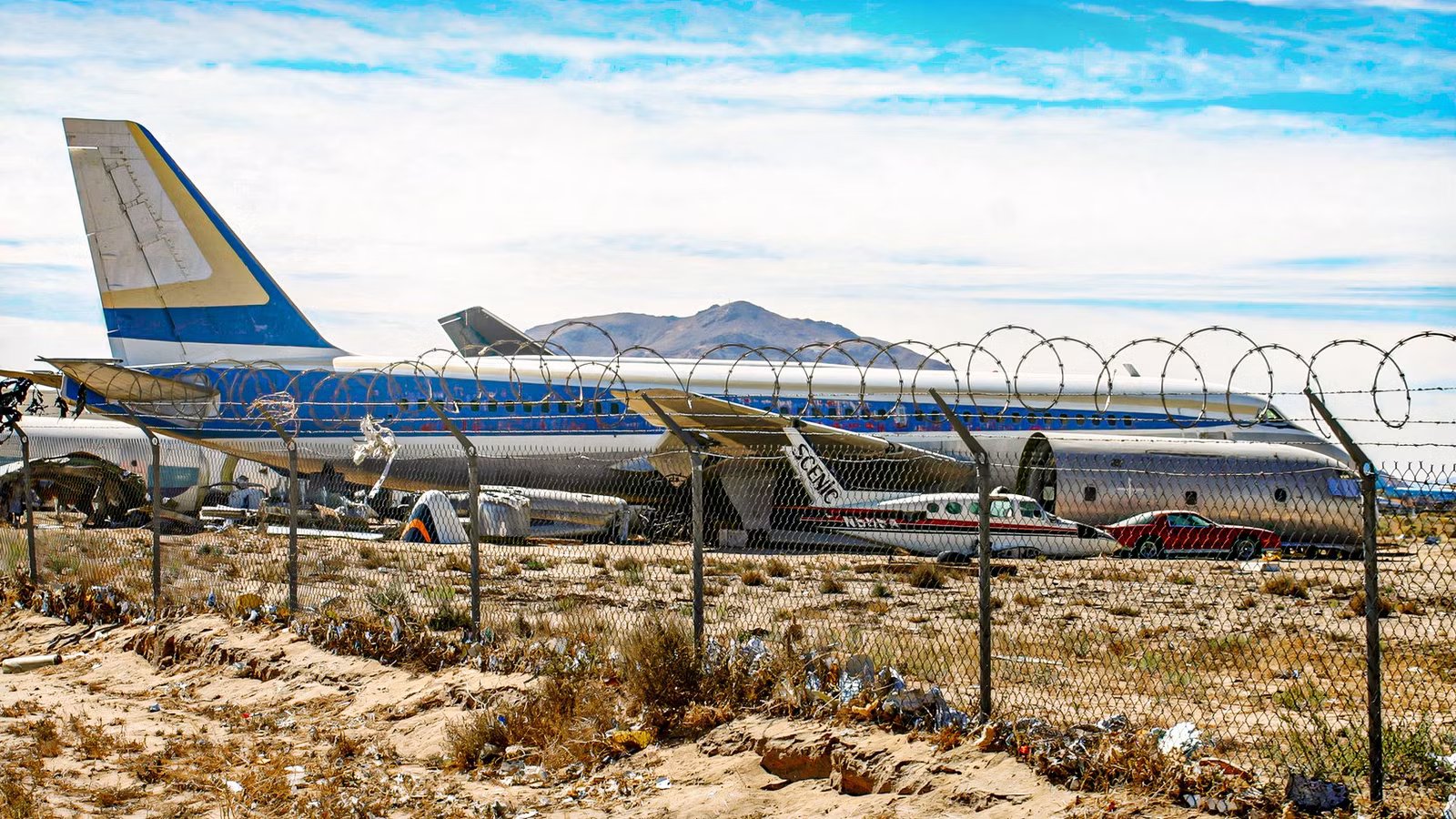
The Mojave Air & Space Port is more than a resting place for forgotten aircraft. Among the hundreds of planes that have passed through its dry California desert environment are the remnants of a failed idea in American aviation: a high-speed, narrow-body, fuel-hungry first-generation jetliner that General Dynamics ultimately lost millions of dollars pursuing.
The Convair 880 and 990 were designed to challenge  Boeing and Douglas during the dawn of the jet age, promising passengers greater speed and a luxurious flying experience. Yet their impressive performance came at a steep cost, and intense competition, high fuel consumption, and limited sales eventually ended Convair’s commercial ambitions. Today, a handful of these rare aircraft remain at Mojave.
The Arid Mojave Desert Preserves Aero Relics Of Bygone Eras

The Mojave Air & Space Port is located roughly 100 miles (161 kilometers) north of Los Angeles, California, near Edwards Air Force Base. In terms of aerospace activities, Mojave is very active, with current operations including flight testing, aerospace design/manufacturing, test-pilot training, spaceflight activities, and aircraft storage. The storage area is located in a remote part of the facility, isolated from major metropolitan areas and other major airports.
Mojave provides an excellent location for long-term aircraft storage because of its constant, dry, low-humidity desert environment. Any area with high or moderate precipitation or humidity would accelerate the natural breakdown of a plane’s fuselage, avionics, and other sensitive components necessary for an aircraft’s operation.
The Air & Space Port’s storage area is so ideal that large Boeing, Airbus, McDonnell-Douglas, and Lockheed aircraft under the ownership of major airlines are, from time to time, placed within the confines of this area. When a plane is deemed ready to reenter service, it is withdrawn, placed into a lengthy, detailed refurbishing process, and made flight-ready again. Of the oldest models, Airport Spotting identified five surviving Convair 880 and 990 airframes or sections at Mojave, including three complete 880s and two 990s. One of these aircraft, NASA’s CV-990 #810, is now preserved as a gate guardian on display at the entrance to the Air & Space Port.
However, more often than not, most planes that enter the storage confines do not leave in one piece. According to Aero Corner, the facility states that ” . . .most of its airframes are destined for scrap, and only a few, isolated on the west side of the field, are kept in flyable storage.”
Convair’s 880 And 990 Programs

In the mid-20th century, the California-based aerospace company Convair was one of the most well-known aerospace manufacturers in the American aviation industry. It produced the B-24 Liberator, and by the 1950s, it had manufactured such aircraft as the F-102 Delta Dagger and F-106 Delta Dart fighters and the B-58 Hustler bomber.
While it could boast of success in defense manufacturing, Convair was no stranger to civil aviation; between 1947 and 1958, the company had delivered approximately 1,200 240/340/440 piston-engined feeder liners. With a strong track record across arenas, Convair executives sought to target the larger commercial carrier market and compete directly with Boeing and Douglas. In so doing, they chose to produce a smaller, extremely fast medium-range jetliner that would pull customers away from the slower Boeing 707s and Douglas DC-8s.
The 880 was designed to be a luxury experience, with travelers able to reach their destination, seated five in a row, in less time than competitor aircraft. The liner had a 120-foot (36.6-meter) wingspan, and the wings had a 35° sweep. The four General Electric CJ805-3A engines could provide 11,200 pounds (5,080 kg) of thrust each for a cruising speed of approximately 615 mph (990 km/h) – making it some 25–35 mph (40–56 km/h) faster than its rivals.
The 990 maintained the narrow body, wingspan, and seating configuration of its predecessor. However, with a 9-foot, 8-inch (2.95 meters) increase in fuselage length, it could accommodate 122–137 passengers. The 990 sported four General Electric CJ805-21 turbofans, which provided 16,100 pounds (7,303 kg) of thrust each, making them more powerful than the powerplants of the 880. It had a top speed of 621 miles per hour (999 kilometers per hour), 14 mph (23 km/h) short of its pledged 635 mph (1,022 km/h). In order to reduce drag in transonic flight, the 990 featured ‘speed pods’ or anti-shock bodies on the wings to reduce wave drag.
While these aircraft were promising, the oil crisis of 1973–1974 would affect the 880 fleet, given that its high fuel consumption, partly attributable to its high-speed design, increased operating costs. Due to this, the fleet operated by Trans World Airlines, the fleet’s largest operator, was withdrawn from service, and the operator’s final flight with this aircraft was on June 15, 1974. The 990 was affected by the same oil crisis, along with its slower-than-advertised speed and competition from Boeing and Douglas, which held much stronger market positions. Ultimately, only 65 880s and 37 990s were ever manufactured.
While The Commercial World Turned Its Back On The 880s and 990s, NASA And The Navy Did Not

As the 880s and 990s were displaced by the companies that Convair sought to compete against, these former airliners were absorbed into various industries. For its part, the United States Navy acquired one of the airframes, an 880-M, in 1980 and retrofitted it for use as an in-flight tanker. The FAA bought this particular aircraft and used it for 18 years.
The aircraft displayed in the image above was assigned to the Naval Air Test Center at Naval Air Station/Naval Air Test Center Patuxent River, Maryland. In addition to performing air-to-air refueling, NASA states that the plane was also configured to receive, record, display telemetry data in real time, and reshape and retransmit the telemetry data. Given these sensitive capabilities, the space agency further noted that the Navy’s UC-880 acted as a:
“Command center for TOMAHAWK cruise missile operations, provide[ed] radar range surveillance, remotely controll[ed] instruments, cameras, emitters, and electronic countermeasures equipment on target hulks . . . process[ed] and display[ed] on CRT’s the maps of the area of operations and the missile profiles and tracks on the maps, and provide[ed] over-the-horizon target displays using a satellite communication system.”
For its testing purposes, NASA utilized a Convair 990 (CV-990) as a Landing Systems Research Aircraft (LSRA) and operated it out of the space agency’s Dryden Flight Research Center in Edwards, California. As an LSRA, the CV-990 was used to test Space Shuttle landing gear and braking systems.
Initial flights with the modified CV-990, equipped with Shuttle test components, occurred at Dryden in April 1993. A further battery of tests utilizing the aircraft was carried out at Edwards and at the Kennedy Space Center, Florida, in 1993 and again in 1994 to study the effects of wear on the CV-990’s equipped Shuttle tires. These tests were undertaken on several sample runway surfaces and evaluated for smoothness and tire wear.
The tests carried out with the CV-990 were significant to the Space Shuttle Program, as they allowed NASA to increase the crosswind limit for the Space Shuttle orbiters’ Return to Landing Site procedure from 15 to 20 knots. Following these impactful tests, additional flights were made at Edwards to test Shuttle tires on the main runway at low air pressures and on the natural lakebed surface.
Convair’s Venture Into Commercial Aviation: A Pyrrhic Victory

Going into the 1950s and 1960s, Convair was very confident, and it had every right to be, having produced numerous highly successful military aircraft. From this wave of effective programs, notoriety, and corporate prowess, the company sought to venture further into the commercial world by taking on Boeing and Douglas directly, no small feat.
In the process of entering direct competition with these two aviation powerhouses, Convair was able to design and manufacture two very luxurious, extremely fast airliners. However, their success was knee-capped by the oil crisis, design issues, and, ultimately, their competition being able to dig deep and win within the market.
This disastrous venture into the 880/990 project ultimately cost Convair’s parent company, General Dynamics, a $185 million loss (approximately £140 million, or more than $1.5 billion/£1.13 billion in today’s dollars), though some estimates are far higher. Ultimately, and sadly, the scrap value of a once-great aircraft like the 880 or 990 at Mojave may amount to only around $15,000 to $30,000 (£11,000 to £23,000).