dailynewsnblog
Credit:
NASA/John Kraus
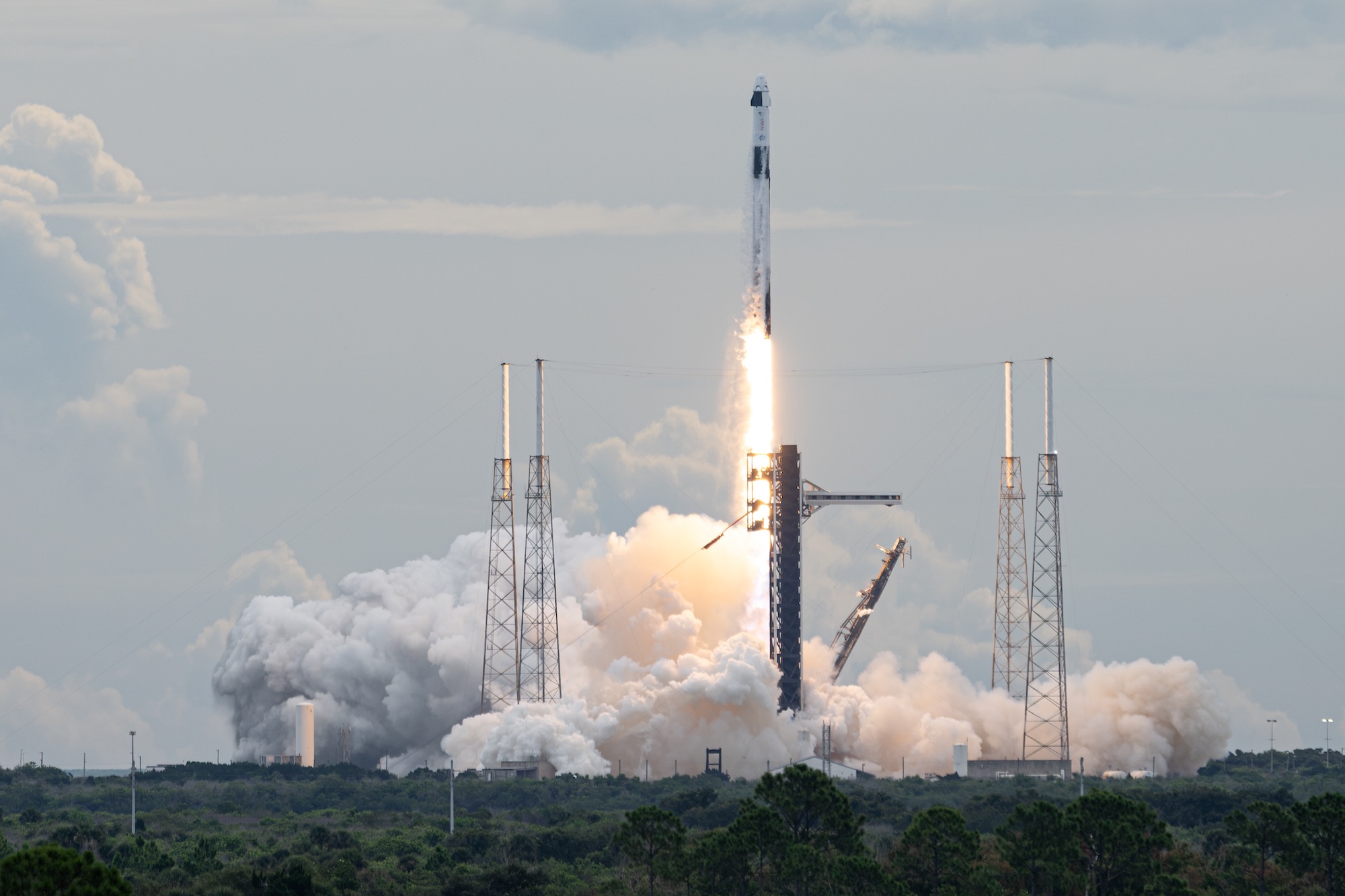
A SpaceX Falcon 9 rocket carrying the company’s Dragon spacecraft lifts off on the Crew-13 mission to the International Space Station.
Credit:
NASA/John Kraus
“By cutting it out, we physically went in and actually cut the valve out of the line,” Gerstenmaier said. “It was welded in place, and then we actually re-welded a new valve in place.”
Engineers are testing the bad valve to diagnose the cause of the leak, but NASA officials were pleased with the fix. No leaks were detected during final preparations for launch Thursday, and Dragon’s propulsion system appeared to be functioning well after arriving in orbit.
“We looked at the plans, all of the data coming out of that, the welds, the leak, everything looks great,” said Dana Weigel, NASA’s program manager for the International Space Station. [We’re] really happy with how that repair was done.”
SpaceX’s preference to cut out the valve in place, rather than take a longer stand-down, kept the Crew-13 mission on track to arrive at the space station in time to replace Crew-12, which will return to Earth in mid-October after eight months in orbit.
The Crew Dragon spacecraft was inside SpaceX’s fueling and hazardous processing facility, known as Area 59, at Cape Canaveral Space Force Station, not at the company’s usual maintenance hangar a few miles away.
“I actually went down and looked at the vehicle itself, got in the clean room, and took a look to see where they actually had to cut the valve out,” Gerstenmaier said. “There was not a lot of room, but there was good access up on the platform. I think the unique aspect of this was the location where it was being done.
“We also did it with oxidizer onboard the vehicle, and the oxidizer tank was full, so we made sure that was all clear,” Gerstenmaier said. “We had to get special permission from the [Space Force’s Eastern] Range to do these activities, to do ‘hot work’ with NTO, with nitrogen tetroxide on the vehicle.”