dailynewsnblog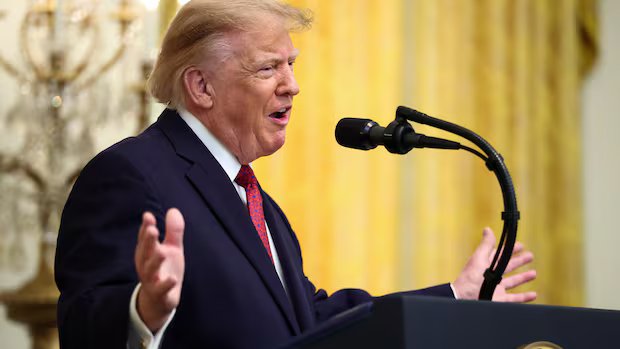

Listen to this article
Estimated 4 minutes
The audio version of this article is generated by AI-based technology. Mispronunciations can occur. We are working with our partners to continually review and improve the results.
U.S. President Donald Trump’s war of words with Canada continued Wednesday as he veered off a prepared script at an event marking Hispanic Heritage Month in the States to chastise Canadian leaders for being what he called “very bad.”
Speaking at the White House, Trump said the U.S. was “stupidly run” before he got the job because past leaders allowed automakers to move assembly plants offshore, including to Canada.
Canada has had a large-scale domestic auto manufacturing industry since 1904, developing at roughly the same time as the one in the U.S.
Still, Trump said past presidents “allowed other countries to make our cars and sell them to us,” and he is ending that now with his high-tariff regime. The Trump administration has repeatedly made it clear that it wants to hollow out Canada’s auto industry.
“Canada has taken advantage of us for so many years. The worst of any country,” Trump said.
“I love the Canadian people, but the leaders have taken advantage of our stupid leadership for many, many years. They felt emboldened. … They act like they’re totally innocent. They’re not. They were very bad. But now they’re being taught a little lesson.”
One of those “lessons,” as the president described it, was his unilateral move to rename Lake Ontario in the U.S.
Addressing a largely Hispanic audience, Trump said his move to rename the Gulf of Mexico to the Gulf of America was “even cooler.”
“There could be a few people in the room that don’t love that one,” he said.

Import ban in effect
Trump’s comments come a day after he imposed an import ban on a list of Canadian products ranging from molasses and motorcycles to dairy products and alcohol.
The ban on Canadian beer, wine and spirits could be the most devastating; Canada exported about $1.2 billion worth last year, according to Statistics Canada data.
In an interview with Fox Business, U.S. Trade Representative Jamieson Greer said the administration is irked by Canadian liquor restrictions and limits on American businesses competing for provincial procurement contracts — restrictions enacted only after Trump slapped tariffs on Canadian goods last year.
Greer said the import ban is retribution for those actions.
“We gave them a lot of leeway,” Greer said.
“But at a certain point we said, ‘That’s enough, you need to take that off, and if you don’t, we’ll just match it.’ So we’ve matched some of the bans.”

Trump trade adviser Peter Navarro told Canadian lobbyists to ‘get the hell out’ of the U.S. and warned Canada would ‘pay even more dearly’ if it interfered in the upcoming midterm elections. Navarro did not explain what he meant by Canadian interference.
Peter Navarro, one of Trump’s top trade advisers, teed off on Canada on Wednesday during an appearance on ex-Trump campaign manager Steve Bannon’s podcast.
Navarro said Prime Minister Mark Carney and other Canadian leaders are “frigging arrogant.”
He accused unnamed Canadian lobbyists of calling U.S. elected officials in Washington “more than MAGA people do” to make them bend to Canada’s will.
“They screw us, they’ve been screwing us for decades,” Navarro said of Canada.
Asked about Navarro’s pointed attacks this week, Carney said he had no comment but reiterated that he thinks it’s possible to negotiate a “mutually advantageous trade arrangement” with the U.S. at some point in the future.
“Canada stands ready to negotiate in good faith,” Carney said.
Greer himself said the U.S. door is “always open” to a possible deal with Canada. But, he added, “we’re pretty comfortable with where we are.”
Canada-U.S. trade picture
The Trump administration’s claims that Canada has been taking “advantage” of the U.S. are not borne out by the facts.
The U.S. runs a relatively modest trade deficit largely because it buys large volumes of Alberta oil at a discount to world prices. Some U.S. Midwest refineries are almost entirely dependent on that Canadian supply.
The U.S. consistently runs a trade surplus in services with Canada.
Despite Trump’s gripes about supposedly “ridiculously high tariffs” on U.S. farmers — a claim he repeated again Wednesday — the vast majority of U.S. agricultural products trade into Canada tariff-free.
According to World Trade Organization figures, 96.7 per cent of those farm products come into Canada duty-free. Trump’s own agriculture department data shows half of Canada’s agricultural imports come from the U.S.
While high tariffs are in place for some dairy products, those only apply if exports exceed a certain quota. As the U.S. dairy lobby itself concedes, the U.S. has never gotten close to exceeding those limits.