dailynewsnblog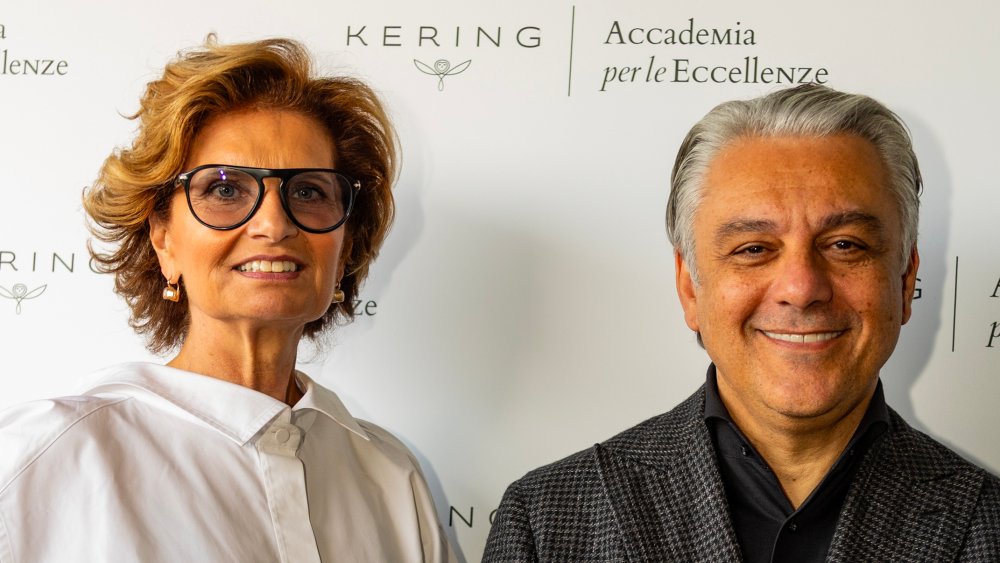
MILAN — In the aftermath of Anthony Vaccarello’s majestic Saint Laurent spring 2027 show that is rumored to be the designer’s last, it was only natural to ask Kering’s chief executive officer Luca de Meo what the future holds for the brand.
“These are rumors I don’t want to comment” on, he said with a sardonic smile. A dry “no comment” closely followed in response to a question about Pierpaolo Piccioli’s equally rumored exit from Balenciaga soon.
These were the only moments when de Meo was shy of words as he hosted the launch of the first academic year of Kering Accademia per le Eccellenze, or KApE, here on Wednesday.
Flanked by newly appointed Kering Italia president and head of Kering Accademia per le Eccellenze Sabina Belli, he welcomed a young audience of students, as well as representatives of the group’s brands and educational institutions, to the campus the group established at MIND, a district dedicated to innovation rising in the area that housed Milan’s Expo in 2015.

Luca de Meo and Sabina Belli at Kering Accademia per le Eccellenze in Milan.
Courtesy of Kering Accademia per le Eccellenze
Revealed last spring, Kering’s educational project now has entered its operational phase, welcoming more than 1,500 students enrolled in 40 programs promoted by its brands as well as seven partner schools scattered across six Italian regions.
To be sure, KApE acts like an ecosystem, with the Milan outpost representing only the headquarters of an initiative that intends to signal the partnership between the existing in-house academies the group’s brands had set up through the years with external schools.
The mission is to train a new generation of artisans to ensure continuity of Italian luxury craftsmanship.
“We want to ennoble this kind of professions,” de Meo said. “The luxury industry is the last one standing where Europe is clearly in the lead.…For now, no one beats us there, and [we have to make sure] no one ever will.”
“Italy is an open-air atelier for the entire world. The [academy] is part of a higher-level commitment that starts with the revitalizing of Made in Italy,” Belli echoed. “The second objective is to bolster the excellence of Italian craftsmanship and of its manufacturing companies by providing them with a highly skilled workforce. And [the academy] is here for that.”
De Meo highlighted the example set by Belli in her previous role as Pomellato’s CEO in promoting the brand’s expertise via the Pomellato Virtuosi Jewelry Academy.
“You already had this idea with Pomellato, I just wanted to scale it up because certain initiatives begin to gain real momentum only when they achieve scale,” de Meo said. “Italy is a country characterized by a multitude of small, fragmented, yet exceptional entities. I believe the challenge is to reach the necessary scale to create an ecosystem that can truly be a global benchmark…because when you have to go up against powerful American or Chinese systems, you need muscles.
“So, this is a first attempt to create something of significant scale, one capable of driving investment in technology, know-how and so on,” de Meo continued. “It also seemed like a way for Kering to assume a social role beyond its purely economic function as a company,” he added, highlighting how 85 percent of the group’s production is based in Italy.
“The group’s head is in France, but the body is here….So as leaders, we have to also take on the responsibility of moving things forward and driving progress,” the CEO said. “This project started from a conversation in November and less than a year later we’re already starting it,” he enthused.

Luca de Meo at the laboratories of Kering Accademia per le Eccellenze in Milan.
Courtesy of Kering Accademia per le Eccellenze
To be sure, in addition to training initiatives already developed by Kering’s brands such as Bottega Veneta, Brioni, Gucci, Pomellato and Kering Eyewear, the ecosystem comprises local schools including ACOF, AFOL, Galdus, HModa Academy, ITS Cosmo, Istituto Modartech and MITA.
“In its logic, this project is open to collaboration and partnerships with anyone willing and having the right level to be integrated into the network,” de Meo said. “If our competitors wanted to join or contribute, we’d welcome them. [Ditto for] the placement of students who have completed the training program, because we can all benefit from it. I have no issues with students finding employment at competitors if they don’t end up working with us. Ultimately, this raises the bar. Competition is a good thing, it’s part of the game. So I envision a very open approach: I don’t know if it will eventually turn out to be so…but the goal is to bring others on board. The key is maintaining a high standard and ensuring stable, well-paid jobs for the students.”
The executive repeatedly turned his attention toward younger generations. “A society without young people has no future,” he said, describing himself as “fortunate enough to have had people putting significant responsibilities on me at a very young age,” like when he was appointed CEO at automotive powerhouse Fiat at age 36. “We have a big issue here [in Italy]: We see the unemployment rates, we see situations in which young people are unable to find stable employment or being underpaid. I see this as one of the biggest social problems.”
Opening a Milan campus but keeping the other schools active in the other regions was also a way “not to force students to necessarily come here and drain the other territories of resources and talents,” said de Meo, who underscored how the more spread-out layout could also gain the support of local municipalities.
At the moment, KApE’s program offers about 62,000 hours of training and more than 22,400 hours of internships, with the contribution of more than 400 master artisans and professionals.
Alongside training in apparel, menswear tailoring, leather goods, jewelry, eyewear and fashion communication and management, students will benefit from dedicated modules covering technology, artificial intelligence, new materials and sustainability. This offer will enable them to master traditional techniques and quality standards while exploring new applications through contemporary creative and design practices.

Kering Accademia per le Eccellenze in Milan.
Courtesy of Kering Accademia per le Eccellenze
“Young people’s role is always to be the first to embrace the future. You are the last ones who should fear change,” de Meo said when asked about his stand on AI by a student. “When they ask me for an advice, I always give the same answer: just be the young one within your organization, because there are already plenty of older people. And what is the role of young people? It is to challenge established rules in some way, otherwise you serve no purpose. If you simply conform to the status quo, you fail to bring on your added value. And when it comes to technology, in particular, older people tend to be afraid, whereas young people must embrace it.
“I see little risks in the application of AI. On the contrary, I believe it will boost creativity,” de Meo continued, providing evidence with an anecdote tracing back to his days at Renault when AI helped designers to reduce 15-hour-long calculations to 10 minutes, freeing time for new ideas.
Another student enquired how he sees the role of creative directors. “Coming from a different world, I realized that in this industry there is a tendency to personalize a brand’s success around a single individual,” de Meo said. “This largely stems from media’s need to decode things and put a face to [success]. That’s understandable. In other industries, it’s the CEO who becomes a sort of hero figure. In ours, it’s the creative director. Since I arrived, I’ve championed the importance of this aspect…yet I also keep saying that business is a team sport,” he said, describing himself as “the coach” of said team sport.
“I try to make everyone understand that every role matters — from the creative director down to the warehouse worker who ensures the product reaches the right place at the right time,” de Meo continued. “It’s not always an obvious point, but I think you’ll see Kering as a prime example of this quest for balance….Ultimately, even those creative geniuses don’t achieve much without a team around them.”
The final piece of the puzzle is customers, whose disenchantment with luxury goods was also caused by the spike in pricing since the pandemic. De Meo said the group is developing an approach of “right pricing.”
“For many months — even years — you have noted and criticized the fact that the luxury industry had created a disconnection between value and the price charged to customers. We are trying to adjust this because we recognize it too,” he said. “This situation led to the loss of [between] 50 to 70 million customers, and we need to win them back. However, that doesn’t necessarily mean lowering prices, there are many other options: you can increase value, come up with creative ideas that make people see the worth in the price we ask and so on.
“So I do believe there is a need to recalibrate the price-value equation, especially for certain categories. The industry has suffered from a sort of ‘squint’ — a split focus between the ultra-high-end and the aspirational customer, while somewhat neglecting the segment in between: the classic, loyal customer of luxury goods,” he continued. “To me, that is the heart of the system and where we need to focus our efforts on. These are people who want value and are willing to pay the price, but who demand substance.”