dailynewsnblog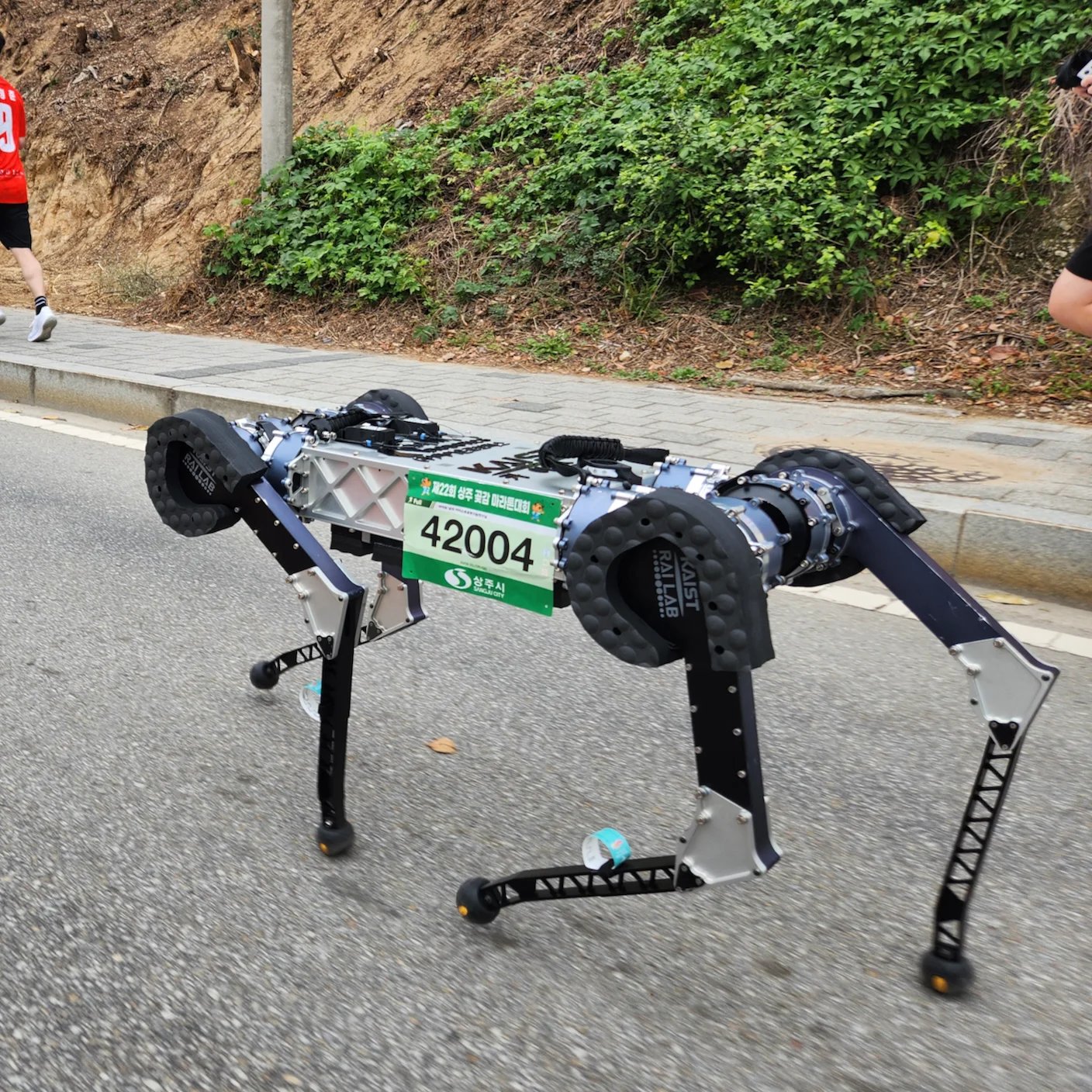
As marathoners navigated the hills of beautiful Sangju in South Korea, they noticed an odd participant at their side. A dog-like robot, named RAIBO2, trotted across winding terrain and slippery roads, finishing the race in four hours, 19 minutes, and 52 seconds—a smidge faster than the human average.
But endurance rather than speed was the robot’s main triumph. It completed the marathon without needing to recharge or swap batteries. At the finish line, it had only used 66 percent of its battery power, pushing the limits of mechanical stamina.
“Outdoor missions often require robots to cover long distances. Current legged robots remain limited in their ability to operate beyond a range of 20 kilometers (12.4 miles),” Hwangbo Jemin and colleagues at the Korea Advanced Institute of Science and Technology wrote in a paper published in Nature last week.
Efforts to boost four-legged (or quadruped) robot efficiency have often focused on individual components. Some engineers have optimized mechanical joint designs; others improved gait control. But to slash energy waste, the team mapped energy losses across the robot’s major joints and circuits in what they call a “holistic” approach. An improved AI-based learning strategy also lowered RAIBO2’s chances of slipping or tripping as it picked up speed.
“I’m impressed with their ability to combine efficiency with speed and mobility in a quadruped,” Carnegie Mellon’s Sarah Bergbreiter, who was not involved in the study, told Scientific American.
Mechanical Helper
Robots have come a long way since bumbling into doors, tumbling over themselves, or struggling up slippery hills. Over a decade ago, Boston Dynamics’ robodog Spot went viral when a video showed it regaining its balance after getting kicked. While it seemed like a stunt, the footage highlighted Spot’s impressive motor control.
Since then, four-legged machines have learned to scale staircases, open doors, and backflip like gymnasts. Equipped with increasingly sophisticated AI, they’ve also graduated from the lab and entered the workforce.
Spot now patrols manufacturing facilities to guard against equipment failures. In one case, it detected components with wildly fluctuating temperatures, flagging maintenance needs before failure. The robot has also joined the Dutch Ministry of Defense to find suspicious packages.
And last year, Spot went straight into an aluminum-plant fire after the building became too dangerous for firefighters. Equipped with a thermal camera, it found the hottest areas through the smoke and helped direct water where it was needed the most.
Meanwhile, scientists at the MIT Lincoln Laboratory are testing robot dogs for search-and-rescue operations at sea. And other researchers are dialing in four-legged robots’ ability to traverse unpredictable terrain, carry large payloads, and operate for long hours.
Endurance is the linchpin. Robots on wheels, such as NASA’s Mars rovers, are generally more energy efficient than legged robots. But wheels lose that advantage when terrain gets too rough or steep. Legs can navigate a rocky hillside, but at higher energy costs.
In this respect, RAIBO2 had already stumbled. In its first marathon at the Geumsan Insam Festival, its battery ran out at the 23-mile mark, a few miles shy of the finish line. Its makers found it had frequently adjusted speed during the course, draining the battery roughly six miles earlier than expected.
Human marathoners train for months perfecting their form to minimize energy expenditure and enter a flow state where running feels relatively effortless. This takes whole-body adjustments, from muscles to posture and mindset.
The new study borrowed this holistic approach, dissecting RAIBO2’s inefficiency across the board to tackle several energy leaks at once.
Go the Distance
Two buckets of energy waste stood out: mechanical and electrical.
The team attributed the biggest drain to motors and electronics, accounting for roughly two-thirds of the losses. Some is unavoidable: Electrical resistance turns a portion of the energy flowing through a motor into heat rather than motion. But the team realized motor controllers were also wasting energy as they rapidly switched electrical currents on and off.
So they redesigned the controllers with lower resistance, changed the current-sensing module, and tweaked the component’s operation to improve battery efficiency.
Physics accounted for the rest of the waste: Feet slipping or colliding at high speeds, the jolt of each foot hitting the ground, and friction in the gears. The weight of the legs was especially important. Every time a leg swings, the robot has to give it momentum, stop it, and repeat the process with every step. Extra weight means having to pull more energy.
The team removed material from the robot’s hip and calf, making RAIBO2’s legs lighter without sacrificing strength and stiffness. All this freed up enough space to install a bigger battery with roughly 33 percent more capacity.
They also upgraded the robot’s AI “brain.” RAIBO2’s learned to move in a simulated environment with reinforcement learning. The team rewarded the robot for softer landings, avoiding skids, and keeping its motors cool. Eventually, it learned to run more efficiently.
Finally, the robot can recharge its battery on downhill sections, much like regenerative braking in electric cars. While it wasn’t the main efficiency booster, every bit counted.
All of these upgrades were put to the test at the annual Sangju Dried Persimmon Marathon. The out-and-back trail features gentle slopes, changing temperatures, and slippery, leaf-covered asphalt roads—far more taxing than RAIBO2’s usual diet of flat, pristine running tracks.
Throughout the race, a support team ran alongside the robot to monitor its “health,” including motor temperatures and internal voltage. At the finish line, RAIBO2’s battery still had 34 percent charge, enough for a total range of about 40 miles. The robot was around 32 percent more energy efficient than the average human runner in the race and could travel roughly three times farther on a single charge than other robot dogs.
It’s worth noting RAIBO2 wasn’t fully autonomous. Although it was equipped with a camera, the robot veered off the road at times and needed a person to steer it back on track. But the engineering behind its endurance could inspire future robots, allowing them to operate in disaster zones or scout dangerous terrain without constantly needing to recharge.
Raion Robots, the team’s commercial spinoff, aims to mass-produce RAIBO2 while adding waterproof and dustproof capabilities. “We will connect the world-class performance achieved in the laboratory to products that anyone can use reliably in industrial environments,” Hwangbo said in a press release.