dailynewsnblog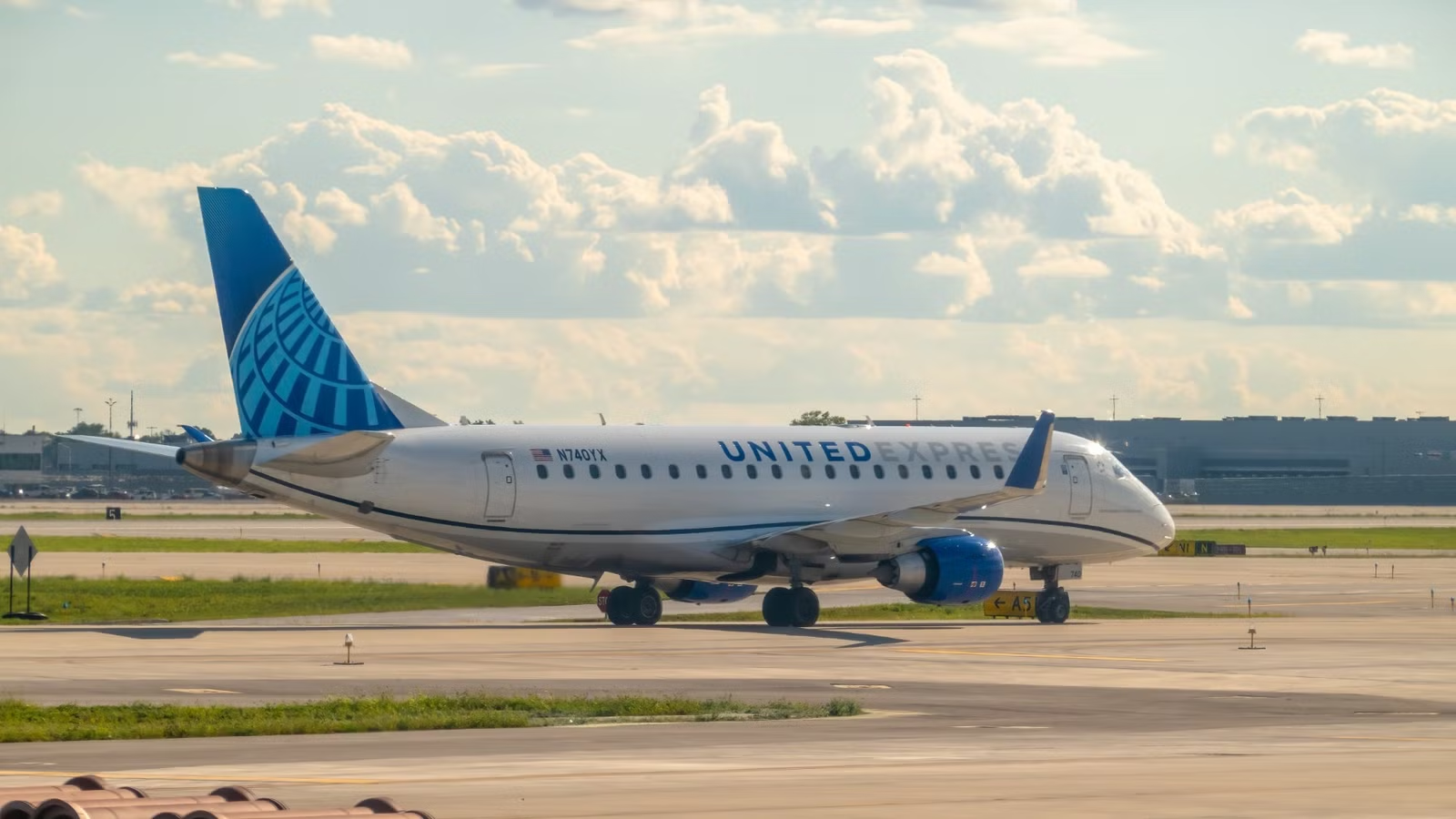
A United Express regional flight was forced to make an emergency landing at  Houston George Bush Intercontinental Airport (IAH) on Sunday when its windshield was shattered after takeoff. Tail number N87360 — an Embraer E175 operated by Mesa Airlines — was performing flight UA6309 from Houston to El Paso Airport (ELP).
Several layers of the windshield reportedly shattered, sending pieces of glass into the cockpit. The crew stopped the aircraft’s climb at around 13,000 feet and returned to Houston, landing safely approximately 35 minutes after departure. Passengers were transferred to another plane and landed in El Paso later that afternoon, according to flight tracking data.
Cockpit Windshield Shatters After Takeoff From Houston

According to a report by CNN, no cause has been given as to why the plane’s windshield broke soon after takeoff. There was no report of depressurization or a bird strike that caused the glass on the first officer’s side of the cockpit to completely fail.
The Houston Fire Department responded to the aircraft distress call and met the plane on the tarmac. First responders cleared the plane safely to continue to the terminal area, where it is waiting for inspection and maintenance.
An investigation will follow by the Federal Aviation Administration (FAA) and potentially the National Transportation Safety Board (NTSB) as well. Findings may take weeks or months to be produced. However, given the limited scope of the mishap, it is likely to be a faster process in this instance. Chron shared audio from the radio call on X when the crew decided to call ‘mayday’ and return to the airport:
“We just had our glass break. We’ll declare an emergency, sir. It looks like the glass busted completely through, it’s just not a layer.”
A Mysterious Malfunction With Shattering Results

Presently, any guesses as to the cause of the broken windshield on UA6309 are purely speculative. Barring the bird strike or depressurization scenarios, there are a handful of other possibilities. One of these is a maintenance error involving improper installation of the glass itself or the electrical anti-ice heating.
The use of improperly sized bolts has previously caused windshield failure at high altitude in past mishaps. Additionally, commercial airplane windows are heavily heated to prevent icing and fogging. If moisture leaks into the window laminates, it can degrade the electrical wiring and cause a short circuit or electrical arc. That power malfunction can cause heating to the glass and degrade its strength over time.
In the past several years, there may have been a couple of accidents caused by such sources. The most recent being Sichuan Airlines flight 8633 in 2018. The Airbus A319 was cruising at 32,000 feet (9,750 meters) when the right-side cockpit windshield shattered and the co-pilot was partially sucked out of the cockpit. It was later determined that a manufacturing defect caused the glass to fail.
Similarly, Frontier Airlines had an Airbus A319 lose its windshield during a flight in 2015. The plane was en route to New Orleans when the crew noticed arcing and sparks on the bottom of the glass, followed by rapidly spreading cracks. Before that, a private jet flying near Fiji in the Pacific Ocean had a similar mishap. This accident happened in 2013 while the Cessna 750 Citation X was flying at 45,000 feet (13,716 meters).
The Danger Of Improper Maintenance In Commercial Aviation

The most infamous windshield mishap in history actually occurred due to a simple mismatch of hardware during standard maintenance. In 1990, British Airways flight 5390 departed Birmingham Airport (BHX) and climbed up 17,300 feet (5,273 meters). Once the plane reached this altitude, the pressure differential broke the windshield and partially sucked the captain of the plane out of the flight deck.
The aircraft was flying over Didcot, England when the glass failed. Captain Timothy Lancaster’s knees caught on the flight controls and his upper torso remained outside the aircraft, exposed to extreme wind and cold. Miraculously, the flight crew and cabin attendants managed to hold the captain against the slipstream while the first officer executed a safe emergency landing at Southampton Airport (SOU).
Lancaster survived with frostbite as well as numerous trauma injuries and broken bones. The subsequent AAIB investigation revealed that a maintenance shift manager had used incorrectly sized bolts. Technicians had used fasteners that were both too thin and too short to secure the window panel. The fasteners failed under cabin pressure causing the BAC One-Eleven 528FL to violently depressurize.