dailynewsnblog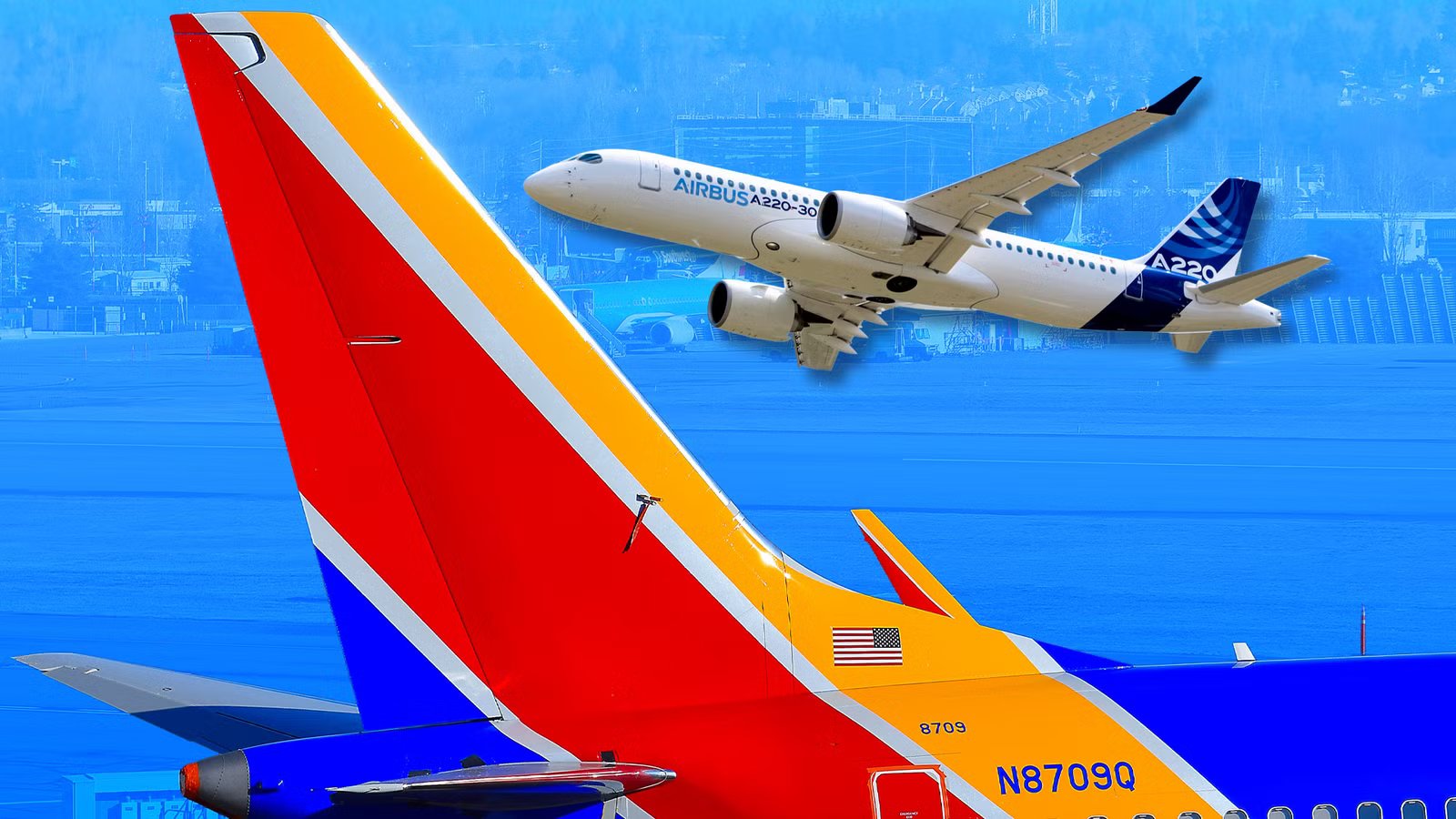
Last year, Simple Flying’s Channing Reid initiated a discussion on our forums about whether Southwest Airlines might consider the Airbus A220, given that the airline has begun retiring more Boeing 737-700s. Orders for 737 MAX 7s would make an obvious replacement, but delays with the type could force the 737-only carrier to look elsewhere.
This article will delve further into what the Airbus A220 could mean for Southwest. We will also take a closer look at why its 737-only operations are now at risk.
Why Would Getting A220s Be So Controversial For Southwest?

Southwest has a 50-year history with Boeing, flying over 1,000 Boeing 737s since the first Southwest 737 flew in June 1971. Per ch-aviation, Southwest currently flies 819 737s, split between -700s (290), -800s (190), and MAX 8s (339). It has a further 228 MAX 7s and 197 MAX 8s on order.
Both Southwest and  Boeing have seen great benefits from this relationship. Boeing has guaranteed billions of dollars of sales of aircraft, parts, and associated services. Meanwhile, Southwest staff can easily get familiar with the entire fleet, which breeds efficiency. The 737s have also proven highly durable, flying over 11 hours a day in 2019 according to Forbes, which helped build a model based on quick turnaround.
Purchasing A220s would be incredibly damaging for this relationship that both parties have worked so hard to cultivate. Boeing would lose a vast number of sales. Furthermore, Southwest would have to invest a huge amount in training and infrastructure to bring Airbus aircraft into its fleet. Moreover, the carrier would likely need to cancel its pre-existing commitments for Boeing 737 MAX 7s, which would potentially force it to pay compensation to the manufacturer.
Southwest Airlines Has Already Rejected The A220

As reported by DJ’s Aviation,  Southwest Airlines has previously considered the A220 as a means to address the retirement of its 737-700s and delays in MAX 7 certification. Speculation around this prospect reached a height during the height of the COVID-19 pandemic. Southwest was using the reduced need to meet the usual demands to modernize its fleet.
It was seen that an examination of the feasibility of adding the A220 to the fleet was simple due diligence, particularly given the issues with the 737 MAX program. Airbus was reported to be presenting its aircraft as a safer, more reliable alternative. The table below details critical specifications for the A220-300, based on data from Airbus.
Max seating | 160 |
|---|---|
Typical two-class seating | 120-150 |
Range | 3,400 nautical miles (6,300 km) |
Maximum takeoff weight | 70.9 tonnes |
Overall length | 127 feet (38.7 m) |
Wingspan | 115 feet (35.1m) |
Powerplant | 2 x Pratt & Whitney PW1500G producing 22,000-24,400 lbf |
When reporting on these moves from Southwest in 2021, Forbes argued that Southwest was going beyond its previous tendency to test Airbus jets to gain leverage on Boeing. Southwest’s CEO was reportedly angry at Boeing for its failures during the 737 MAX debacle. It was considered that a move away from ‘single-sourcing’ was inevitable.
However, for all the reasons that Southwest had previously chosen Boeing, it decided against actually procuring A220s. The disruption it would cause to its operations, along with the additional investment required for training and infrastructure, could not be justified.
So, Why Ask The Question?

Given that Southwest has repeatedly found a move away from the Boeing 737 and towards the A220 to be infeasible, it may seem odd to ask whether Southwest could seriously consider the A220 again. However, years have passed, and Boeing is still facing issues with the 737 MAX. Instead of rehabilitating its relationship, Boeing has lost further face in recent years.
Most concerning for Southwest is that the certification for the 737 MAX 7 took so long to arrive, having been delayed due to engine anti-ice complications. Given the numerous delays Boeing aircraft have experienced over the past decade, nobody could blame Southwest if it were skeptical.
The problem in question was with the CFM LEAP-1B engines, and concerns that the anti-ice system can overheat the inlet in dry air conditions. Both the Federal Aviation Administration and European Union Aviation Safety Agency issued directives that Boeing fixed to certify the aircraft. Even so, Southwest may decide that now is the time to cut its losses and make the necessary investment to diversify its fleet.
How Might Southwest Welcome The A220 Into Its Fleet?

Should Southwest decide that the A220 is the right option instead of the 737 MAX 7, it would need to find a way to add the aircraft to its order sheet. One unorthodox option would be to acquire the low-cost startup airline Breeze Airways. This carrier focuses on connecting huge airports with smaller and less often served destinations. Leeham News argues that this merger would give Southwest access to a pre-existing A220 fleet and an order sheet of dozens more jets for further expansion.
Aircraft | Number in Service | Orders | Breeze Ascent Seats | Extra Legroom Seats | Standard Seats | Total Seats |
|---|---|---|---|---|---|---|
Airbus A220-300 | 64 | 35 | 12 | 45 | 80 | 137 |
It would also likely provide it with access to the necessary infrastructure and staff for operations. The value of Breeze’s order sheet and existing aircraft is approximately $1.1 billion. Including the carrier’s other assets, this would fall well within the roughly $10.5 billion in cash and cash equivalents, making an all-cash transaction possible. The table above details Breeze’s A220 fleet.
Action Is Needed Because Of Southwest Airlines’ 737-700 Retirements

Southwest has built its legacy on the Boeing 737 Next Generation. The carrier was also the 737-700’s launch customer and largest operator. However, it now has to prepare for a future after the 737 NG, with a final retirement date for all of these aircraft set for 2031. Simple Flying examined these coming retirements last year. The extended period over which the retirements are set to be executed will buy Boeing time to show Southwest that it should continue to be a 737-only operator.
The main reason that Southwest has planned to retire its 737 Next Generation aircraft is their age. The -700s should be first to go, with an average age of 20.3 years old, followed by the -800 (averaging 11 years old). Aircraft of this age are more likely to require expensive and frequent maintenance, and will exhibit signs of fatigue that can compromise their safety. For example, the FAA recently forced Southwest to inspect all of its 737 Next Generation fuselages for cracks.
Newer aircraft also utilize more advanced materials and are designed to be more efficient, resulting in lower operating costs. Southwest hopes to use these aircraft retirements as a financial opportunity, as these jets are not old enough to be fully scrapped yet. Southwest CEO, Bob Jordan, explained how the carrier hopes to leverage the second-hand market, saying that:
“We have a unique opportunity to capture value and earnings on excess aircraft we do not need with our moderate growth plan. With that in mind, we are pursuing direct sales of [737]-800 aircraft.”
Will We Ever See A Southwest A220?

The prospect of Southwest breaking its commitments to Boeing and flying the Airbus A220 warrants considerable skepticism. The carrier’s contemporary business model and identity are built upon the 737. Any moves away from this aircraft would cause considerable damage to Southwest’s bottom line, regardless of whether the A220 has the right characteristics for the carrier.
Furthermore, the fact that Southwest has previously considered, and subsequently rejected, the A220 cannot be ignored. For Southwest to choose the nuclear option and go with the A220, it would have to conclude that there is more to be lost by sticking with the 737 MAX 7 to replace the 737-700. That is not currently the case, particularly now that the MAX 7 has been certified, but, in aviation, you can never say never…