dailynewsnblog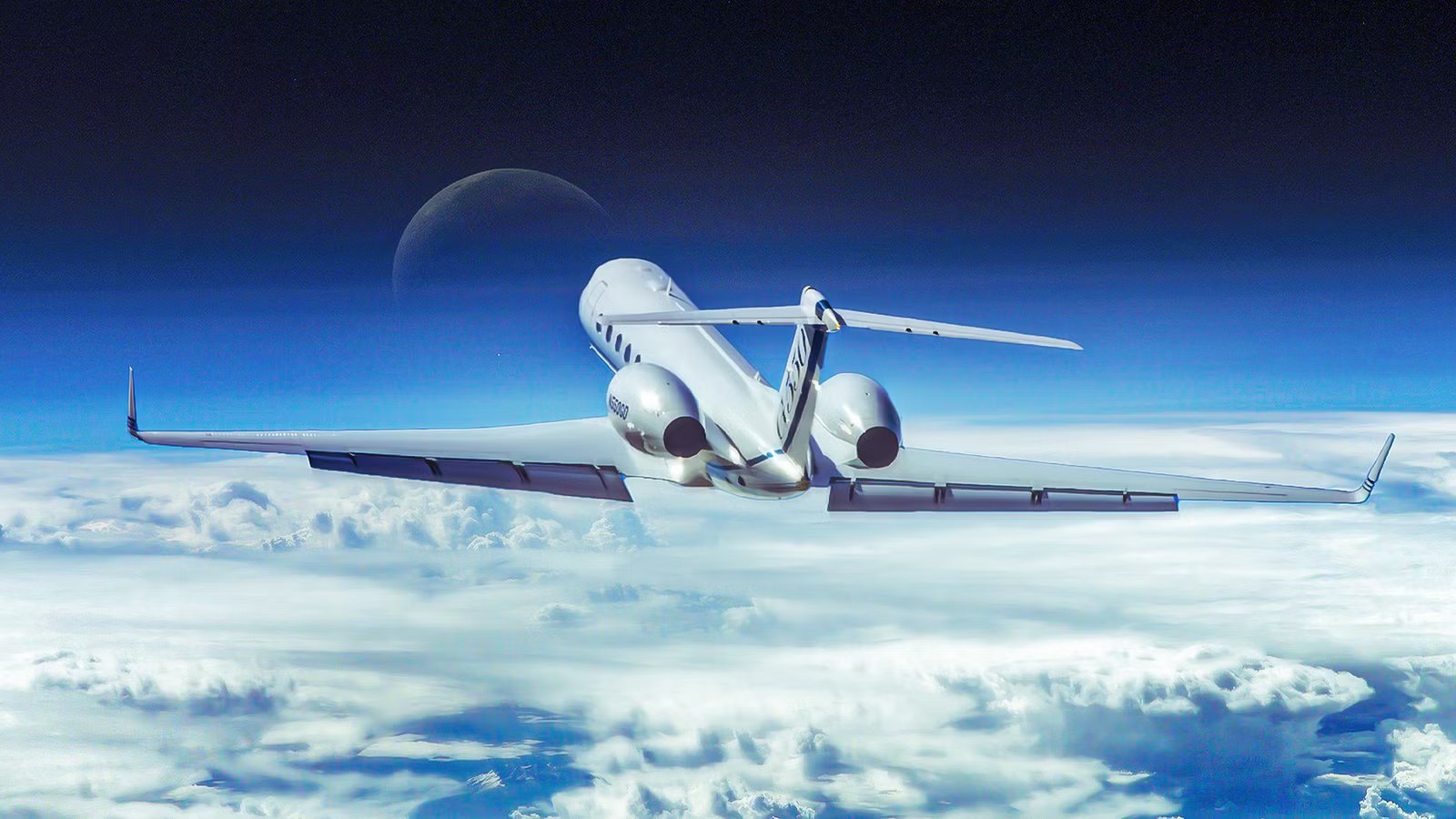
Reaching 51,000 feet (15,544.8 meters) is a transformative moment in a pilot’s career, marking the transition from traditional flight into a realm that feels distinctly extraterrestrial. At this altitude, the familiar bright blue of the troposphere deepens into a rich, space-like indigo, and the horizon begins to exhibit a perceptible downward curve. This guide explores the sensory and technical realities of cruising ten miles above the planet, where the air is so thin that the sky loses its ability to scatter light.
Standard commercial airliners are restricted to the lower layers of the atmosphere between 31,000 feet (9,448.8 meters) and 41,000 feet (12,496.8 meters), yet jets like the Gulfstream GVI and the Bombardier Global 7500 are designed to punch through the tropopause. Climbing into the lower stratosphere, these jets escape the turbulence and congestion of the lower airways, offering a perspective on our world that remains inaccessible to the average traveler today.
On The Edge Of Space

At 51,000 feet (15,544.8 meters), the visual experience of flight undergoes a profound shift as the aircraft climbs through the bulk of the Earth’s atmosphere. Most of the water vapor, dust, and oxygen molecules that scatter sunlight to create a blue sky are now far below the wings. Looking up through the windscreen, pilots observe the sky transitioning from a pale cerulean to a dark navy, eventually becoming almost black at the zenith. This is the first clear indication that the aircraft is operating at the very edge of the habitable atmosphere, where the sun appears as a harsh, white disk without the softening glow found at lower altitudes.
Here, the visible curvature of the Earth can actually be seen, a geometric reality that becomes undeniable once the observer reaches the ten-mile mark. The curve is subtle, but it is easily identified by comparing the horizon to the straight line of the aircraft’s glare shield or a level flight instrument. The horizon does not sit at eye level as it does on the ground; instead, it drops away, and the atmosphere appears as a thin, glowing blue laminate hugging the surface of the planet. This perspective provides a visceral refutation of flat-earth myths, as the sheer scale of the planetary sphere becomes a tangible part of the pilot’s field of vision.
The lack of atmospheric haze at this height provides a level of clarity that is almost disorienting. Pilots report being able to see distinct geographical features hundreds of miles away, from entire mountain ranges to the sprawling outlines of coastal cities, all rendered with sharp, high-contrast edges. The lensing effect of the thicker lower atmosphere is gone, leaving a crystal-clear view that makes the world feel both immense and strangely fragile.
Quicker Or Costlier?

Such a high altitude provides an operational clean slate that is unavailable to the heavy metal of the airline world. Commercial pilots are constantly negotiating with air traffic control for altitude changes to avoid bumps or to find better tailwinds, whereas the Gulfstream or Global pilot is already above 99% of the world’s weather. Most cumulonimbus clouds, even those powering severe thunderstorms, typically top out between 35,000 feet (10,668 meters) and 45,000 feet (13,716 meters). By cruising much higher, these aircraft glide over the violent updrafts and anvil tops that force airliners into fuel-heavy diversions, ensuring a ride that is often described as glass-smooth.
This stratospheric exclusivity was not always reserved for the private elite. For 27 years, the Concorde reigned supreme as the only commercial aircraft to regularly reach 60,000 feet (18,288 meters), a height where the curvature of the Earth was an everyday sight for 100 passengers at a time. However, the retreat from these heights was driven by a brutal economic reality: the cost of punching through the thick lower atmosphere to reach the thin stratosphere requires an exponential increase in fuel burn. While the Concorde could cross the Atlantic in under four hours, it consumed over two tons of fuel just to taxi and take off, and its supersonic reach was ultimately curtailed by noise regulations regarding sonic booms and the sheer maintenance intensity of engines that lived in a permanent state of high thermal stress.
Today’s commercial market has favored a slow and low approach to efficiency, with modern twin-jets like the Airbus A350 optimized for the fuel-dense air of the high troposphere. This leaves the flight level 500 to 510 band as a ghost town in the sky, as there is virtually no other traffic at these heights, and pilots are frequently granted direct-to routings that can shave hundreds of miles off a journey. Without the need to follow the rigid, zig-zagging aerial highways required to keep airliners separated, a private jet at ten miles high can essentially point its nose toward the destination and fly a perfectly straight line, further enhancing the efficiency of its ultra-high-bypass engines.
The Systems Keeping Passengers Safe

As an aircraft ascends higher and higher, the aerodynamic environment shifts from a forgiving medium to a razor-thin margin of error. This higher region is governed by the laws of high-altitude physics, where air density is roughly 20% of what it is at sea level. This is where the theoretical coffin corner, technically known as the Q-corner, becomes a daily operational reality. At these heights, the gap between the speed at which the aircraft will stall due to lack of lift and the speed at which it will encounter Mach buffet can narrow to as little as five or ten knots.
The technical challenge at ten miles high involves managing the relationship between indicated airspeed (IAS) and true airspeed (TAS). The pitot tubes on the wing sense very few molecules, meaning the airspeed indicator in the cockpit might only show 180 knots, even though the aircraft is actually hurtling over the ground at over 500 knots. This discrepancy requires high-performance wings with advanced sweep angles and supercritical profiles that are specifically engineered to maintain laminar flow in the low-Reynolds-number environment of the stratosphere. Unlike commercial jets that would struggle to maintain level flight in such thin air, ultra-long-range jets have the power-to-weight ratio to stay safely within the envelope of controllable flight.
To stay outside of this dangerous aerodynamic trap, pilots must utilize high-precision auto-throttle systems that can maintain a constant Mach number with millimetric accuracy. A sudden change in outside air temperature or a sharp turn can cause the stall speed to rise or the Mach limit to fall, potentially leading to a high-altitude upset. Mastering this environment is a point of pride for private jet crews, as it requires a deep understanding of atmospheric gradients and the poise to handle an aircraft that is effectively balanced on a needle’s point.
Where Engines Make A Real Difference

The stratosphere is a thermodynamic goldmine for aircraft equipped with high-bypass turbofan engines. Once a jet passes the tropopause, usually around 36,089 feet (11,000 meters) according to ICAO, the ambient temperature stabilizes at a frigid -69.7°F (-56.5°C). For an engine like the Rolls-Royce BR710, this extreme cold is essentially high-octane fuel for the Brayton cycle, the thermodynamic process that powers jet engines. Colder air is naturally denser relative to its weight, allowing the compressor to pack more oxygen into the combustion chamber without the risk of the turbine blades overheating, which is the primary limiting factor for engine performance at lower, warmer altitudes.
In this rarified environment, the two BR710 engines, each producing 14,750 pounds (6,690.4 kg) of thrust at sea level, operate with a level of efficiency that would be impossible in the thicker air below. It is true that the total thrust decreases as the air thins, but actually, the corresponding reduction in parasitic drag more than compensates for the loss of raw power. At 51,000 feet (15,544.8 meters), the air density has dropped by roughly 80% compared to sea level, meaning the aircraft can maintain a high cruise speed using only a fraction of the fuel required at 30,000 feet (9,144 meters).
This altitude represents the sweet spot for the specific range of the aircraft, or the distance flown per unit of fuel consumed. Turbofans can spin at higher rotational speeds with less resistance, allowing the engine to operate at its peak thermal efficiency. This is why a Gulfstream V can achieve a range of nearly 6,500 nautical miles (12,038 km). For the pilot, this results in the satisfying sight of fuel flow gauges dropping to remarkably low levels even as the true airspeed remains high.
A Hostile Environment

At 51,000 feet (15,544.8 meters), the environment outside the fuselage is instantly lethal to unprotected humans, as the ambient atmospheric pressure is insufficient to force oxygen into the bloodstream. This physiological threshold is far above the Armstrong Line, where the boiling point of liquids drops to the temperature of the human body. To safely transport passengers through this vacuum-like environment, the aircraft must maintain a high-integrity pressure vessel that simulates a much lower altitude.
The ability to maintain a low cabin altitude while flying at extreme flight levels is a function of the aircraft’s maximum pressure differential, the difference between the air pressure inside the cabin and the thin air outside. To achieve a cabin altitude of only 3,300 feet (1,005.8 meters) to 4,800 feet (1,463 meters) while the jet is cruising in the stratosphere, the fuselage must be incredibly strong to resist the massive outward force of the internal atmosphere. This superior pressurization means that passengers arrive at their destination with higher oxygen saturation levels, significantly reducing the physical toll of long-haul travel.
Flight Level | Aircraft Type | Cabin Altitude (Effective Feel) | Oxygen Saturation Level |
FL380 (38,000 ft) | Standard Commercial Jet | 8,000 feet (2,438.4 meters) | ~92% |
FL410 (41,000 ft) | Advanced Airliner (e.g. 787) | 6,000 feet (1,828.8 meters) | ~94% |
FL450 (45,000 ft) | Top-Tier Business Jet | 3,300 feet (1,005.8 meters) | ~98% |
FL510 (51,000 ft) | Ultra-Long-Range Jet | 4,800 feet (1,463 meters) | ~96% |
For the flight crew, operating at flight level 510 requires constant vigilance regarding the time of useful consciousness, which at this height is less than nine seconds in the event of a rapid decompression. Consequently, these jets are equipped with automatic emergency descent modes that can autonomously bank the aircraft and dive to safer altitudes if the cabin pressure is lost.
Not As Flat As It Seems

The persistence of the flat-horizon myth is usually a result of being tethered to the ground or the lower troposphere, where atmospheric refraction and the sheer scale of the planet mask its true shape. However, at 51,000 feet (15,544.8 meters), the geometry of the sphere becomes an undeniable participant in the flight experience. The horizon is no longer a static line at eye level and is a receding boundary that physically drops below the horizontal plane of the cockpit. This phenomenon is a mathematical proof of a curved surface, as the distance to the visible edge of the world expands to approximately 276 miles (444.2 km) from the cockpit window.
The clarity of the stratosphere removes the lensing effect caused by the denser, moisture-laden air of the lower atmosphere, which can often create the illusion of a flat or even concave horizon through terrestrial refraction. In the thin air of flight level 510, the light reaches the eye with minimal distortion, allowing the brain to process the three-dimensional depth of the planet.
Catch what other trackers miss
Emergency squawks, holds, NOTAMs — live signals, no signup.
Open tracker
Catch what other trackers miss
Live aircraft — emergencies, holds, NOTAMs.
Open tracker
The rise of ultra-long-range jets continues to push the ceiling of civil aviation closer to the edge of space, potentially making this perspective a standard part of high-end global travel. As manufacturers explore even higher altitudes to accommodate next-generation engines and sustainable fuel technologies, the boundary between atmospheric flight and suborbital experience will continue to thin. For now, the view from ten miles up remains a rare privilege, serving as a reminder that the world is a complex, revolving sphere, and that the most efficient way to navigate it is to rise above the clouds and into the indigo.