dailynewsnblog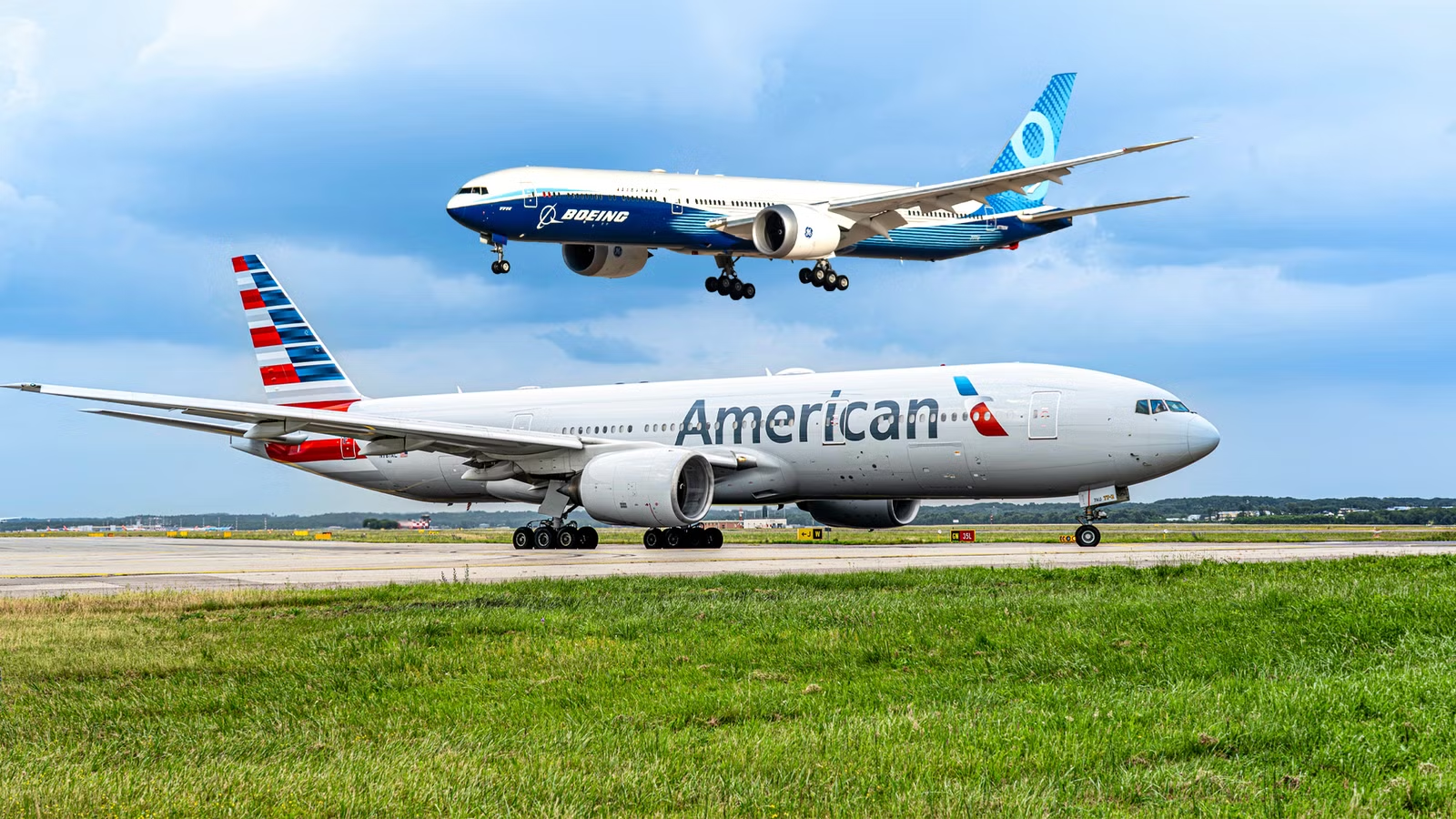
 American Airlines is approaching a major decision that could reshape its long-haul fleet for decades. While the airline has already embraced the Boeing 787 Dreamliner and has dozens of the type in service, it remains the only member of the US Big Three, American,
  Delta Air Lines and
  United Airlines, without a commitment to a next-generation widebody larger than the 787-9.
With its aging 777-200ER fleet approaching retirement in the 2030s, American has now opened the door to a major new aircraft order, with both Boeing and Airbus competing for the business. That makes a recent development involving Boeing’s 777-9 particularly interesting. An American Airlines test pilot was reportedly filmed flying the 777-9 during the aircraft’s ongoing certification campaign and described the aircraft as “AAmazing.”
The appearance does not confirm that American will order the type, as  Boeing regularly uses airline pilots during human-factors and operational evaluations. Nevertheless, the timing is notable. American has an active request for proposals covering its future widebody requirements, while Boeing is looking for additional customers for its delayed 777X program. The question is no longer whether American needs new widebodies, but exactly how large those aircraft need to be.
Split Between Old & New: American’s Current Long-Haul Fleet Of 787s & 777s

As of 2026, American’s widebody fleet consists exclusively of Boeing aircraft. On the older side of its fleet, American operates 67 Boeing 777 aircraft, split between 47 Boeing 777-200s and 20 of the larger Boeing 777-300ERs, according to Planespotters.net. Between these two variants of the Triple Seven, the -200 is substantially older, with an average fleet age of 25.8 years compared to just 12.6 years of the -300ER fleet.
Coming into the 2020s, however, it has become clear that much of American’s future widebody fleet will be centered on the Boeing 787 Dreamliner family. Of the three Dreamliner variants, American operates the two smaller versions, the Boeing 787-8 and Boeing 787-9. The number of each aircraft type is roughly split down the middle, with the carrier operating 37 787-8s and 33 787-9s. These aircraft are just 7.4 years on average, with ages of 8.3 and 6.4 years, respectively.
Notably, prior to the pandemic, American operated a much more diverse widebody fleet, with both the Airbus A330 and Boeing 767s playing large roles in the carrier’s route network. However, at the onset of the pandemic, American made the decision to retire all of its A330s and 767s, opting instead to use the global shutdown as an opportunity to accelerate its dramatic fleet renewal program with huge numbers of 787 deliveries, helping it achieve one of the youngest active fleets in the United States.
Is It Possible American Could Order The Boeing 777X?

While the 787 will continue to form the backbone of American’s widebody fleet, the Boeing 777-9 presents an interesting possibility for American as it would give the airline something it does not currently have: a true next-generation replacement for its largest widebodies.
When certified, currently slated for early 2027, the 777X is expected to carry roughly 426 passengers in a typical two-class configuration, although American would likely outfit the aircraft in a three-cabin configuration to include its new premium economy product. Powered by GE Aerospace’s enormous GE9X engines, the sole power plant available for the 777X, the 777-9 will offer a range of up to 8,000 nautical miles (14,820 km) as well as substantially improved fuel efficiency compared to the legacy 777 variants.
Speculation over a potential American Airlines 777X order grew in recent weeks after the appearance of an American test pilot at a Boeing 777X training facility. This visit shouldn’t be treated as a confirmation of an order, as Boeing routinely works with airline pilots during development and certification.
Nevertheless, Boeing has a particularly strong incentive to win American over. The Boeing 777X program has faced years of delays, with no US airline placing an order for the aircraft despite all three major airlines having operated at some point older variants of the 777. Adding American as a new customer for the 777X would provide a major vote of confidence in the aircraft, especially since American is one of Boeing’s largest existing customers, both in terms of widebodies and narrowbodies, and already operates a substantial 777 fleet.
Catch what other flight trackers miss
Emergency squawks, holds, NOTAMs — live signals, no signup.
Open tracker
Catch what other flight trackers miss
Emergency squawks, holds, NOTAMs — live signals, no signup.
Open tracker
For American, the biggest advantage of the 777-9 would be its capacity. When the 777-200 and 777-300ER are eventually retired, American’s largest aircraft would be its Boeing 787-9, offering 244 seats in its new premium-heavy configuration, compared to the 777-300ERs 330 seats (with over 100 of those seats being business or premium economy).
The 777-9, which would likely have a three-class capacity in the upper 300-range, would allow American to maintain high-capacity service on dense routes from the US abroad. However, its size is also the main argument against a potential American 777X order, especially given American’s current international long-haul strategy.
American’s International Network Is The Bigger Problem

American’s widebody fleet decisions cannot be separated from its international network. Among the Big Three US airlines, American has been arguably the most conservative when it comes to expanding its own long-haul network. Where United has built an extensive international operation from its major hubs, serving far-flung destinations like Greenland and Mongolia, and Delta with its strong transoceanic joint ventures, American does not have many international strengths.
The carrier’s Latin America network is one of the more valuable international ones in its portfolio, with Miami and Dallas/Fort Worth providing connectivity to countless destinations in the Caribbean, Central, and South America. In Asia, however, American serves just four destinations: Delhi, Seoul, Tokyo, and Shanghai. When including Oceania services, American adds another three cities to the list, including Auckland, Sydney, and Brisbane, with a full table of American’s Asia and Oceania network available below.
In comparison, United Airlines, which has the strongest transpacific network of any US carrier, operates to 28 Asian destinations with another seven in Australia, New Zealand and Tahiti. Even in Europe, American limits its transatlantic network to mostly major European cities like London, Paris, and Amsterdam, although some niche destinations like Nice, Naples, and Porto are also served seasonally from the carrier’s East Coast hubs.
Destination | Served From | Aircraft Type |
|---|---|---|
Tokyo (NRT) | Dallas/Fort Worth (DFW) | Boeing 777/Boeing 787 |
Tokyo (HND) | Dallas/Forth Worth (DFW), New York (JFK), Los Angeles (LAX) | Boeing 777 (DFW), Boeing 787 (JFK/LAX) |
Seoul (ICN) | Dallas/Fort Worth (DFW) | Boeing 777/Boeing 787 |
Shanghai (PVG) | Dallas/Fort Worth (DFW) | Boeing 787 |
Delhi (DEL) | New York (JFK) | Boeing 787 |
Sydney (SYD) | Los Angeles (LAX) | Boeing 777 |
Auckland (AKL) | Dallas/Fort Worth (DFW), Los Angeles (LAX) | Boeing 787 |
Brisbane (BNE) | Dallas/Forth Worth (DFW) | Boeing 787 |
As for its long-haul fleet, American simply doesn’t need a massive widebody aircraft for its current international network. While the 777X could aid American’s operations to London, by far its most profitable international destination, or other high-demand destinations, smaller aircraft such as the 787-9 could actually be more useful and provide American with more flexibility than a 777X order, both in terms of capacity and fleet commonality. American is also slowly introducing the Airbus A321XLR on select international routes, although the aircraft type will also operate premium transcontinental domestic routes in addition to ones across the Atlantic.
Why Ordering More 787s Or Even The A330neo Could Benefit American

Given American’s current long-haul international markets, the carrier likely would not require the additional capacity or range provided by the 777X or even A350 families. Given this, it looks increasingly likely that American will instead choose one of Boeing or Airbus’ smaller long-haul aircraft: the Boeing 787 or Airbus A330neo.
Between these two aircraft families, the 787 jumps out as the seemingly logical choice. American already operates 70 787s with over a dozen still on order. These aircraft are already well integrated into American’s network on both domestic and international routes, with established maintenance bases and trained crew to operate the aircraft.
A potential order as rumored for up to 65 aircraft would put American’s total 787 commitment to a massive 154 Boeing 787 aircraft, rivaling United for the largest 787 fleet in the world. This order would likely consist of either 787-9s, or, potentially more beneficial for American in terms of replacing its 777s, a 787-10 order to more closely match the 777’s capacity.
Simple Flying Quiz
Think you really know American Airlines?
Answer 10 questions and put your knowledge to the test
Think you really know American Airlines?
Answer 10 questions and put your knowledge to the test
Easy (15s)Medium (10s)Hard (5s)
While the 787 does jump out as the most logical choice, Airbus’ A330neo family, particularly the Airbus A330-900neo, presents an interesting proposition for American. More specifically, the A330-900neo is both cheaper than the 787 and has a much shorter wait time from order commitment to delivery.
Roughly the same size as the 787-9, the A330-900neo could provide American with more immediate growth capability with a similar profile to the 787-9, allowing American to expand its international network in a similar way more 787s would. One other hint that points toward a potential A330-900neo order is the carrier’s Chief Commercial Officer, Nat Pieper, who served as Delta Air Lines’ VP of Fleet Strategy & Transactions at the same time the Atlanta-based carrier ordered the A330neo.
Where Do Delta & United Currently Stand On Next-Gen Widebody Commitments?

Looking at American’s two main competitors, Delta and United, can help put into perspective the carrier’s widebody fleet. United, like American, has made the 787 family the centerpiece of its long-haul strategy. The airline operates the 787-8, 787-9, and crucially the Boeing 787-10 in its fleet.
The latter gives United a larger Dreamliner capable of carrying more passengers than the 787-9, allowing the airline to deploy the type on high-demand international routes without moving up to a larger aircraft like the 777-9 or A350-1000. As for the numbers, United has 92 787s in its fleet (12 787-8s, 59 787-9s, and 21 787-10s) as well as 96 Boeing 777s (74 777-200s and 22 777-300ERs), giving United considerable flexibility across its international network.
Delta, meanwhile, has taken a much more diverse approach to its future widebody fleet. The airline currently operates Airbus A350-900s, A330ceos, A330neos, and Boeing 767s as part of its international widebody fleet. However, within the next five years, the carrier plans to introduce two brand-new aircraft types to its fleet, the Airbus A350-1000 and Boeing 787-10.
The A350-1000 is particularly significant because it gives Delta a next-generation aircraft larger than both the A350-900 and 787-10 on order and will be the largest aircraft operated by a US airline. Combined with its A330s (the Boeing 767 family is already being retired and will be completely phased out in the next few years), Delta’s widebody fleet allows it to fit aircraft to specific routes based on demand and length.
That leaves American in an interesting position as the only Big Three airline without a long-term order commitment to any next-generation widebody aircraft. Both Delta and United have dozens of long-haul aircraft on order in the form of 787s and A350-1000s/787-10s respectively. Meanwhile, American’s 787 deliveries are slowing down in pace.
Additionally, American operates the smallest widebody fleet in terms of aircraft size, with United’s 787-10 and Delta’s A350-900 larger than American’s 787-9. American’s imminent widebody order will reveal if it follows its competitors towards larger next-gen aircraft or doubles down on smaller widebodies that already form the backbone of its long-haul operation.