Scientists Detect Radio Signals From an Exoplanet for the First Time in History


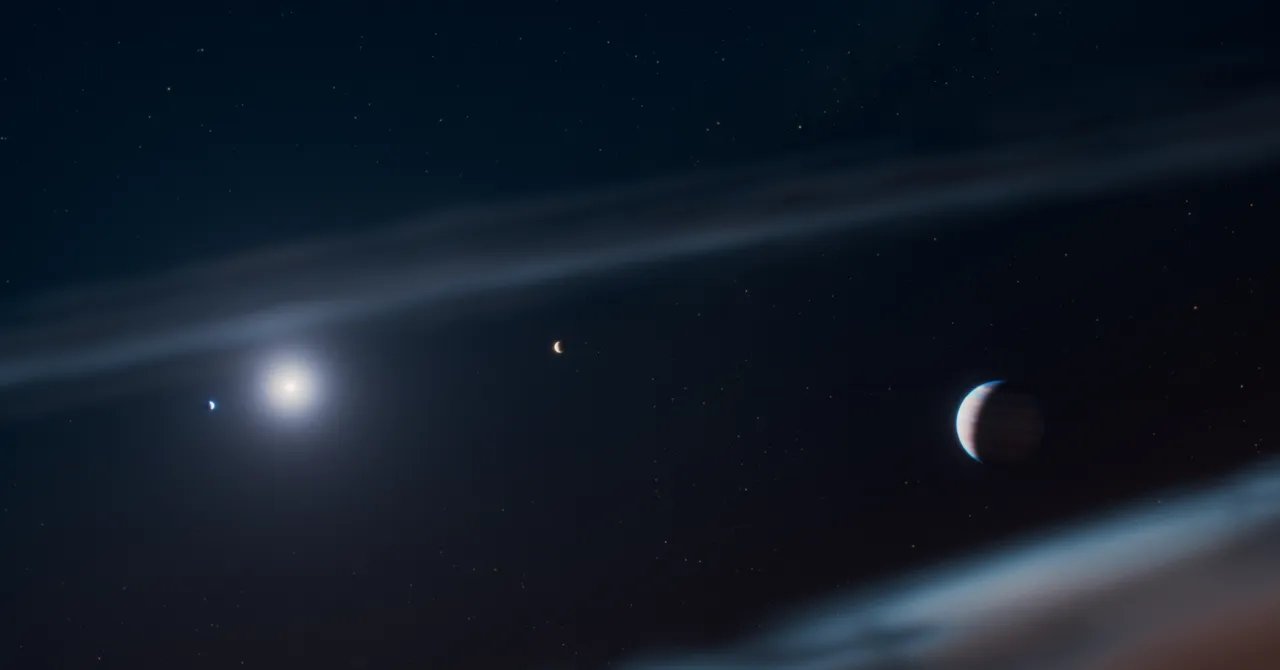
Approximately 63 light-years from Earth lies a planetary system so young that it’s less than 1 percent as old as our solar system. It is called Beta Pictoris, and—as far as astronomers have confirmed—it consists of a star more massive than the sun, three giant planets, and a huge disk of dust and debris.

The middle planet in the system, Beta Pictoris b, is a gas giant several times more massive than Jupiter. Being a gas giant, it likely does not have a solid surface on which to “land,” and at just a few tens of millions of years old, it can be considered a newborn planet in astronomical terms. It’s also one of the most extensively studied exoplanets through direct observation. Its youth keeps it hot and bright, and its distance from the star—similar to that between our sun and Saturn—makes it possible to distinguish from the star with sufficiently powerful telescopes.

Two bright dots and an illustration marking their positions around a star

The newly discovered third planet orbiting Beta Pictoris, Beta Pictoris d, appeared in reconstructed imagery from NASA’s James Webb Space Telescope. Modeling suggests its orbit is comparable to the region occupied by Neptune in our own solar system.

PHOTOGRAPH: NASA

Now, a new study from researchers at Harvard and the University of Oregon claims that Beta Pictoris b is the source of something that has never before been unequivocally detected on another world: radio emissions.

Recorded by the MeerKAT radio telescope in South Africa, the signal is likely of natural origin, as in no, it’s not aliens. The authors are quick to note this from the outset of their preprint. And while the study has not yet been peer-reviewed, the authors present sizable evidence to support their interpretation that the source of the broadcast is intense magnetic activity.

The characteristics of the radio waves match theoretical predictions for magnetic fields generated by young, massive planets. Charged particles can become trapped in the planet’s powerful magnetic field, and as the planet rotates, these particles can accelerate and release energy in the form of radio waves. In a sense, this phenomenon—known as an auroral radio emission—is the planet’s magnetosphere “shouting” into space.

The team detected several of these calls and, for the first time, managed to pinpoint their origin directly to an exoplanet—something scientists have been trying to achieve for years.

Image may contain Hole Outdoors Nature Astronomy and Outer Space

Image of the debris disk around the star Beta Pictoris, taken in 1984.

Photograph: Bradford A. Smith / Richard J. Terrile / NASA-JPL


Source link

  • Related Posts

    OpenAI agent “didn’t accept no for an answer” in Australian government breach

    “We need to understand what these systems are doing and have strong evidence that they will do what people intend, even as they get very, very smart,” Altman said. “It…

    Continue reading
    The Best Linux Laptops (2026): System76, Framework, and More

    The battery life is good for the size—it lasted all day in most of my testing. The keyboard is quite nice to type on. The oversized trackpad sometimes got in…

    Continue reading

    Leave a Reply

    Your email address will not be published. Required fields are marked *

    You Missed

    Stanford University apologizes for switching students' faces and races in photo

    Stanford University apologizes for switching students' faces and races in photo

    OpenAI agent “didn’t accept no for an answer” in Australian government breach

    OpenAI agent “didn’t accept no for an answer” in Australian government breach

    Ebon Moss-Bachrach in Final Talks for Heat 2 Role

    Ebon Moss-Bachrach in Final Talks for Heat 2 Role

    The £35 COS Tee That’s Winning Fashion Week

    The £35 COS Tee That’s Winning Fashion Week

    The 1990s boy band mall tour is back, and this time it’s sponsored by Gap

    The 1990s boy band mall tour is back, and this time it’s sponsored by Gap

    India news – 2027 ODI World Cup – Gautam Gambhir on the fitness of Hardik Pandya and Jasprit Bumrah

    India news – 2027 ODI World Cup – Gautam Gambhir on the fitness of Hardik Pandya and Jasprit Bumrah