dailynewsnblog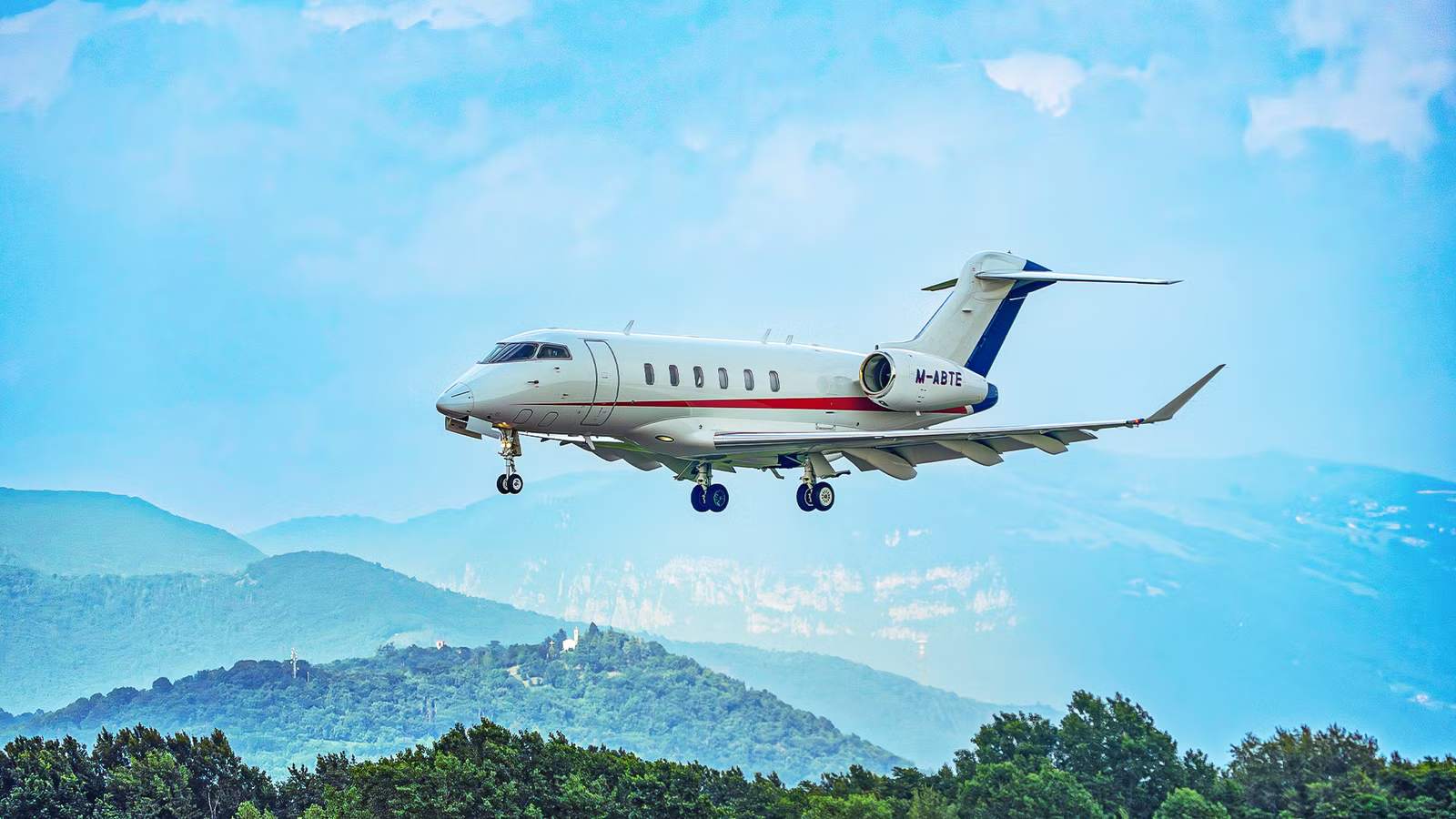
Everything about Ryanair’s ironing-board seats, tiny legroom, and poor catering seems the antithesis of private aviation. Yet, the airline operates a secret fleet of five Bombardier Challenger 3500 planes. These aircraft aren’t for luxury passengers. Rather, they carry parts and mechanics to deal with urgent aircraft maintenance needs. Ryanair has found that an expensive private flight is less costly than paying compensation to passengers for extended delays.
You can use the Simple Flying Live Flight Tracker to try to spot these jets in service. The registrations to look out for are M-ABSU, M-ABTE, M-ACOR, and M-ASBA. The airline also has a Learjet 45XR from its legacy private jet fleet. You can use the flight tracker to look for this one too. It has the registration M-ABGV. Our tracker was built specifically for avgeeks, with tools that go way beyond what you can usually expect from a flight tracker.
Why Ryanair Uses Private Jets?

The factor that makes private jet ownership worthwhile for Ryanair is the enormous amount of compensation European airlines have to pay out because of the EU261regulations. A cancellation or extended delay forces a compensation payment, as well as helping passengers with accommodation, meals, rebooking, and more. Further costs come from crew disruption and airport costs. Aircraft Broker Program writes that the costs can exceed €100,000 ($116,000).
Delays and cancellations can be averted by flying out mechanics, parts, or flight crew, depending on what has caused the problem. The quickest and most cost-effective way to do this is with a small business jet. Aircraft Broker Program estimates that the costs of operating such a flight will be between €10,000 ($11,600) and €20,000 ($23,200).
Another cost to factor in is the acquisition cost for these Bombardier Challenger 3500 jets. Aircraft Charter Service writes that a new Challenger 3500 costs $26.7 million. Therefore, all four jets likely will have come to a price point of under $100 million once any deals done are factored in. Given that these aircraft help keep a vast fleet of 340 Boeing 737 aircraft in the skies, it’s not surprising that Ryanair concluded the ownership is worthwhile.
Ryanair’s Challenger 3500 Aircraft

The four Bombardiers have been acquired over the past 18 months. The first jet, the Isle of Man-registered M-ABSU, was delivered in March 2025, ch-aviation reports. It was delivered from Montréal-Pierre Elliott Trudeau International Airport (YUL) to Dublin Airport (DUB), before continuing to London Stansted (STN).
The second Challenger 3500 was delivered the following month and the third the month after. It added the fourth aircraft in April 2026. Ryanair accepted each aircraft brand-new, in line with the carrier’s commercial aircraft acquisition policy, which tends to buy new jets directly from the manufacturer. The table below shows specifications for the Bombardier Challenger 3500, making use of data published by Bombardier:
Range | 3,400 nautical miles (6,300 km) |
|---|---|
Typical capacity | 10 |
High-speed cruise | Mach 0.82 |
Typical cruise speed | Mach 0.80 |
Maximum operating altitude | 45,000 feet |
Powerplant | 2 x Honeywell HTF7350 turbofans producing 7,323 lbf (33 kN) |
Wingspan | 69 feet (21 meters) |
Length | 68 feet, 8 inches (20.9 meters) |
It initially wasn’t clear what service these aircraft would perform when they first arrived. However, the airline’s legacy fleet was used primarily to fly parts, engineers, and reposition flight crews, so it was assumed they would use the aircraft the same way. That has come to pass. A modern fleet of business jets performing such functions is vital because Ryanair operates decentralized point-to-point operations, rather than always flying out of a few hubs. That means its crew, engineers and parts remain spread over a large area.
The Aircraft Replace Ryanair’s Bombardier Learjets

Ryanair’s Challengers are not the first time it has used private jets. It previously operated three Learjet 45XRs, acquired from 2012 to 2015, and one Learjet 45 bought in 2022. The planes were between 12 and 25 years old when the carrier acquired the Challengers. One of the 45XRs remains in service. These jets have the registrations ABEU, M-ABGV, M-ABJA, and M-ABRB. These aircraft were distinguished from Ryanair’s standard planes by their different livery and, sometimes (though not always), by the call signs FR1, FR2, and FR3.
The table below shows specifications for the Learjet 45XR. It makes use of Guardian Jet’s brochure for the aircraft:
Typical capacity | 8 |
|---|---|
Range | 1,690 nautical miles (3,130 km) |
Cruising speed | 460 knots |
Ceiling | 51,000 feet (15,545 meters) |
Maximum takeoff weight | 21,500 lbs (9,752 kg) |
Wingspan | 47 feet, 9 inches (14.6 meters) |
Maximum asking price | $4,600,000 |
Operating cost per hour | $3,565.56 |
As with the new Challenger 3500s, these jets had an Isle of Man registration. They were leased from Aviation Leasing (IOM) Limited, as reported by AeroTime.
You Can Track Ryanair’s Bombardiers Using Simple Flying’s Live Flight Tracker

Because of the business jet coverage achieved by Simple Flying’s Live Flight Tracker, you can use it to hunt for Ryanair’s Challenger 3500s and see what operations they are currently involved in.
The vignette embedded below shows the current status of the flight tracker, dealing with all the Ryanair jets flying right now. Can you spot any of the carrier’s business jets?
Please note that these jets are usually only deployed when operational disruptions occur. As a result, you shouldn’t be surprised if none of Ryanair’s Challenger 3500s are currently in the skies.
Catch what other trackers miss
Emergency squawks, holds, NOTAMs — live signals, no signup.
Open tracker
Catch what other trackers miss
Emergency squawks, holds, NOTAMs — live signals, no signup.
Open tracker
Ryanair Is Currently Seeking Another Challenger 3500 Pilot

Ryanair has announced an expression of interest request for a Challenger 3500 captain to assist the engineering support operation based in Bergamo, Italy. It notes that it doesn’t currently have a position open, but the expression of interest request suggests that may soon change. Ryanair says that the pay will be up to €133,400 ($155,000). It also says that the role is an opportunity to fly to up to 240 destinations, providing a more dynamic and varied job than its commercial pilots have. Unsurprisingly, pilots with a Challenger 3500 type rating have preference, but other pilots can obtain it subject to a three-year training cost agreement.
The position has many minimum requirements. The pilot must have at least 3,000 flight hours, at least 1,000 of which must be command hours in a multi-crew and multi-jet engine environment. The pilots also need strong English language proficiency and the right to work in the EU. A valid ATPL EASA or UK CAA-issued Part FCL license is necessary.
Finally, Ryanair has also published the selection process. It will include a pre-simulator briefing, company presentation, simulator assessment, and technical assessment. Candidates will also need to show that they are a good fit for Ryanair through a personnel interview.
Qatar Airways Has A Very Different Use For Business Jets

Ryanair’s private jets are unusual because they never transport paying customers. Other airlines use business jets in a more conventional way, offering elite customers luxury charters. This is a product for customers who want more comfort, flexibility, and privacy than conventional business or first class. For example, Qatar Executive is the private charter jet division of Qatar Airways, which has been active since June 2009. This service offers access to nine Gulfstream G700s, 15 G650ERs, two Global 5000s, and one Airbus A319CJ. Qatar Executive says that it operates the jets as a “floating fleet“, meaning that the aircraft are repositioned to anywhere in the world based on customer need.
Qatar Executive describes its fleet as “ultra-modern.” For example, it began installing Starlink Satellite internet connectivity across all its jets in 2025. The project was finished by early 2026. Qatar Executive also goes beyond chartering its business jets. It provides assistance to private jet owners through aircraft management, maintenance, and fixed-base operator (FBO) services. The FBO product is based in Doha, Qatar, with a local team operating 24/7.