dailynewsnblog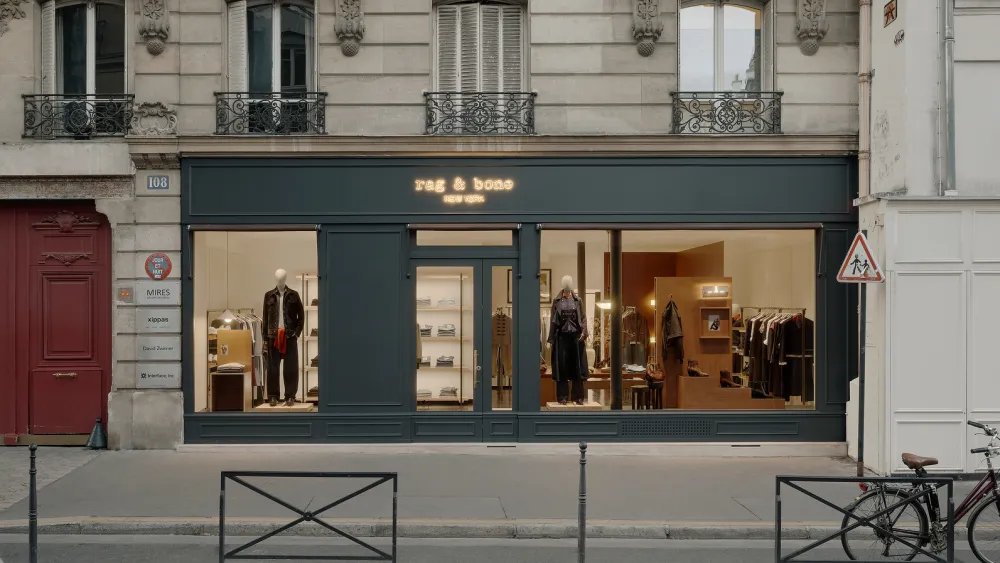
PARIS — Rag & Bone will officially open its doors to its first Paris flagship Wednesday, and celebrate with a splashy party on Sunday night. But the New York-based label’s arrival in Paris is less about planting a flag in the French capital than the first step in a bigger expansion strategy across Europe under new ownership.
“There’s so much to do,” said brand president Valentina Lucaj, who joined Rag & Bone four months ago following senior roles at Fendi, Louis Vuitton, Saint Laurent and Prada.
The Marais store on Rue Vieille du Temple is intended to be the first of at least two Paris locations. The company is also targeting another stand-alone store in London by mid-2027, plans to turn an October pop-up at Galeries Lafayette into a permanent space and is exploring expansion in Italy and Spain.
However, the strategy is less about reinventing Rag & Bone than honing its house codes for both retail and product. The company has “hired some additional talent” on the design teams across multiple categories, said Lucaj, but there is no plan to bring a big-name designer on board to wholly reinvent the label.
“It’s more further establishing the product pillars that we have and upgrading some of the skill in the pursuit of our ambition,” she said.
Lucaj’s appointment followed Rag & Bone’s acquisition by Guess and WHP Global in 2024. Guess acquired the brand’s operating assets, while Guess and WHP took joint ownership of its IP. The deal was intended to give the New York label access to a larger global infrastructure while allowing it to retain its identity focused on denim, British tailoring and upscaled everyday pieces.

Inside the Rag & Bone Paris flagship.
Sean Davidson / Courtesy of Rag & Bone
“It’s not about trends. It’s not about being something that we’re not,” she said. “We have always been a brand founded on the base of a wardrobe big in denim, mixed with British tailoring and uncompromising quality. And so, for me, the language should really be about focusing on the discipline of that.”
That discipline is being applied to distribution as much as product. Rag & Bone has historically been heavily wholesale driven, and Lucaj does not see stand-alone retail growth as a replacement for wholesale. Instead, the two channels have different jobs within a larger ecosystem.
The brand has had a wholesale business in France for more than a decade, including a long-standing relationship with Le Bon Marché. The new flagship will allow the brand to control the full customer experience itself.
“When you’re working in wholesale, sometimes you can have a limited representation of the brand,” she said. “So having a physical retail store in France and in Paris specifically allows us to articulate a full brand expression and showcase all of our product categories.”
That expression will become increasingly important as Rag & Bone builds out additional product categories.
The brand has had a consistently strong footwear business, and there will be a new focus on growing that category, while leather goods and accessories are “definitely an underdeveloped category that has a massive potential for our future,” she said.

Inside the Rag & Bone Paris flagship.
Sean Davidson / Courtesy of Rag & Bone
The larger opportunity, however, is not simply to sell more products. It is to establish itself in what Lucaj describes as “a new middle” between contemporary fashion and luxury.
“Contemporary’s opportunity today is to define a new middle,” she said. “And that’s what we’re really focused on as we think about evolving our product categories, both in terms of end use, function, price, quality. The business that we’re in today is really redefining what it means to be in the middle.”
As luxury prices have risen, she said consumers have increasingly mixed contemporary and luxury pieces in the same wardrobe, creating space for brands that can offer quality, design and longevity without luxury-level pricing.
“Consumers have always mixed high and low, right?” she said. “Mixing contemporary items with luxury items has been a consistent trend for many years, and with the price of luxury increasing over the years, it offers the space for contemporary brands to show up differently.”
To that end, Rag & Bone’s positioning will double down on well-made, distinctive pieces with classic core values. “Our main objective always is to design product that we believe in, product that stands for quality, and a kind of product that you can live in,” she said.
The Paris flagship is one of the first expressions of that more cohesive brand identity. The 1,745-square-foot space features residential-style interiors, designed with Studio Armando Aguirre and furnished with vintage and antique pieces sourced from markets outside of Paris.
The store also houses the Rag & Bone Archive, with pieces from the brand’s history displayed exhibition style to showcase its craftsmanship and house codes. While the assortment will be tailored for Paris, the two cities share a common approach to fashion, Lucaj said.
“It’s not what you wear; it’s how you live. In other words, we design products that you can really live in. Both cities have specific physicality to the way that you have to kind of live and move in the city, and I think New Yorkers and Parisian men and women are always looking for product…starts with quality, but it all also starts with a sense of ease,” she said.
Lucaj also envisions the store as a connection between New York and Paris café culture, and has partnered with nearby La Perle, commissioning a custom mural and creating a bespoke coffee experience as part of integrating into the neighborhood.
Plus a personal styling service is on offer to reinforce the more intimate, service-led retail experience Lucaj wants to grow.
“The store might be new to Paris, but Rag & Bone is not new to the world,” Lucaj said.

Inside the Rag & Bone Paris flagship.
Sean Davidson / Courtesy of Rag & Bone
Sales have grown more than 30 percent over the past three years, she said.
“We work closely with our shareholders in the pursuit of our ambition, and we’re very transparent about what we’re trying to accomplish,” she said. Both Guess and WHP have been “incredibly supportive,” but have left the brand to work independently.
The next stage is to use that momentum to build more DTC, e-commerce, as well as continue to strengthen international markets such as South Korea, where it operates 17 points of sale with partner Samsung. It is also exploring Middle East expansion based on its strong client base that currently shops abroad at Harrods in London, for instance.
“It’s also about taking existing markets where we have an established business through wholesale in particular, and finding our way to physical retail as the next evolution of the brand,” she said.