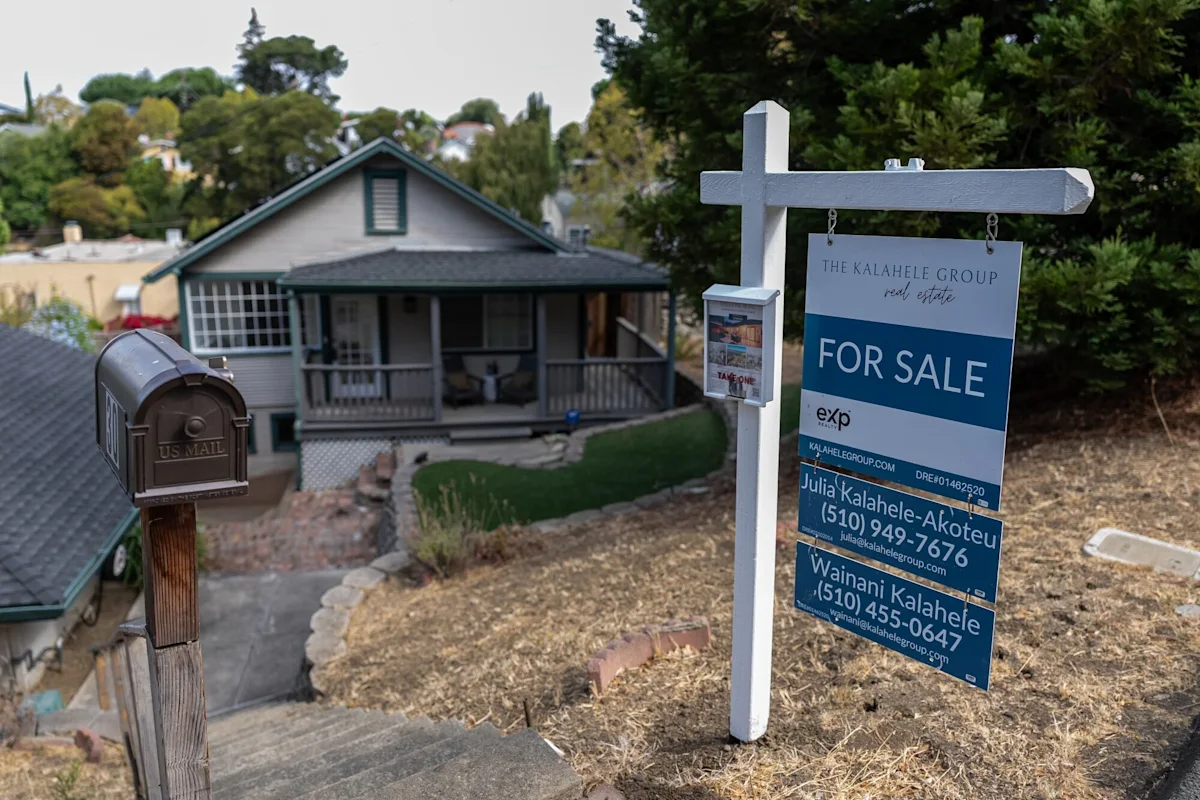
(Bloomberg) — Barely six weeks out from the midterm elections, housing costs that many Americans have long said are too high are looking even more out of reach.
Most Read from Bloomberg
The latest blow for consumers came Thursday, when Freddie Mac reported that rates for 30-year mortgages climbed to 6.95%, the highest since January 2025, when President Donald Trump returned to office. That report emerged after the Federal Reserve raised interest rates for the first time in three years, crushing any hopes that borrowing costs will come down soon.
The outlook for housing remains grim. The 10-year Treasury yield, which mortgage rates closely track, is hovering around its highest since 2007. Builder confidence has tumbled to match the lowest level since late 2022, thanks to an ugly mix of falling mortgage applications, inflated building material costs and immigration enforcement that’s scared away workers.
“The housing sector is not a good-news story from any dimension,” said Douglas Holtz-Eakin, president of the right-leaning American Action Forum. “We had a period of low inventory on both the owner-occupied and rental side, and now we have the problem of high prices and high financing costs.”
Nationwide, 49% of US metropolitan areas tracked by the National Association of Realtors now require a household income of $100,000 to qualify for a mortgage on a median-priced home, assuming a 10% down payment. That’s up from just 6% of US metro areas in 2019 and includes cities in political battlegrounds like Columbus, Ohio; Dallas-Fort Worth-Arlington, Texas; and Lancaster, Pennsylvania.
In 2025, the real median household income in the US was $87,460.
For Trump — who promised on his first day back in office to lower housing costs — the inability to provide relief is boosting chances that Democrats take the House and, possibly, the Senate in November. “Making Housing Affordable Again” is still listed as the top accomplishment of Trump’s Department of Housing and Urban Development, but that’s not how it feels to many in the housing market, or their employers.
“Whenever one of our staff members is looking for housing, it can be very tough to find something,” said Andrew Volk, who owns the Hunt & Alpine bar in Portland, Maine, a top election battleground. Asked if that’s made it harder for employers to hang on to workers, he responded, “One thousand percent.”
The broader outlook among US consumers is also worsening, adding to GOP headwinds ahead of the Nov. 3 midterms. Preliminary data from a closely watched University of Michigan survey showed consumer sentiment deteriorated again in September, nearing a record low. Only 35% of Republicans believe the administration is doing a good job with the economy, according to the survey, the lowest reading since Trump returned to the White House.
“I think Republicans should be quite cognizant of this,” Holtz-Eakin, who once led the Congressional Budget Office, said. “The unemployment rate is 4.1%, but people are going to work and not getting ahead. That’s not a happy feeling.”
Since taking office, Trump has vacillated between claiming credit for lowering consumer prices and dismissing affordability as a “con job” fabricated by Democrats. It’s an issue candidates from both parties can’t avoid on the campaign trail.
“Democrats are talking about affordability, and now Republicans are trying to talk about it, even though Trump calls it a hoax,” said Bernie Porn, a longtime pollster in Michigan, home to one of the nation’s most-watched Senate races.
In Maine, a state where Democrats hope to flip a Republican Senate seat, the major campaign issues are “affordability — then a gap — and then Trump,” said Mark Brewer, chair of the University of Maine’s political science department. “Data centers are moving up fast. Everything else comes after.”
In Washington, some Republicans are still grousing about Trump squandering a political victory with his handling of a sweeping housing bill this summer. After it passed Congress in a rare bipartisan deal, Trump canceled a signing ceremony at the Capitol at the last minute over demands that a voter ID bill pass first. The housing legislation became law anyway without the president’s signature, but the opportunity for Republicans to claim credit publicly alongside Trump was lost.
Another administration effort to ease housing costs also fell flat when, under Trump’s direction, mortgage giants Fannie Mae and Freddie Mac announced a plan to purchase $200 billion of mortgage-backed securities in a bid to bring down rates, only to see them rise after the administration launched a war with Iran that exacerbated inflation concerns. The conflict — which the president repeatedly said would be over in weeks — sparked a surge in fuel costs that has been hammering consumers for months.
There have been other affordability pitches. White House officials last month floated increasing the capital gains tax exemption for primary home purchases. Yet that idea, which would require congressional action, would disproportionately benefit the wealthy and hasn’t gained traction since. Trump also touted a plan this month to give Americans $5,000 dividend checks, but only if Republicans retain control of both chambers of Congress in November.
‘Really Terrible’
In trying to tackle housing costs, the president may have backed himself into a political corner. If housing prices decline, prospective buyers would benefit, but existing homeowners would see their property values decline — a result Trump said he wants to avoid.
“For some people it might be a better outcome if you had prices really falling like we had in the financial crisis,” said Chen Zhao, Redfin’s head of economics research. “But that’s really terrible for the 56% of Americans who already own their homes. So there are different constituents we have to think about here.”
Because housing is most Americans’ largest monthly expense, it figures heavily into their views of the state of the economy. Housing affordability ranked as the top issue for voters aged 18-34 and the second most important issue for voters aged 35-49 in a survey CNBC conducted in July.
“These things don’t have – especially in housing – a silver bullet,” said Zhao.
That’s not much consolation to Yousef El-Raghy, a 28-year-old Jersey City resident struggling to find an affordable home in the New York area. He said housing costs are driving a rise in populism, particularly among young people.
“I did everything right — I went to a good school, I didn’t take on a ton of debt, I saved money,” El-Raghy said. “I worked on Wall Street, I moved into tech, and I still can’t afford a home,” he added. “What more could I have done?”
Most Read from Bloomberg Businessweek
©2026 Bloomberg L.P.


 dailynewsnblog