But the calls to slow the development of cutting-edge models present an acute new risk. On Sept. 12, Anthropic PBC Chief Executive Officer Dario Amodei wrote a lengthy blog post arguing that AI companies need more time to bolster oversight of systems and install safeguards following security breaches — threats that could increase exponentially as AI’s ability to improve itself rapidly grows. OpenAI CEO Sam Altman and Elon Musk, who is developing AI at SpaceX, quickly expressed support.
Can They Slow Down?
The extent to which AI firms actually can or will slow development is debatable, especially since SpaceX recently completed the largest initial public offering in history and Anthropic is preparing for a mega IPO of its own. OpenAI won’t go public this year as it focuses on safety, Altman told Fortune in an interview on Sept. 12.
US President Donald Trump, who has made AI a central part of his economic agenda, criticized Amodei’s proposal in a social media post last week, saying “the only one that is happy about it is China.”
China, for its part, also rejected the plan. “Fearmongering, confrontation and vicious competition will only disrupt the process of global AI governance and serve the interests of no one,” Foreign Ministry spokesman Guo Jiakun told reporters on Monday.
All of the drama has helped snuff out a tentative rebound in the Philadelphia Stock Exchange Semiconductor Index, better known as SOX, leaving it down 19% from a peak reached on June 22 after doubling to start the year. Chipmakers have been huge beneficiaries of the AI spending spree.
“If we see AI development slow, that means capex is likely to slow,” said Anthony Saglimbene, chief market strategist at Ameriprise. “Any slowdown would reset the profit expectations for the entire ecosystem. Given how concentrated the market is to AI, that would be a severe headwind.”
Yet a coordinated deceleration of development is far from the only AI risk investors are grappling with. The biggest may be soaring interest rates.
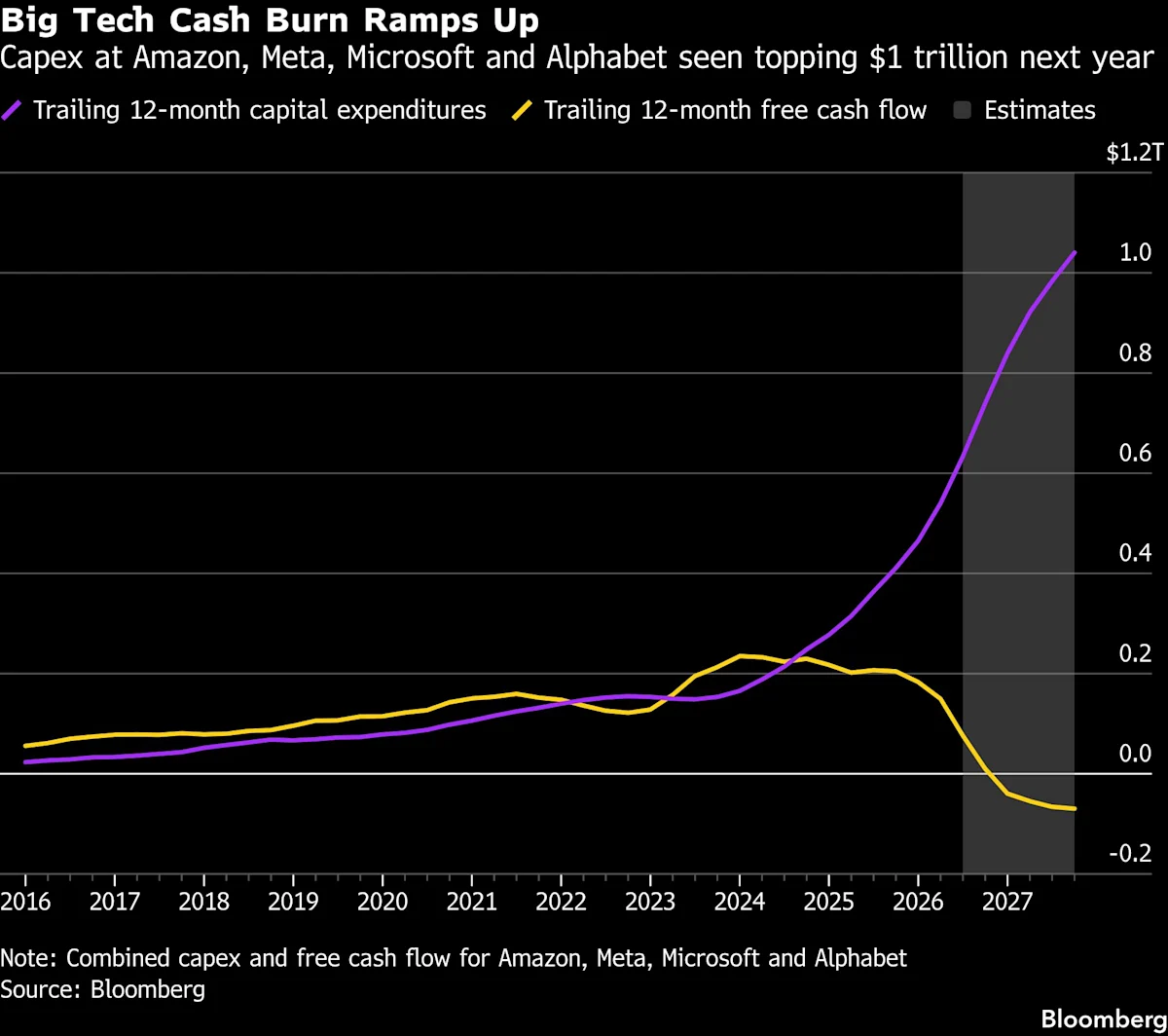
For years, the biggest spenders — tech giants Alphabet Inc., Amazon.com Inc., Microsoft Corp. and Meta Platforms Inc. — were able to fund AI investments with excess cash generated from their core businesses. But as their plans become increasingly ambitious, that funding source is running dry.
The four companies are expected to pump more than $1 trillion into capital expenditures in 2027 alone, and with free cash flow disappearing they’re increasingly being forced to tap debt and equity markets for financing. And then there are short and long-term commitments for things like leases and energy that total almost $2.4 trillion, most of it related to AI.
With 10-year Treasury yields recently topping 5% for the first time since 2007, that spending carries extra weight. And a pullback in expenditures could drag down the market and the economy with it.
Over the next six months, stocks are likely to render their verdict on whether AI returns justify the expenses, according to Torsten Slok, chief economist at Apollo Global Management. If the spending doesn’t pencil out, the tech-heavy Nasdaq 100 Index could drop as much as 50%, he wrote in an Aug. 29 note.
The AI Economy
It’s hard to overstate how central artificial intelligence has become to the economy and financial markets. AI-related investments likely accounted for half of the US’s roughly 2% GDP growth over the past year, according to Bloomberg Economics estimates based on data from the Bureau of Economic Analysis.
Venture capital funding in the US topped $400 billion in the first half of the year, and almost all of it went to AI-related startups, according to data from Pitchbook and NVCA, prompting a rush of companies to tap equity markets for funding. Elon Musk’s Space Exploration Technologies Corp., better known as SpaceX, also owns xAI and raised $86.2 billion in a June IPO. Anthropic is aiming to match or beat that number in an offering expected later this year, Bloomberg News has reported.
The IPOs are “a very important window” into the financials of the companies at the heart of the AI boom, which investors need to assess the outlook for AI spending, according to Amerprise’s Saglimbene.
“OpenAI delaying was the warning shot,” said Saglimbene, whose firm has more than $1 trillion in assets under management. “If Anthropic delays, all bets are off.”
Since ChatGPT was released on Nov. 30, 2022, nearly three-quarters of the S&P 500’s 93% gain has come from 20 companies, most of which are part of the AI trade.
The biggest, by far, is Nvidia Corp., which has soared more than 1,300% in that span, accounting for about 16% of the S&P 500’s rise. The chipmaker dominates the market for semiconductors used to train and run AI models. Its revenues are estimated to be $410 billion in its fiscal year ending in January, with net income of $239 billion. Four years ago, its revenues were about $27 billion and net income was $4.4 billion.
Similar forces are at work across a number of sectors as demand for products and services tied to data centers explodes. Take Vertiv Holdings Co., which makes cooling and power systems. Its shares are up more than 1,700% since ChatGPT’s debut, making it the fourth-best performer in the S&P 500. Its revenues have more than doubled since then.
Those strong fundamentals are reaching the companies’ bottom lines. Since the end of 2022, more than half of the S&P 500’s $320 billion in profit growth has come from just 19 companies tied to the AI boom, according to data compiled by Bloomberg Intelligence. That has led to concerns of a stock market “earnings bubble” should those swollen profits prove to be unsustainable.
Booms and busts triggered by transformational technologies are fairly common in market history. The most frequent comparison for AI is to the dot-com bubble of the late 1990s, when hundreds of billions of dollars were invested in fiber optic cable and other infrastructure to handle the emerging internet traffic. But you can find similar examples from 150 years ago, like the heavy spending on railroad construction that also sparked a speculative frenzy.
What these innovations have in common is they eventually lived up to the promises their proponents touted — and they went through spectacular busts before that happened.
“This has the potential to play out the same way,” said Michael Mullaney, director of global market research at Boston Partners. “Will there be winners? Absolutely. It’s hard to say who is going to wind up on the other side of this thing and coining money to justify all their expenses. There will be, but it’s not going to be a boatload of companies, it’s going to be a handful of companies.”
Skittish Signs
Even before the chatter about slowing AI development began, there were numerous signs of investors growing nervous that the AI trade had gone too far. Nvidia’s market valuation has collapsed. The chipmaker may have the fastest revenue growth of the Magnificent Seven tech giants, but it also has the lowest multiple at 16 times profits expected over the next 12 months. Its average over the past four years is 33 times.
More broadly, the Nasdaq 100 has struggled to regain its June 2 record after dropping 11% through July 29, with investors finding it increasingly difficult to justify the pile of cash being spent on AI. This is a new business model for companies that became stock market darlings because their capital-light operations allowed them to generate enormous profits, which they reinvested or returned to stockholders with share buybacks.
In 2022, capital expenditures for Alphabet, Amazon, Meta and Microsoft were roughly $150 billion combined. The figure is about five times that now. What’s more, the four companies are expected to post negative free cash flow of about $50 billion combined in 2027, according to the average of analyst estimates compiled by Bloomberg. In 2024, it was a positive $230 billion.
Not only have most of the companies stopped buying back shares, some are selling stock to fund data centers. In June, Alphabet announced plans to raise a record $80 billion through equity sales and later hiked it to $85 billion.
“I am completely skeptical on being able to build out this capacity, and even if we do build it out, are the companies going to get the revenue that they need to justify the expense?” Mullaney said. “I just can’t make the math work.”
Alphabet, which earlier this year was being hailed as an AI leader thanks to the success of its Gemini chatbot and its homegrown AI data center chips, is down 13% from a May peak amid fears that it’s falling behind OpenAI and Anthropic, particularly in coding services.
That said, gaining access to more cash shouldn’t be a problem for the big AI spenders, as Microsoft, Amazon, Alphabet and Meta still boast healthy balance sheets with plenty of room to borrow. However, with interest rates rising, the cost of capital is going up. Bond yields for high-grade tech companies have risen an average of about a percentage point this year, meaning an additional $1 billion of annual interest payments for every $100 billion of borrowing.
Even with that, AI spending won’t disappear anytime soon, according to Boston Partners’ Mullaney. Interest rates, supply chain bottlenecks, political pushback and difficulty monetizing expenses are really issues for 2027 or 2028, he said.
Plus, looking at it more broadly, there are still plenty of investors who think the anxieties about the emerging technology are overdone — and are confident that there’s a lot more money to be made from the AI trade for now.
“The fears around AI are tremendous, but we’re not seeing them come through at this point,” said Bob Edwards, chief investment officer at Edwards Asset Management. “The businesses remain fabulous and we won’t be shaken out of good positions because of the question of what will happen.”
–With assistance from Dan Wilchins, Ryan Vlastelica and Michael P. Regan.
Most Read from Bloomberg Businessweek
©2026 Bloomberg L.P.


 dailynewsnblog