dailynewsnblog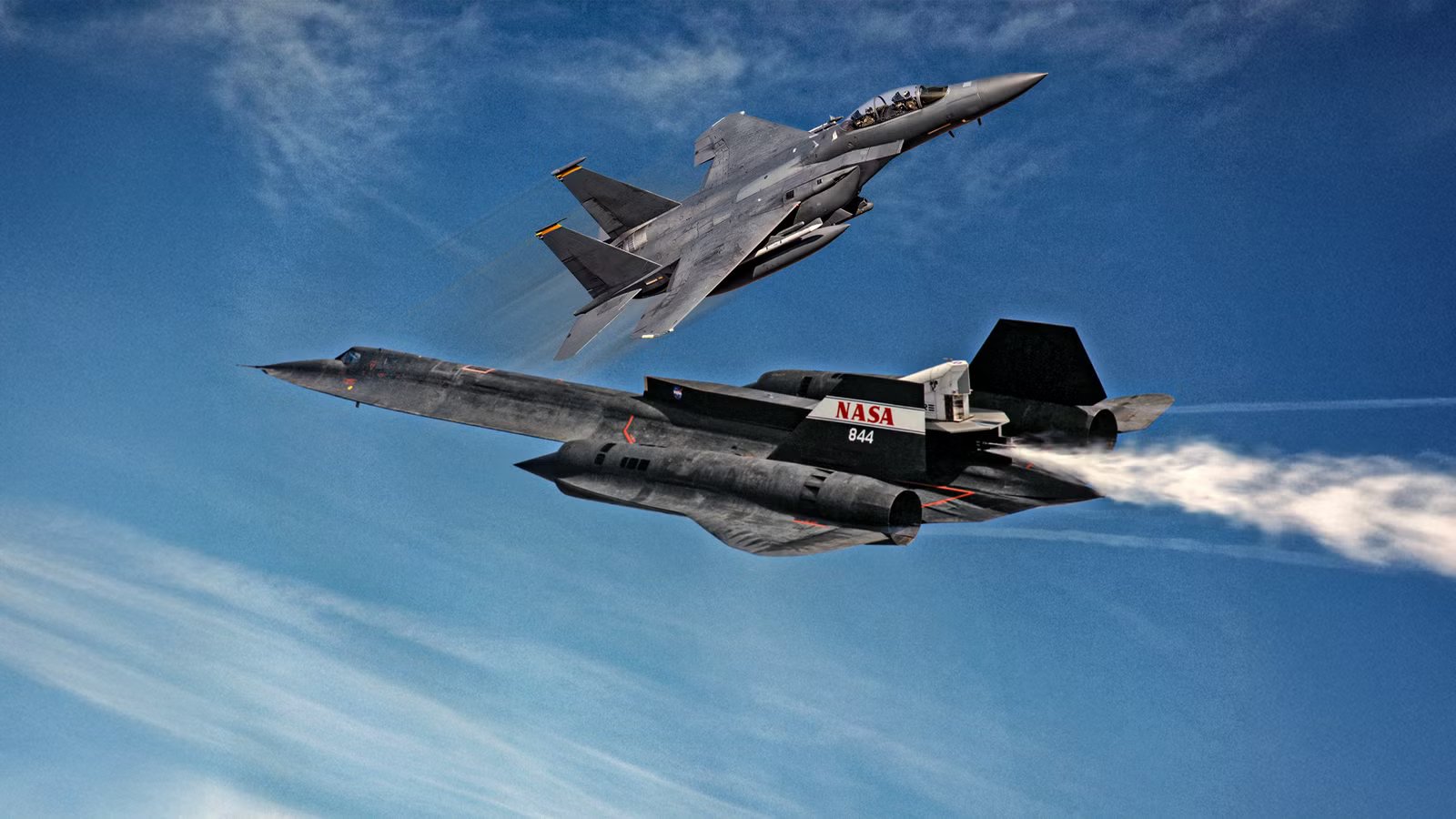
The Lockheed Martin SR-71 Blackbird was a legendary Cold War aircraft designed to soar at incredible altitudes in order to produce high-quality images of sensitive sites within nations hostile to the United States (US). The spy plane was highly active over Eastern Europe, the Soviet Union, and swaths of Asia. Additionally, it could operate at heights and speeds that made it extremely difficult to target, much less hit, with surface-to-air missiles (SAMs) or interceptors launched by the countries it was flying over.
While such missions added to the Blackbird’s mysterious nature and aura of seeming invincibility, the aircraft was also employed for operations that could be considered highly peculiar given its primary mission as a clandestine intelligence collector. Beginning in 1982, the SR-71 served as a flying target aircraft for the United States Air Force’s McDonnell Douglas F-15 Eagles.
Targeting The Blackbird Was No Easy Task

The Blackbird accomplished its first flight on December 22, 1964, and entered active-duty service in January 1966 with the 4200th (later 9th) Strategic Reconnaissance Wing based at Beale Air Force Base in California. Once aloft,the SR-71 operated at altitudes between 80,000 and 85,000 feet (approximately 24,000 to 26,000 meters) to discreetly gather sensitive intelligence. At such heights, 95 percent of the Earth’s atmosphere would be below its fuselage, and it could survey 100,000 square miles of the Earth’s surface per hour.
To keep the crew and aircraft safe, each of the Blackbird’s two Pratt & Whitney J58 engines could produce 32,500 lb (14,742 kg) of thrust with afterburner. Further, the SR-71 could cruise at Mach 3 continuously for more than one hour, with its highest recorded speed reaching Mach 3.32 (2,193 mph/3,529 km/h) on July 17, 1976.
Operating at such immense speeds let the Blackbird evade not only interceptor aircraft but also enemy SAMs. Incredibly, the Smithsonian reports that the aircraft was fired upon more than 4,000 times, with no hits. While not a single Blackbird was shot down, its ability to evade every weapon system designed to blast lesser aircraft to pieces came at the cost of tremendous fuel consumption. During a typical 90-minute flight, the aircraft would consume approximately 12,000 gallons (45,425 liters) of specialized JP-7 fuel.
The USAF’s F-15s would square up against this formidable target to hone fighter pilots’ skills in target acquisition, tracking, achieving a lock, and finally conducting a simulated firing of their Sparrow missiles. These high-altitude, high-speed trials were known as “Eagle Bait” missions and were conducted at Nellis Air Force Base (AFB), north of Las Vegas.
The SR-71 Became the Ultimate F-15 Training Target

Beginning in 1982, the USAF initiated its “Eagle Bait” exercises, which were intended to allow its F-15 pilots to simulate firing AIM-7M Sparrow missiles at fast-moving targets, and the SR-71 was perfect for the role. Additionally, Nellis AFB was ideal because it had F-15 pilots, mission-support infrastructure, and restricted airspace that would allow for such training.
The exercises were detailed by Colonel Richard H. Graham (USAF Ret.) in his book, Flying the SR-71 Blackbird: In the Cockpit on a Secret Operational Mission. Graham stated, “In order to maximize scarce, high-altitude/high-speed intercept practice for the fighters against the SR-71, we stacked the deck in their favor to avoid a multitude of missed intercepts…The practice intercepts were conducted in a highly controlled environment, favoring a successful outcome by the fighters.”
To help the fighters locate the Blackbirds, the participating aircraft operated on a common Ground Control Intercept (GCI) frequency. This allowed the fighters to be vectored in for a direct intercept; the crews on each side could also communicate to help establish contact. In addition, the Blackbirds flew in a straight line, which the GCI controller and participating fighters knew well in advance of the SR-71’s arrival.
Once underway, Graham stated that the Blackbird crews “…kept the SR-71 at a constant altitude, airspeed, and heading as the fighters maneuvered for their head-on attack. GCI controllers provided constant range and bearing for the fighters to their target SR-71 so they could begin searching on their aircraft radar.” Even under such controlled operating conditions, the F-15s found it extremely difficult to achieve a lock and subsequent “kill.” Regarding the situation, Graham noted, “All we ever heard on the radios from the fighters as they raced by well below us was, ‘Ah, damn, we’re too late!'”
The F-15’s Radar Struggled To Keep Up

Despite the highly controlled variables of the Eagle Bait exercise, the fighters still struggled to achieve a simulated kill. Most missed intercepts resulted from two factors that strongly influenced intercept geometry: the altitude difference between the Blackbirds and F-15s, and the extreme closing velocity between the two aircraft.
Regarding closing velocity, Graham noted, “At the start of the Eagle Bait missions, the F-15s discovered that their fire control system (FCS) speed gate (the computed closing velocity between the interceptor and the target) was not large enough to accommodate their extreme closing velocity against the SR-71.” Corroborating this, another SR-71 pilot, Dave Peters, found that the Eagle’s speed gate was 1,500 knots. He further explained that the Blackbirds “…were casually warping along from 1850 to 2000…” knots. “So, for them, we didn’t exist.”
In a head-on intercept, an F-15 traveling at 600 knots (1,111 km/h) and an SR-71 at 1,900 knots would produce a closing speed of roughly 2,500 knots. The original F-15 fire-control system’s speed gate could not accommodate such extreme closing velocities, presenting a significant technical challenge during the early Eagle Bait missions.
The issue was ultimately resolved through software changes rather than hardware modifications, allowing the radar to account for the SR-71’s extreme speed. Later APG-70 radars featured programmable signal processors that further enabled software-based improvements. Even after the SR-71’s characteristics were incorporated into the radar’s programming, however, the F-15 still struggled to intercept the Blackbird.
The SR-71 Pushed Air-to-Air Missiles to Their Limits

Beyond the issues related to tracking and achieving a lock, making a simulated kill was further hampered by the F-15’s AIM-7 Sparrow missile itself. According to Graham, if the F-15s did not climb and remained at 25,000 feet (7,620 meters), their AIM-7s had extreme difficulty climbing to 55,000 feet against gravity in an attempt to achieve a simulated kill.
Additional complicating factors included the design of the missiles. Specifically, their small fins were aerodynamically optimized for maneuvering in the denser air below 50,000 feet (15,240 meters) and did not provide sufficient maneuverability to make tight turns in the thin air at 80,000 feet (24,384 meters). Graham elaborated: “As a missile races toward the SR-71 Mach 3 or greater, the closing velocity between the two approaches Mach 6, or about one mile every second! The missile’s impact point in front of the SR-71 has to be perfectly predicted early on by the fighter’s computer.”
The missile’s proximity fuse required the AIM-7 to detonate near its target, projecting the warhead’s blast toward the aircraft. However, the missile’s extreme closing speed and the SR-71’s speed made it exceptionally difficult for the missile to perform any last-minute terminal maneuvering. In order to adjust to this issue, Graham stated that the “…F-15 crews were given special permission to do a zoom-climb to 50,000 to 55,000 feet before a simulated AIM-7 launch against the SR-71. They had permission to be above 50,000 feet for a maximum time of 90 seconds without wearing a pressure suit.”
The SR-71 Proved Almost Impossible To Defeat in Training

The SR-71’s legendary speed and altitude made it one of the most difficult aircraft in the world to intercept, but the Eagle Bait exercises revealed how challenging the Blackbird could be even for America’s premier fighter. Despite giving F-15 crews significant advantages, extreme closing speeds, altitude differences, radar limitations, and missile performance repeatedly frustrated simulated engagements.
Ultimately, Eagle Bait demonstrated that intercepting the SR-71 was far more complicated than simply getting close enough to fire. The exercises pushed the F-15’s radar, fire-control system, and AIM-7 Sparrow to their limits, requiring software modifications and unusual tactics. Even as a training target, the Blackbird remained exceptionally difficult to defeat.
Catch what other trackers miss
Emergency squawks, holds, NOTAMs — live signals, no signup.
Open tracker
Catch what other trackers miss
Emergency squawks, holds, NOTAMs — live signals, no signup.
Open tracker