dailynewsnblog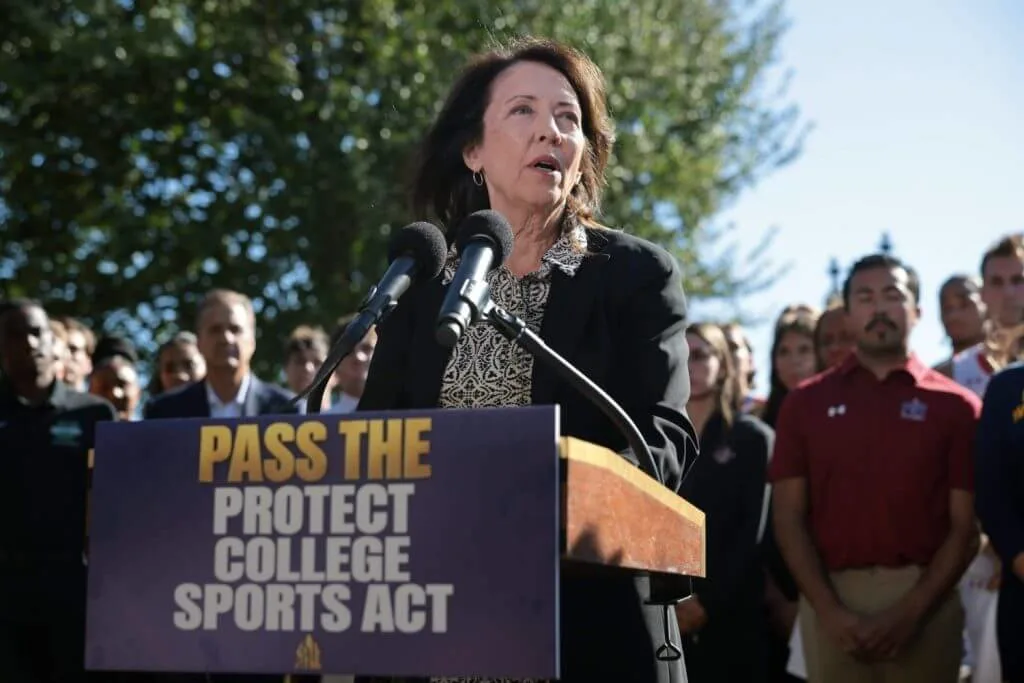
On Tuesday, the ballyhooed Protect College Sports Act took a big step toward a vote in the Senate. It passed cloture by a 74-24 margin, which means it will proceed to the floor for debate. Given the lopsided margin, the bill is expected to officially pass as soon as early next week.
It’s a testament to the power of effective messaging that the NCAA, the conferences and their lobbyists — not to mention Sens. Ted Cruz (R-Texas) and Maria Cantwell (D-Wash.), who co-authored the bill — managed to convince three-fourths of the Senate that the “chaos” of college sports was a crisis in need of federal intervention.
Advertisement
Because it’s unclear how the central components of the bill would solve the central components of the so-called crisis.
On Monday, I scrutinized some of the more suspect statements Cruz made during his “College GameDay” appearance this past weekend. Today, I’d like to turn to his Democratic counterpart.
This week, Cantwell rolled out a data-heavy report in a release titled “Runaway Athletics Spending Threatens the Financial Health of America’s Colleges.” Some of the numbers are undeniably alarming:
“94 percent of all Division I athletics programs now spend more than they generate.”
Advertisement
“A $520 million increase in institutional support from 2015 to 2025.”
“15.2 percent of budgets being funded by endowments.”
Then it goes on to list the biggest causes of those soaring expenses: “From 2005 to 2023, schools saw increases of 322 percent in recruiting costs, nearly 300 percent in sports equipment, around 250 percent in both medical and game day expenses, and more than 200 percent in travel. Coaching salaries increased a whopping 370 percent over the same time period. And the problem is accelerating. Two years after a roughly $20 million roster was considered exceptional, industry surveys in 2026 placed several leading programs at $40 million or more.”
The Athletic can confirm the accuracy of that last part.
Advertisement
But notice the end date on the time period she is citing for that data: 2023. The House settlement, which ushered in revenue sharing in college athletics, was not passed until 2025. Which means, at the time of all those listed expenses, schools were still spending $0 on paying their athletes directly. Most name, image and likeness deals at the time were coming from outside collectives.
Yet when it comes to Cantwell’s grand solution to this problem, there is only one category of expenses in her and Cruz’s entire 171-page bill that would explicitly get capped: revenue sharing, of course. There is no attempt to rein in that 322 percent increase in recruiting costs or 370 percent increase in coaching salaries. (There’s probably not much they can do about equipment and travel costs.)
Even that new rev-share cap of $47.5 million doesn’t seem likely to result in any immediate decrease in spending, and if anything, schools’ combined spending might increase. Take a look at The Athletic‘s new list of Power 4 roster budgets. If we assume most schools are spending around 75 percent of their revenue sharing allotment on football, then only the teams spending at least $35 million on football this year will approach $47.5 million across all sports. We believe that’s fewer than 20 out of 68 Power 4 schools. That leaves a whole lot of room for the others to keep adding. (And even the rich schools will only level out if you believe these caps will actually be enforceable.)
There is, however, one provision in the bill that doesn’t directly address athlete compensation but may prove to be effective at suppressing it: transfer portal restrictions.
Advertisement
The bill would give the NCAA an antitrust exemption allowing it to restore its 2021-23 policy that grants players a one-time exception to transfer and play immediately. Still, even that exception has a couple of exceptions. Players could transfer freely in the event of a coaching change. But also, graduate transfers will continue to be allowed to play right away. So we could still have players changing schools two or three times in a five-year career. But that’s still a big departure from the current model, in which every athlete is a free agent every year.
What effect could that have? Well, it could cost a lot less for coaches to retain the bulk of their rosters, because the majority of players will be stuck there the next year and therefore will have no leverage to demand a raise. The flip side of that, of course, is that transfers will have more leverage because of their scarcity. Perhaps an economist can tell us how those scales will balance.
But let’s say it works. Let’s say all those roster budgets in our story this week get frozen right where they are for the next five years. It doesn’t change the fact that all of the other out-of-control expenses that caused that $520 million rise in institutional support will still be there — and they’re going to keep going up. Problem not solved.
Interestingly, the two co-sponsors of the bill have expressed very different motivations for their involvement.
Advertisement
Yes, they both want to protect women’s and Olympic sports from the massive cuts everyone has been prophesying for five years but to this point have not remotely come to fruition. But Cruz, a fan of pretty much every Texas school, talks a lot more about the scourge of players transferring four or five times, hazy eligibility rules, “a booster in a back alley just showing up with a bag of cash.” The issues fans care about most.
Cantwell’s interest in this topic is rooted in what happened to her home-state school, Washington State, after the Pac-12 dissolved. Her pet topics: slowing down realignment (the bill caps conferences at 19 schools and makes it difficult for schools to change conferences) and standing up to the Big Ten and SEC. And her main solution to those is the so-called Cody Campbell plan, allowing conferences to pool their media rights and sell them as one package, which her report says “could bring in an additional $4 (billion) to $8 billion in media rights revenue, allowing athletic departments to be self-sustaining again.”
Two problems with that: 1) The conferences’ current TV deals run into the 2030s, so it’s going to be a while before it could even happen. And 2) Does it really matter? During that same 2005-2023 period, P4 conference revenues skyrocketed by 212.4 percent. In 2006, the Big Ten struck a deal with ABC/ESPN valued at $100 million a year. Its current deals with Fox, CBS and NBC, signed in 2023, are worth $1.1 billion a year.
And yet, her report cites Big Ten members UCLA, Minnesota, Wisconsin and Rutgers among those subsidizing athletics at the expense of academics.
Advertisement
But hey, 73 (at least) senators agree with her that this bill is the best way to “stabilize” those expenses. I don’t know how many of them read her report, but clearly the message has been received. We must rein in this one specific subset of runaway expenses that did not exist prior to 2025.
This article originally appeared in The Athletic.
College Football, Men’s College Basketball, Sports Business, Women’s College Basketball, College Sports
2026 The Athletic Media Company