dailynewsnblog
What do you get for spending more than $1,000 on a smartphone? Some of the best mobile cameras on the market.
That’s certainly true for Apple’s $1,199 iPhone 18 Pro and Samsung’s $1,300 Galaxy S26 Ultra. Both premium (and pricey) phones pack highly advanced camera systems that can deliver impressive results, whether you’re a casual or professional photographer.
Apple unveiled the iPhone 18 Pro and Pro Max last week with updated camera features including a variable aperture to adjust how much light reaches the sensor and the option to tweak white balance and other settings. The iPhone 18 Pro and Pro Max have a triple 48-megapixel rear camera system with wide, ultrawide and 4x telephoto lenses. There’s also an 18-megapixel selfie camera. The phones are open for preorder now and will be available on Friday.
The Galaxy S26 Ultra debuted earlier this year with a 200-megapixel wide-angle, 50-megapixel ultrawide, 10-megapixel 3x telephoto and 50-megapixel 5x telephoto camera array. There’s also a 12-megapixel selfie camera. (If you’re looking for a foldable option with solid cameras, the rear cameras on the Galaxy Z Fold 8 Ultra match the S26 Ultra’s optics, hence the “Ultra” title of both phones.)
I took the iPhone 18 Pro and Galaxy S26 Ultra around San Francisco to see how their cameras compare.
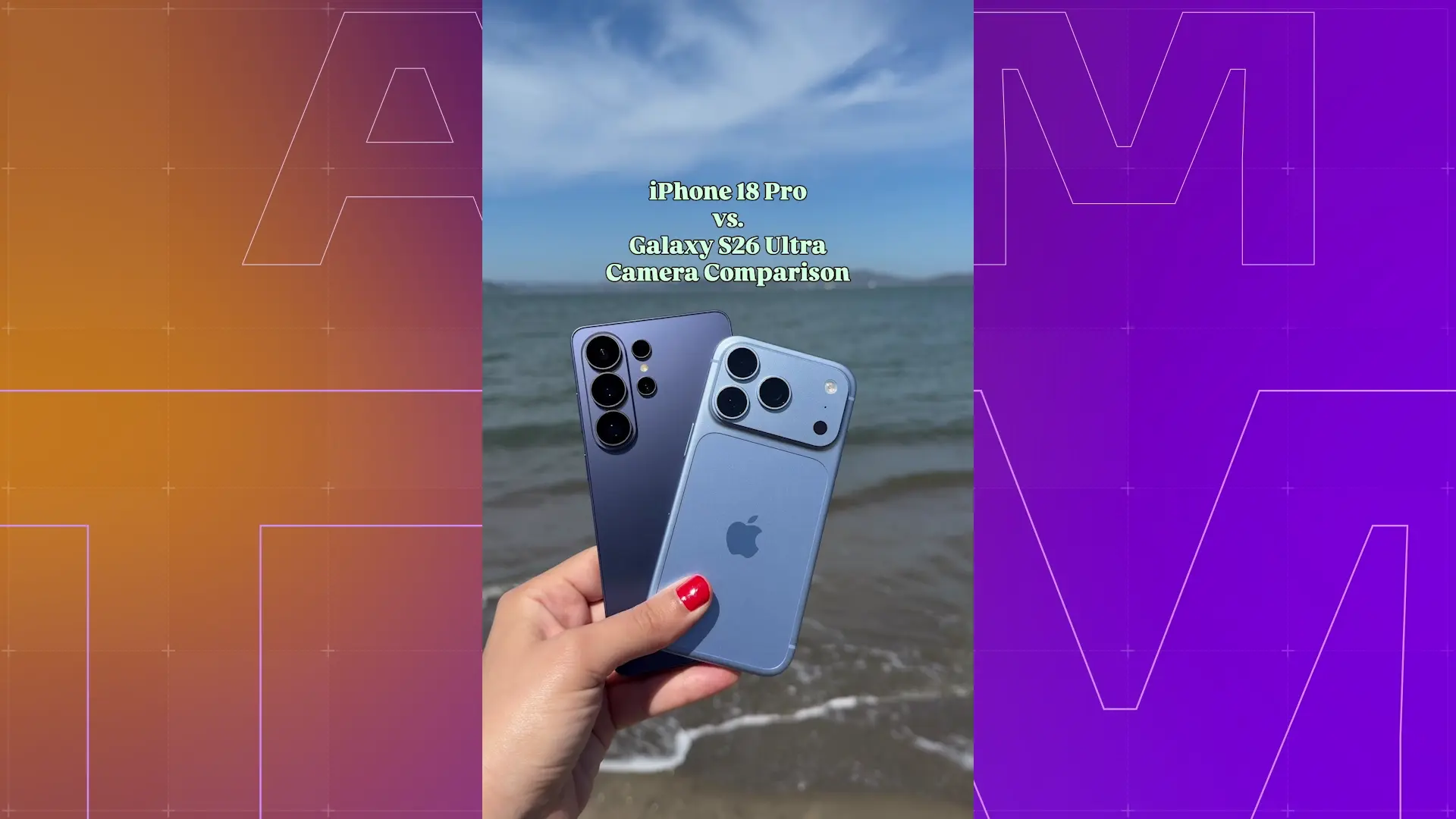
iPhone 18 Pro vs. Galaxy S26 Ultra photo comparison
Almost instantly, I saw where the greatest difference lies between the iPhone 18 Pro and the Galaxy S26 Ultra. The iPhone’s camera tends to produce warmer, more vibrant colors, as seen in the stonework at the Palace of Fine Arts. The Galaxy image has gentler hues and softer shadows, for an overall brighter shot.
There are things I admire about both photos. I like the richness of the iPhone image, but I also appreciate the crispness of the Galaxy picture and the details it captures in the stonework and trees. Ultimately, the iPhone 18 Pro image feels a little more inviting to me.


This photo was taken in a hotel lobby, with light streaming in from both the foreground and background. Notice how vivid the detail is in the leaves and petals in both photos. I like the punchier shades of orange and pink in the Galaxy S26 Ultra photo, which helps to brighten up the overall image.


The Garden Court at the Palace Hotel made for an interesting scene, with so much light streaming in through the glass ceiling. Here’s where you can really see how much warmth the iPhone 18 Pro adds relative to the S26 Ultra, for better or worse. I prefer the S26 Ultra photo here, because it comes off as a bit more true-to-life.


You can adjust white balance on the iPhone 18 Pro, so I gave that a try to get some slightly cooler tones. This is the image in Tungsten, which I felt was a little too dramatic of a shift. I generally prefer to keep the camera on auto white balance so it can adjust as needed, but it’s neat to have this capability if you want to play around a bit.

The iPhone 18 Pro has an 8x preset zoom, while the S26 Ultra punches in closer, up to 10x. Both cameras preserve detail, though in this comparison the S26 Ultra seems to maintain just a little more sharpness.


Lunch time! In these outdoor shots, the iPhone 18 Pro and Galaxy S26 Ultra are similarly bright and vibrant.
I like that more of the S26 Ultra photo is in crisp focus, from the shreds of coconut to the slivers of almond. By focusing on the food, my thumb takes on a slightly blurred effect, but the spotlight is where it needs to be: the açaí.


The iPhone 18 Pro’s warmer tones extend to selfies. That makes for a more flattering, smoothing effect compared to the S26 Ultra photo, which adopts a grayer hue. But, for better or worse, the S26 Ultra does preserve more detail, including lines and blemishes.


Last but not least, here’s a nighttime shot to show how each phone handles darker settings with bursts of light. The iPhone 18 Pro depicts a richer sky and more pigmented leaves, while the S26 Ultra feels a little less artificially processed, with more true-to-life colors. The string lights in each shot give off a nice, balanced glow.
This is a tricky one, but I’m giving this one to the Ultra because it feels a bit more lifelike. But I also appreciate the vibrancy of the iPhone image.


It’s worth noting there’s a neat feature on the iPhone 18 Pro that makes nighttime photos dazzle. By adjusting the aperture to f/4, I got this starburst effect that makes for a slightly more elevated, artsy image. So, points to the iPhone 18 Pro for that.

Final thoughts: Which camera is better?
I sound like a broken record at this point, but camera comparisons largely come down to personal preference. Some people may prefer the warmth of the iPhone 18 Pro’s photos, while others might favor the Galaxy S26 Ultra’s crisper, brighter shots. I found myself pretty evenly split between the two, which isn’t surprising given that both are top-of-the-line devices and favor different types of shots.
So, if you frequently use your phone to capture moments throughout the day, both the iPhone 18 Pro and Galaxy S26 Ultra should deliver frame-worthy images that, at least in part, justify their sky-high prices.

See full bio