dailynewsnblog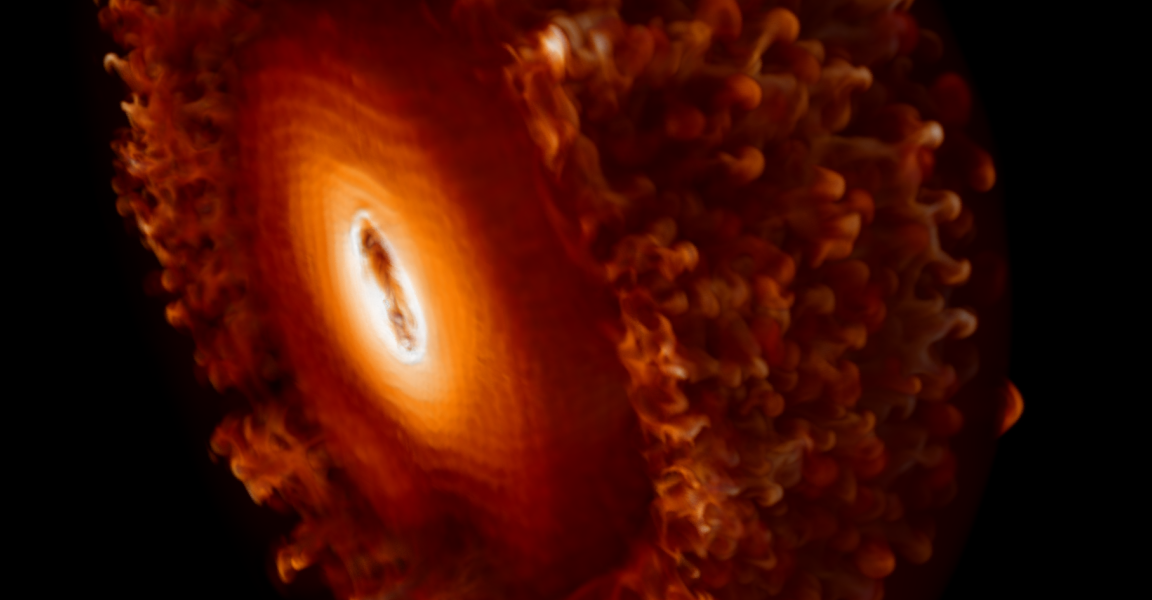
Meanwhile, on the theory side, things have been in a bit of flux. As we’ve added ever more sophisticated physics to our models of supernovae, we’ve gone through periods where either everything blows up or nothing blows up. It has been harder to develop models that give us a good picture of why some stars blow up and others might not.
Still, our best current models agree that neutrinos are essential to the process. Neutrinos are produced in prodigious quantities both by the complex fusion reactions that take place during a supernova and by the formation of neutron star material at the heart of the collapse (which happens even if the collapse continues on to form a black hole). And those numbers matter for the fate of the material outside the core of the dying star.
With fewer photons coming out of the core of the star, that material lacks the energy to resist the pull of gravity and starts rushing toward the core. On its way, it encounters the shock wave from the formation of a neutron star/black hole, which is rushing in the opposite direction. Left on its own, these forces roughly balance out, stalling the shock wave and letting gravity take over.
Neutrinos change the equation. While they tend not to interact with matter often, the sheer number of them rushing out ensures that enough bump into the material around the stalled shock wave. This transfers energy, heating it up enough to overcome gravity and allow the shock wave to escape, destroying the star. Failure of this process would, in contrast, allow almost the entire contents of the star to collapse into a black hole, killing the star without an explosion.
Flavorful
One potential problem with the models that show neutrino heating is that they treat neutrinos as a single factor. Neutrinos don’t want to be pinned down that way. There are three types, or flavors, of neutrino (electron, muon, and tau). But each particle is in a superposition of all three flavors and can shift among them in a process called flavor oscillation. So, even if the events inside the supernova produced nothing but electron neutrinos, they would likely oscillate among the two other identities multiple times before they reach the surface of the star.