dailynewsnblog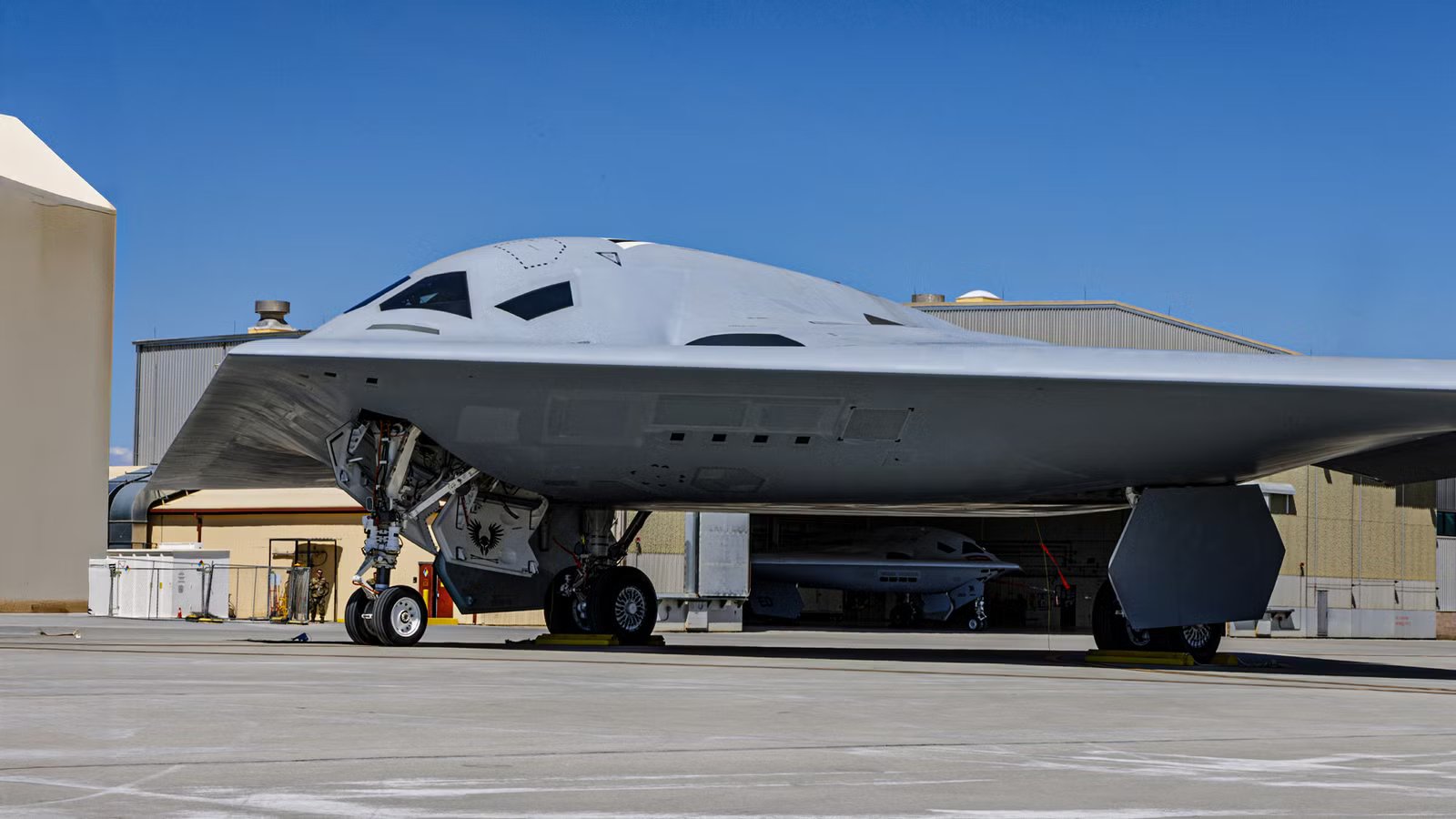
Four Northrop Grumman B-2 Spirit bombers touched down at Whiteman Air Force Base in the early hours of March 1 after a marathon sortie that endured for more than 36 hours. The four-ship formation had each deployed roughly 60,000 pounds (27,215 kg) of smart bombs against hardened Iranian military sites. The US Air Force flying wings had knocked out a network of ballistic missile batteries as part of Operation Epic Fury. It was the second time in under a year that Whiteman’s bombers had made the hazardous trek, following the June 2025 raid under Operation Midnight Hammer.
All the while, engineers of the US Army Corps of Engineers program are steadily ramping up construction efforts on the base’s first dedicated Northrop Grumman B-21 Raider facilities. The current scope is just the beginning of an infrastructure buildout the Air Force estimates will cost hundreds of millions of dollars at Whiteman, but still be about $1 billion less than other sites. No other base in the Air Force Global Strike Command is currently undergoing such a massive transformation while simultaneously sustaining full combat mission tempo.
A 36-Hour Round Trip From A Base With No Backup

Whiteman’s headline role is fulfilled by the 509th Bomb Wing, the Air Force’s only operational B-2 wing. Therefore, every stealth-bomber sortie, against any target, originates and terminates at the same runway in Missouri. It is also one of just a handful of airstrips in the world where the secretive ‘Flying Dorito,’ as the B-2 is endearingly known, is authorized to land.
A round-trip flight from Missouri to Iran and back covers roughly 14,000 miles (22,000 kilometers). No Spirit sortie into Iranian airspace and back to Missouri could happen without large-scale tanker support. That tanker requirement is a major undertaking to support the ultra-long-haul strike sorties. A B-2 Spirit stealth bomber needs to tank approximately six to eight times total for a nonstop, round-trip bombing mission from Whiteman.
When hooked up to a tanker, the B-2 can take on up to 100,000 pounds (45,359 kg) of fuel in a single session, which is about half the capacity of the average air tanker. The massive transfer happens via a flying boom connected to the top of the B-2’s spine and takes about 20 minutes per plane. For a round-trip mission from Whiteman AFB to Iran and back, a single B-2 will take on between 400,000 and 500,000 pounds of fuel total along the way.
At least 12 to 16 aerial tankers were needed to enable the March mission. The Atlantic Council estimated that roughly a third of the Air Force’s mission-capable Boeing KC-135 Stratotanker and KC-46 Pegasus fleet was tied up in Epic Fury refueling tracks at various points in the campaign. One open-source count put more than 160 tankers, including at least 17 KC-46A Pegasus jets, forward-positioned across CENTCOM and EUCOM to sustain the air bridge.

Every Epic Fury sortie draws on a fleet smaller than a single Air Force fighter squadron. Those missions are also generated from a base whose Bomb Wing has no sister unit to share the load. That scarcity is precisely why the Air Force is pushing forward to build new capability. Whiteman’s answer to rally the readiness of its small but mighty 19-strong B-2 fleet is the ‘Spirit Realm.’
The software factory was established in 2022 by AFGSC in partnership with Northrop Grumman, to modernize a plane whose core design dates to the sunset of the Cold War. Spirit Realm applied Scaled Agile development practices to a nuclear bomber for the first time in aerospace history. The Air Force credits it with cutting software-upgrade timelines from 24 months to roughly three while eliminating many software defects previously found in testing trials under the legacy process.
Its first release, Spirit Realm 1, was delivered in July 2024 to update the B-2’s cockpit displays and flight hardware. Critically, for a bomber flying 36-hour combat sorties, it also upgraded communications and weapons integration through open-mission systems. That expanded the Flying Dorito’s arsenal to include the GBU-72/B bunker-buster alongside the 30,000-pound GBU-57 Massive Ordnance Penetrator used in Operation Midnight Hammer, according to 19FortyFive.
The expedited and improved software cycle has enabled the fleet built to fight the Soviet Union to adapt much more rapidly to emerging technology and threats. Still, software modernization only buys time. It does not extend an airframe’s service life indefinitely, which is why the groundwork is already ongoing to usher in the replacement that will inherit the Spirit’s mission: the B-21 Raider.
Whiteman’s Cut-Rate Ticket To The B-21 Era

That timeline is why the Air Force moved fast to name Whiteman’s successor role. In September 2024, the Secretary of the Air Force approved the airfield as the second Main Operating Base for the B-21. It was only behind Ellsworth AFB, South Dakota. Meanwhile, Dyess AFB, Texas, was designated as the third MOB.
Because Whiteman already operates the only other US stealth bombers, the USAF’s analysis found it would need construction or renovation of roughly 30% fewer facilities than Dyess. That translated to an estimated savings of billions in construction costs. The fiscal 2026 Defense Appropriations Act, a $839 billion package, included roughly $1.9 billion for B-21 procurement, which also pays for base infrastructure.
Construction that is already underway includes a dedicated B-21 stealth-signature testing hangar that will dramatically improve the readiness of B-21s while also cutting operating costs compared to the outgoing B-2. Whiteman’s cost advantage over Dyess answers one question but opens another. If the base is reusing existing facilities rather than starting from a clean slate, does that work have to compete with the active support for B-2 combat missions?
Ellsworth Got Ribbon-Cutting, Whiteman Got More Missions

That question is where Whiteman’s position diverges from the other incoming B-21 bases. It is also the clearest evidence of a dual burden. Ellsworth, not Whiteman, is the Raider’s designated first Main Operating Base and Formal Training Unit. It reached its first milestone in that role on July 1 when the base’s first two new facilities formally kicked off. Ellsworth’s legacy Rockwell B-1 Lancers, unlike Whiteman’s B-2s, do not simultaneously fly 36-hour combat sorties against a live adversary during the construction overhaul.
The B-1 can, and did, perform marathon strike missions when OEF began, but its crews have the option to deploy forward in theater, which alleviates Ellsworth’s burden. Once a sustained air campaign begins, flying 34 hours every single day burns out crews and wears down aircraft. Thus, the Air Force shifts to an expeditionary deployment, packing up maintenance crews and flying the B-1s to forward operating locations. This helps move up the $161 million Low Observable Restoration Facility and an $81 million wash rack and general maintenance hangar, which are part of roughly $2 billion in base projects.
Dyess, the third base in the sequence, faces a heavier construction bill than Whiteman precisely because it lacks existing stealth-aircraft infrastructure. As another B-1 base, however, it also lacks Whiteman’s operational tempo demands. Neither Ellsworth nor Dyess were where the call went when Washington reached needed a sudden strike on Iranian targets.
Whiteman is thus the only one of the three future B-21 bases simultaneously running a live-fire bomber campaign, absorbing a new ‘exquisite’ bomber infrastructure, and doing so with the smallest legacy fleet of the three types of bombers in AFGSC. That would seem to create a conflict where flying the B-2 fleet at wartime tempo constrains how fast the B-21 buildout can actually progress.
Rebuilding Whiteman To Reshape The AFGSC

The $4.5 billion ‘One Big Beautiful Bill’ nationwide deal to accelerate B-21 production is also ramping up construction efforts to improve the bases that will host the newest stealth bombers in the US Air Force. The B-21 Raider will become the primary strategic strike platform for the entire USAF. Past bombers like the B-2 and even the supersonic B-1B were restricted by their heavy maintenance requirements and rigid hardware configurations, frequently trapping them in maintenance hangars for hundreds of hours.
The B-21 Raider breaks this cycle entirely because it was conceived as a digital-first platform. The plan to prepare for the incoming B-21 encompasses dozens of construction projects over the span of the next decade. The B-21’s smaller size and ‘baked-in’ stealth materials will mean less maintenance and simpler facilities, leading to lower operating costs and a higher mission-capable rate. Service on the B-2 was notoriously labor-intensive to maintain delicate stealth coatings, a key area in which the B-21 aims to improve. Still, the radically innovative new plane requires major changes at the bases that will host it.
One basic factor is the physical dimension of the Raider. From the limited information revealed to the public, the B-21 will be 10% to 20% smaller in wingspan. That is based on the Spirit being 172 feet (52.4 meters) wide, and the Raider is expected to be between 132 feet (40.2 meters) and 150 feet (45.7 meters) wide. Similarly, it won’t have just two engines, whereas the B-2 has four, and its overall payload is expected to be 25% to 30% lower. The B-2 can carry max out at over 330,000 pounds (149,685 kg), but the B-21 will be lower at 225,000 pounds (102,058 kg) to 260,000 pounds (117,934 kg) MTOW
The trade-off for size and payload was decided by the Air Force in order to make its latest and greatest strategic strike platform more stealthy, more rugged, and more multi-mission flexible. Despite the smaller wingspan and weapons capacity, the increased operational readiness and lethality will make the B-21 a worthy next-generation successor to the legendary B-2. Still, overhauling the bases for the Raiders requires an intense, decade-long rebuilding effort.