dailynewsnblog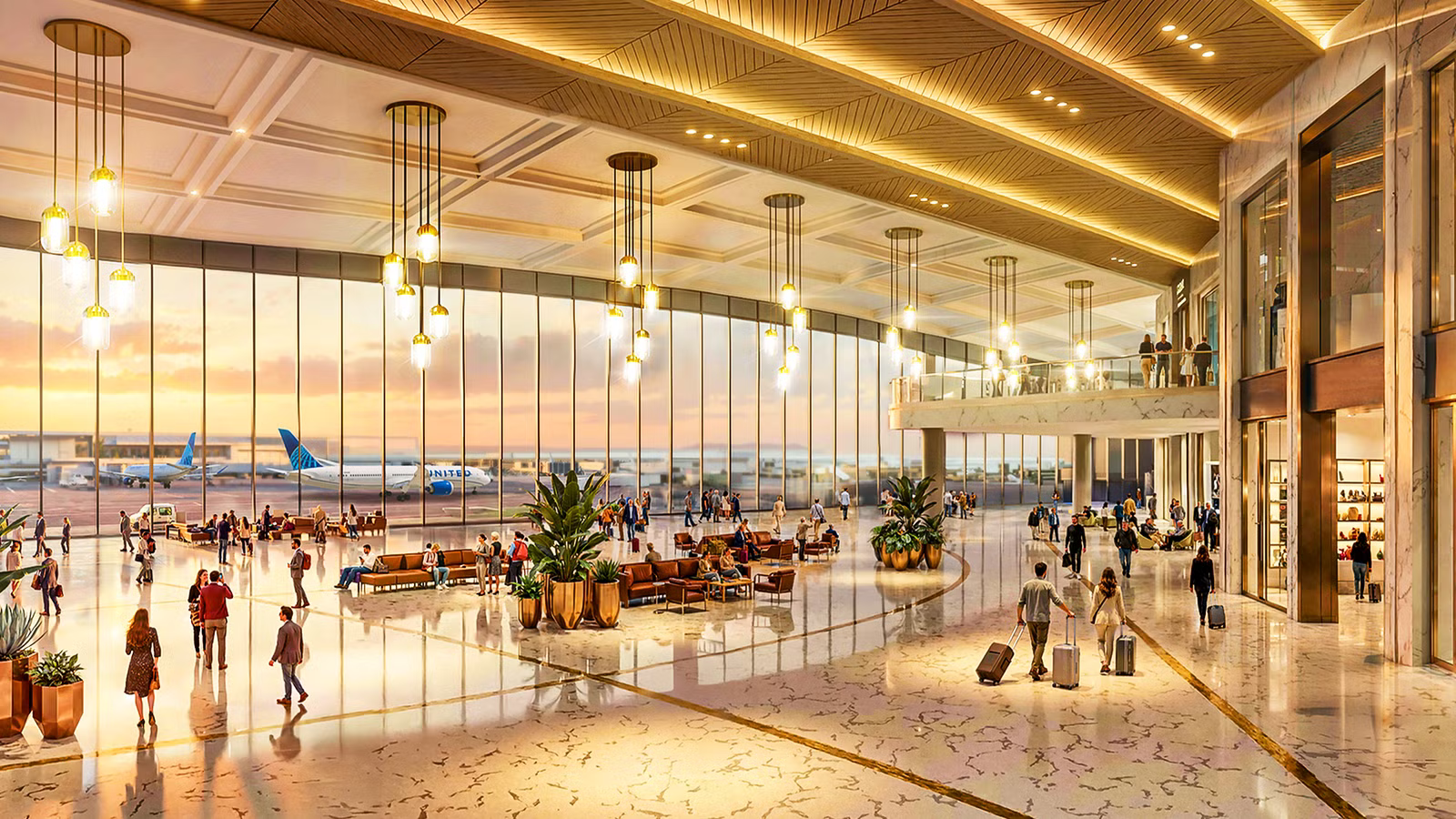
Washington Dulles International Airport (IAD), a key hub for  United Airlines, is undergoing a major transformation. The opening of a new concourse this month will precede major refurbishment of its main terminal, an expanded underground transport system, and other works that will ultimately add or revitalize over five million square feet (0.5 million square meters) of usable space at the site. In total, around $20 billion has been earmarked for the overhaul, with the airport’s board having given the go-ahead for a $15.5 billion boost to its existing $4.4 billion budget in August of this year.
But it will be no mean feat. Having served 29 million passengers last year, an annual increase of 6.4%, Washington Dulles was the fastest-growing large airport in the United States. Come the year’s end, United alone accounted for just under 70% of traffic at the hub. So, that raises the question: how is this being sustained as such extensive work takes place?
Current Work At Washington Dulles

Work is in fact well underway at the airport. With passenger growth outstripping capacity, approval for the new Concourse E came in March 2023, with ground then broken the following November. September this year is set to see it open to the public.
At 435,000 square feet (40,400 square meters), the new concourse is poised to add 14 additional gates as part of a wider bid to relieve congestion around the hub’s existing infrastructure. These will be served by United for both international and domestic routes, alongside the existing A, C, and D-gate waiting areas, which are currently used solely by the airline.
Having been built from scratch on space specifically dedicated for future expansion, the development of Washington Dulles’ latest concourse has been carried out above an existing AeroTrain station. As such, the roughly $500 million of work could be done without disrupting operations at the hub — a feat the airport and others like United hope to mirror during later expansion.
Future Overhaul Of Washington Dulles

Following Concourse E’s completion, the next stage of development at Washington Dulles is set to see the main terminal refurbished. As reported by Reuters, work should begin in 2027 and be finalized toward the end of 2034, amounting to $6.2 billion.
Meanwhile, Washington Dulles will expand its automated AeroTrain system and walkway, with the same targeted opening date, Reuters reported. As it stands, these connect the main terminal and first concourse building, with train stops at gate sections A, B, and C, and a walkway stretching 1,000 feet (305 meters).
Washington Dulles’ existing concourses:
Concourse | Number of gates | Original opening date | Airlines |
A | 24 | 1999 | United Express Air China Copa Airlines Emirates |
B | 31 | 1998 | Air India Austrian Avianca Brussels Airlines EGYPTAIR Ethiopian Airlines Lufthansa TAP Air Portugal Turkish Airlines |
C | 23 | 1985 | United United Express |
D | 31 | 1985 | United United Express |
Z | 4 | 2005 | United Air Canada |
Upon ultimate completion, seven stops and walkways will fully link each of the site’s adjacent midfield concourses. After Concourse E’s opening, plans are for the building itself to be extended out to the entire width of the terminal area to form a new Concourse F, with another two built further south. All told, that will leave nine distinct gate areas, including those in the terminal itself, plus pathways and automated train links between them, compared to five today. The work will not stop there, though.
Replacing Decades-Old Infrastructure

For United specifically, the new infrastructure will eventually offer the benefit of older buildings getting a long-overdue upgrade. Concourses C and D opened in 1985 on the premise that they would be a temporary solution to rising passenger numbers. Some $23.6 million worth of minor work in 2006 extended the facility’s useful life. Nonetheless, 41 years later, those same original buildings remain in use.
While not a direct replacement, Concourse E adds capacity and room for a brand-new 40,000-square-foot (3,716-square-meter) United Club lounge. Importantly, this capacity includes space to process international flights, with the direct successor to Concourses C and D set to serve only domestic traffic.
Washington Dulles passenger traffic:
Year | Domestic | International | Other | Total |
2025 | 18.2 million | 10.5 million | Approx 0.3 million | 29.0 million |
2026 (through June) | 8.7 million | 4.8 million | Approx 0.2 million | 13.7 million |
So, for United, that opens up an alternative when the existing gates are torn down. As such, efforts to rebuild and upgrade should not dampen operational efficiency too much, if at all. At least, that is how the plan has been designed.
Maintaining Operations At Washington Dulles

At the plan’s core is a phased approach. Where one area gets an upgrade, another should, in theory, pick up the slack. That said, it will be far easier said than done in practice, given that Washington Dulles itself has acknowledged how busy its existing infrastructure has become. But capacity should remain in line with demand over the coming years as building takes place.
As the airport noted upon confirming the plan in August, it is “designed to add new infrastructure and renovate current facilities in phases over time to match the growth in consumer demand and evolving airline business needs”. After Concourse E’s initial completion, the terminal refurbishment will follow. Timelines remain up in the air for the transport link extensions, Concourse E’s further expansion, Concourse G/H construction, and Concourse C/D’s own redevelopment, which will follow. That said, each project has been sorted into an individual construction package, so the airport can effectively focus on one at a time.
Washington Dulles construction phases (order yet to be confirmed):
Package A | Will expand the airport’s historic Main Terminal, upgrade ticketing areas, create new TSA and US Customs facilities, build a walkable connector between the Main Terminal and the current A/B Concourse, and add international gates to the Main Terminal. |
Future package | Will extend the AeroTrain system to serve new facilities, enabling the eventual retirement of the mobile lounges, and building a tunnel through the center of the airport connecting all concourses for baggage and passenger transit. |
Future package | Will extend the current Concourse E. |
Future package | Will build a new concourse for domestic flights near the current Air Traffic Control tower (G/H). |
Future package | Will build a concourse for regional flights on the site of the current C/D Concourse. |
All of that means one area should be up and running before the next receives attention, leaving United and its counterparts with sustained capacity. However effective this thinking proves in practice, time will tell, with contractor proposals for the first construction package expected by the year’s end. Regardless, the coming phases will see another outdated feature of Washington Dulles, itself worthy of a mention, made obsolete. That is, one put in place before the aging Concourse C/D, and one that has long been due for an overhaul.
Washington Dulles’ Mobile Lounges No More

When pieced together, the new train systems and walkways at Washington Dulles will allow the airport’s unique Mobile Lounge vehicles to be retired. Under original plans, passengers would check in at the main terminal and board these bus-like people carriers, which would take them directly to their aircraft without the need for steps or jet bridges.
Time proved too great a test for the Mobile Lounges, though, and soaring travel demand since the hub’s initial construction in 1962 has increasingly called for modernization. Indeed, Washington Dulles was originally intended to serve just six million passengers annually. As mentioned, that number has risen nearly five times to almost 30 million today.
While these have remained in use for over 60 years, with some upgrades along the way, the updated AeroTrain system and complementary walkway running from the main terminal to the newest concourses will mark their ultimate retirement. The way airport leadership and airlines at Washington Dulles intend to go, that was arguably always unavoidable.
Traffic Forecast To Boom At Washington Dulles

Based on the Washington Dulles master plan, the baseline forecast is for annual aircraft operations at the hub to rise by 48% from the 308,159 recorded in 2019, to 455,900 by 2045. Annual departing, or enplaned, passengers are seen rising by 78% from 12.3 million to 21.9 million over the same period. Today, “Washington Dulles International Airport’s record-setting passenger growth is outpacing its current terminal gate capacity, especially for hub airline United Airlines,” in its own words. Needless to say, the $19.9 billion budget approved by the airport’s authorities in August was committed with such figures in mind.
Through this, it will gain an additional 36 gates in the end, each capable of handling either one widebody or two narrowbodies at a time. For United, Concourse E’s imminent opening will mark the first major benchmark in what will be a complex upgrade process ahead.
United Airlines was contacted for comment.