(Bloomberg) — Chinese President Xi Jinping and Indian Prime Minister Narendra Modi’s first sit-down on Indian soil in seven years signaled a will to further repair ties and manage an unpredictable Donald Trump.
Most Read from Bloomberg
But fundamental differences remain despite the good vibes flowing from the 10-nation BRICS summit in New Delhi.
In a 45-minute meeting on Saturday, the two leaders agreed to take a strategic and long-term perspective on the relationship, further promote cultural and business exchanges, and coordinate on regional and global issues.
Sitting across from Modi, Xi recounted with a smile his first visit to India in 2014 to the state of Gujarat. “You received me in your home state on your birthday,” he said.
He went on to call China and India “partners rather than rivals, and development opportunities rather than threats to each other.” Modi, in turn, said “differences should not become disputes.”
The bilateral meeting was a symbolic moment for the world’s two most populous nations, which are emerging from a multi-decade low point in relations fueled by bloody border clashes and deep strategic distrust. The meeting allowed both countries to show the world that ties are on the mend at a time when each is navigating their own troubled relationship with the US under Trump.
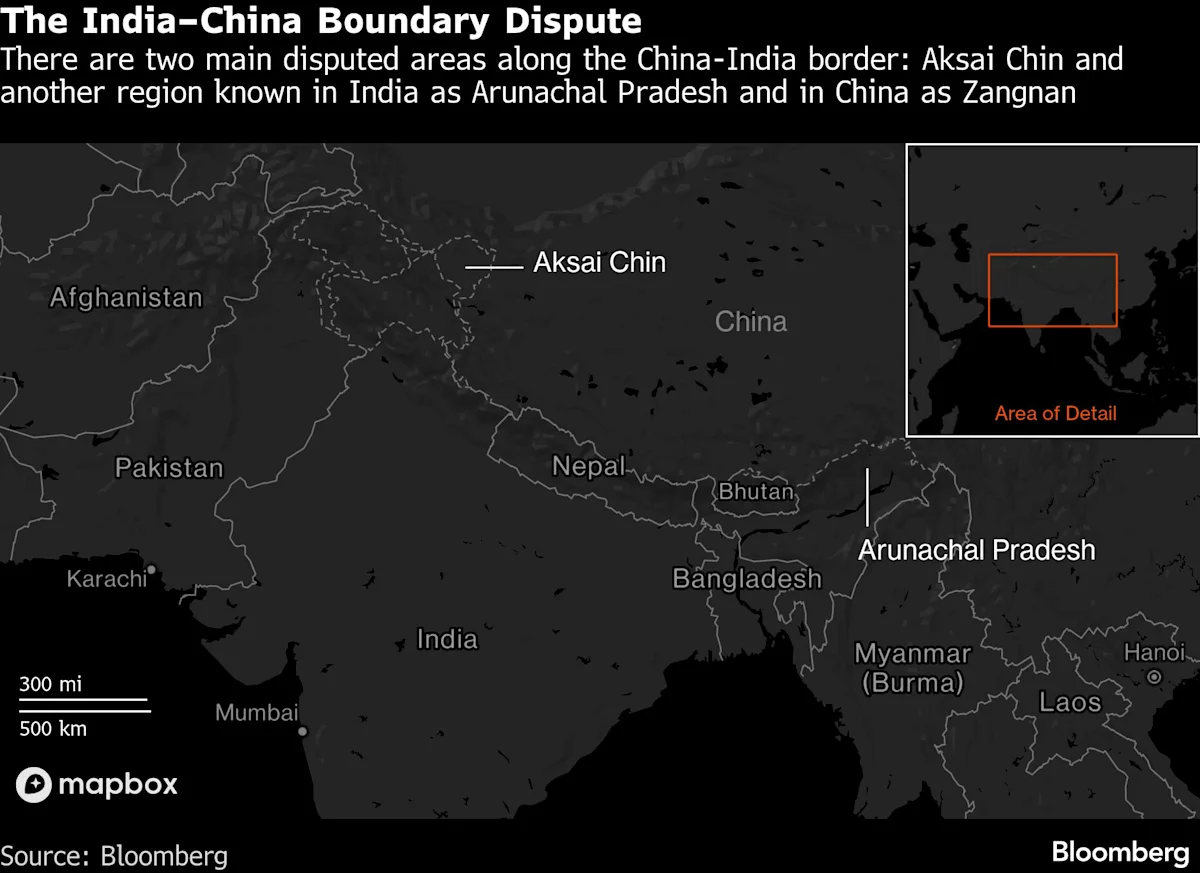
However, beneath the show of unity, deep differences remain. The two remain far apart on their border dispute, with those differences on display in diverging readouts from each side following the leaders’ meeting: India said border peace was “essential” for ties to develop further, while Beijing issued its usual position of separating the boundary dispute from broader ties.
New Delhi also highlighted economic imbalances that have made India more reliant on China over the years, with a trade deficit that has doubled in the past decade.
“External factors, such as US policies and the ongoing wars, are driving the thaw, but I’d be cautious about calling it anything more than a thaw,” said Sana Hashmi, a postdoctoral fellow at Taiwan-Asia Exchange Foundation, a think tank. “There are still more divergences than convergences and China still sees India as a competitor.”
The New Delhi visit was capped by a joint BRICS statement that called for restraint in the US-led war in the Middle East and a rollback of tariffs and trade barriers. For Xi, whose country dominates the bloc politically and economically, the summit offered a platform to shore up his image as a global statesman capable of managing the newly fluid global order challenged by Trump. The BRICS summit comes just weeks before Xi’s expected visit to the US.
It’s “unmistakable optics — a clear show of unity and a signal to Trump as Xi prepares to visit Washington,” Julian Gewirtz, a former senior director for China and Taiwan Affairs at the White House National Security Council, wrote on X.
China-India relations entered a deep freeze in 2020, when a confrontation at their 3,488-kilometer (2,167-mile) frontier killed soldiers on both sides and drove relations to their lowest point in decades. Covid halted travel between the nuclear-armed neighbors, while India imposed restrictions on Chinese investment and technology.
Since then, the two sides have taken tentative steps to rebuild ties. Modi visited China in 2025, discussions have taken place on resolving border disputes, and direct flights between the two countries have resumed.
The body language between Xi and Modi at this weekend’s meeting showed a level of comfort between the two leaders, said Rajiv Dogra, an author and former Indian diplomat. It was the second time in a matter of weeks that they had been photographed holding hands as they spoke, following their recent meeting at the Shanghai Cooperation Organisation in Kyrgyzstan.
“The visit, I would say, was consciously tailored to be on the hopeful side for the Indo-China relationship,” said Dogra. The two sides were looking to project a “plus moment” in their relationship, although the border dispute remains a “punctuation mark” and a source of concern for New Delhi, he said.
Another growing irritant to the relationship is around trade. China’s exports to India exceeded its imports by about $105 billion last year — an imbalance that’s more than doubled over the past decade.
“The desirable outcomes from India’s standpoint will at best be gradual,” said Shubhada Rao, an economist and founder of QuantEco Research. “Expectations of swift improvement, especially in trade dynamics, would be unrealistic. The trade balance remains extremely skewed in favor of China currently.”
India remains highly dependent on Beijing for consumer goods and for inputs for its manufacturing sector, including its massive drug-making industry.
Additionally, India is reliant on China for specialized products like rare earth magnets needed to meet its ambitious goals in the electric vehicle, renewable energy and consumer electronics sectors. Beijing has leveraged the imbalance at times, blocking specialized equipment from leaving China and recalling staff working in India.
Policy Predictability
Pankaj Mohindroo, chairman of the India Cellular and Electronics Association, said businesses want predictability in the China-India relationship, which has been lacking since 2020.
“The current dialog between the two governments is a highly positive step,” he said. “For global supply chains to function efficiently, industry requires smooth access to capital goods and business mobility, such as visas.”
There’s been notable steps toward closer ties since last year. China and India indicated progress in border talks in August, while India has loosened some curbs on investment from Chinese companies. Just before Xi’s touchdown in New Delhi on Saturday, China Southern Airlines announced that it will resume its daily Guangzhou-New Delhi route starting Sept. 21, ending a six-year suspension. It’s the third major Chinese carrier to restore routes.
“This situation has not come easily and needs to be cherished,” Xi said of the reset in the Saturday meeting with Modi.
Other thorny obstacles remain. Beijing’s support of Pakistan, which was involved in a brief armed conflict with India last year, remains a concern to New Delhi. Pakistan deployed Chinese fighter jets during that clash, and most recently showcased an air-defense system resembling a Chinese platform in a promotional video.
“The key would be in sustaining communication and following up from this meeting,” said Dylan Loh, associate professor at Nanyang Technological University.
–With assistance from Anup Roy and Shruti Srivastava.
Most Read from Bloomberg Businessweek
©2026 Bloomberg L.P.


 dailynewsnblog